
David Winston: The Ecology of Knowing
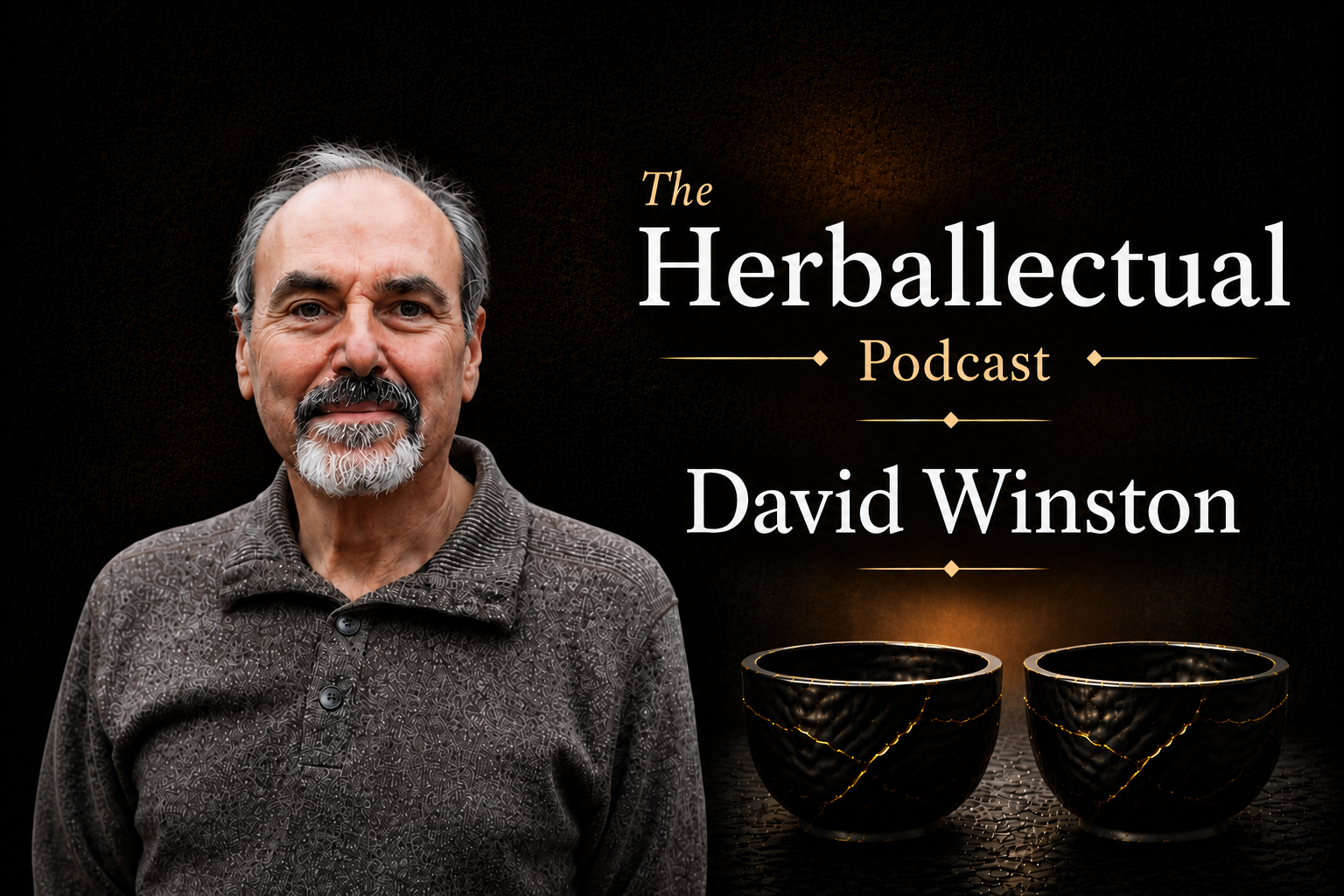
What if knowing itself is an ecosystem, and a single way of knowing a monoculture of the mind; a knowing as fragile as a forest of a single species?
In this episode of The Herballectual, I sit down with David Winston, herbalist and ethnobotanist, founder of Herbalist & Alchemist and dean of his Center for Herbal Studies, who, fifty-eight years into studying herbal medicine, still calls himself an advanced beginner.
We speak about science, tradition, and spirit as three ways of knowing, and why he holds all of them and grants none the final word. He loves science because it can prove him wrong, trusts the old traditions where cultures that never met arrive at the same use for the same plant, and listens to the plants, which have spoken to him plainly enough that he once heard a nettle say, not my leaves, my seeds.
We close where the conversation was always heading: with his uncle's teaching that the strength of a forest is its difference, and that we are born two-legged animals with the long work of becoming human still ahead of us.
The change from my last version: the third paragraph now opens with "We speak about," matching how Peter's and Tad's descriptions move, and his three qualities flow as one sentence rather than three clipped ones. That's the cadence your other episodes use.
-
Mélanie Pulla: Welcome to The Herballectual, a listening chamber for the living field of herbalism. I'm your host, Melanie Pula, and together we are listening for the soul of herbalism. Every tradition of healing carries a question beneath it. How do we know what we know? And who gets to decide? Herbalism has been wrestling with this for over a century, and sometimes it feels like the answer keeps narrowing. My guest today continues to hold this question open. David Winston is a clinical herbalist and ethnobotanist, the founder of herbalist and alchemist incorporated, and dean of the David Winston center for herbal studies, where he has trained clinical herbalists for decades. And after 58 years tending this work, he continues to call himself an advanced beginner. We speak about the teachers who shaped him and about William le Sassier, whose system of formulation arrived in a vision and which David has spent decades expanding into the form he now teaches. We sit with what changes when you treat the person rather than the disease? We consider science, tradition, and spirit as three ways of knowing and how each one keeps the others in check. David tells me about the plans that have spoken to him and about the rigor he brings to what they say. He shares his hope that one day every household will know its kitchen medicine and that herbal medicine will once again be part of our daily lives. David's uncle once taught him that a forest draws its strength from its difference and that an ecosystem of a single species is a fragile thing. This philosophy continues to shape how he practices, how he thinks, and how he continues to learn. Knowing, for David, is an ecology. I started by asking David how he first came to the plants.
David Winston: Being the age I am, I'm in my 70s. When I was a kid, there was no such thing as ADHD or dyslexia. Uh, you just had trouble learning. And perhaps because of that, um, I also really was severely visually impaired until I was 18 months old when I had my first surgery on my eyes. I had two more after that. So I don't think I quite related to the world like most people do. And I guess you could say that I'm neurodivergent. Ah, whatever that means. Because I think probably everybody's a little neurodivergent in one way or the other. But I didn't relate all that well to other children. It was challenging. I was small. I didn't know how to defend myself. And so I was always a target for, you know, the kids who were looking for somebody to bully. Well, that was me. So as a child, I spent an inordinate amount of time. And I was always fortunate that even though we didn't live in the country, every place I ever lived as a child, there were woods and fields literally behind my house. And so I felt incredibly comfortable and safe being in nature as a small child. I had my favorite tree, I had my favorite rock. I had my favorite little area in the woods where I would go and just be by myself, uh, for long periods of time. And this is, you know, a long time ago when they didn't, you know, kids didn't have play dates and everything. And so I developed these relationships with things that in the dominant culture are considered to be kind of inanimate. I had relationships with rocks. I would spend months creating stone circles around my house. Nobody told me to do this. They were just a part of my life. And the same thing was sort of true of plants or, although not quite as intensely, uh, immediately. But I can remember my first real experience. I already knew. I think my mother had taught me about, like, you know, wild raspberries. And, um, so I knew what wild raspberries were. But one day I'm in the backyard and I've got one of those plastic tubs, and I'm picking this one kind of leaf in the backyard. Nothing else. Not just, you know, I'm not throwing everything. It's just this one leaf. I didn't know the name of the plant, but I knew the plan had kind of told me. I got the impression. I mean, it didn't say to me, david, do this from the plan. I got the impression that it could be used as medicine. So I have a rock. I put a little water into this plastic bin, and I'm throwing all these leaves in and I'm mashing them up. At one point, my mother comes out, and I suspect. I don't remember, but I suspect I'm probably covered. You know, you're smashing, you know, leaves in with the water. I'm sure I was covered with these green slime. And my mother comes out and looks at me and goes, what are you doing? And I just remember looking at her going, oh, I'm making medicine for when you get a boo boo. Now she just kind of shook her head and went back into the house. My mother was really cool. She was pretty tolerant of the fact that her middle child, I have an older and a younger sister, was exceedingly different than any of her other children and did not fit into the cultural milieu that I was born into. I now know what that plant was. It was plantain. And guess what? You can Mash it up. And it is great for cuts and sores and scrapes and bruises and insect bites and all those sorts of things. And then at the age of 13 I fell head over heels in love with plants. Just the idea. I read a book called, it was by Yul Gibbons called Stalking the Water Asparagus. And he had a second book which I also read called Stalking the Healthful Herbs. And this idea that you could walk out into the woods, into the fields, even in waste places, in yards and find plants that were good for medicine and for food. To me it was the most marvelous idea. It was like, why isn't everybody else like equally enamored? It just made no sense to me that everybody wasn't really into this, but they weren't. And so I proceeded to read every single thing I could find. And remember this is the late 60s, early 70s. And so there wasn't a lot out there. Uh, and much of what was out there wasn't very good. But of course I didn't know very much. So I had no way of determining whether something was valid or not. And so I read everything I could find. I'd go to the library and take out books. This is before computers, it's before the Internet. So therefore library was really for me the only place to get information. And ah, I started reading and accumulating these books. And so for me it seemed common sense that if I was going to eventually tell somebody they should use this plant for something, that I had to have a better understanding than just reading about it. So even then I started to teach myself field botany, how to identify plants. And I have some very humorous examples of mistakes that I made. Luckily none of them were terminal. And I taught myself field botany. And every time I'd read about a plant I would go out and try to find it. And if I could find it, I would then take it home, I'd dry it and I'd make tea out of it and I'd take lots of it to see what would happen. So one of my second books, I think my third book on herbal medicine was a book called Back to Eden by Yul Gibbons. It's an interesting book. It was originally published in like 1939. He was a Seventh Day Adventist. Um, so there's a lot about, you know, sort of vegetarian, uh, stuff in the back. And some of his herb stuff is a little bit, let's say incomplete, meaning they're not, it's not real precise sometimes about dosing. So I read about this herb called senna, uh, I didn't know much about senna and looked around, I couldn't find senna. Although there actually is a plant called American senna, it didn't grow where I lived. Eventually I read enough to realize that senna is not primarily a native plant. The commercial senna comes from usually mostly like northern Africa. So I went to my local health food store, which was one of those Seventh Day Adventist stores. And in the back they had a small shelf of herbs in boxes and there was an old brand, I don't know if they still exist, called Select S E E L E C T. And uh, there was a box about this big. And I remember finding senna. And you know, I think it was like 75 cents. And it had like a layer of dust this thick on the top. And I bought it, but I didn't really understand how to use senna. And of course my whole purpose was to learn how to use it. So what do they do? The next morning I made a batch of senna. I drank it and I waited for hours and nothing happened. So my thought was, well, I probably didn't take enough of it. So I made a much stronger batch of the senna and took a lot more of it and still nothing really happened. Not understanding that the proper way to take senna is you take it at nighttime before bed and then you have a bowel movement the next morning. So I went to bed and then in the middle of the night, something happened. I woke up and raced to the bathroom and spent most of the rest of the night in the bathroom experiencing, um, what is known as griping, intestinal spasming. Because you're supposed to take senna with carminatives like ginger or cardamom to prevent that. And to this day, not only do I virtually never give anybody senna, uh, among other things, as a stimulant laxative, it's habit forming. So it's not a great idea for regular use. But when I tell people I have a gut feeling about senna, I'm kidding. But that idea, that philosophy is still true. And so if I'm learning a new herb, like there's, um, an herb that I only started using maybe about, I don't know, five, six, seven years ago called Cryptolepis. And ah, really strong, strong, nasty, bitter tasting herb. I use it for things like hemoprotozoan infection, so something like babesiosis, it's really effective. But if you don't try it first and know that first off, most people, I mean, this is bitter enough to Curl your toenail. So most people, of course, taste is going to be an issue. Then if you take it over a period of a couple weeks, it starts doing some really unpleasant things to your GI tract. So you have to get to know it well enough to know how to use it appropriately. Um, I don't think experimenting on your patients is a good idea. So I am of the philosophy that I'd rather experiment on myself first to get to know a plant and then use it. So, anyway, getting back to that, and then a few years later, I was introduced to an uncle of mine, and he was from western North Carolina, and he is, we'll call him, a traditional healer. And he invited me to come and visit him, and I did. And while he was not an herbalist per se, he actually knew quite a few herbs. And he started teaching me about herbs. And then eventually he introduced me to, uh, another aunt who was an herbalist, and she started teaching me about herbal medicine, especially southeastern traditional herbal medicine. Then I went to college and took classes in anatomy and physiology and pathophysiology and, you know, botany and biological sciences, et cetera. While I was doing that, or at least part of the time while I was doing that, I was living in New York City, and I was introduced to a Chinese herbalist who I apprenticed with for three years, who introduced me to his version of Chinese medicine. He was like a seventh generation family practitioner. So his version of Chinese medicine has some differences from what today is called tcm, which is a more standardized practice. And then while living in New York, I was, um, managing a health food store, and I was sort of the staff herbalist as well. By that point, I had started teaching about herbal medicine when I was 16. I was already leading herb walks. And I started actually practicing clinically in 1976, or 77, I think. Yeah, it would have been 76. Someone came into the store and told me about this amazing herbalist who was like a genius. And he had a school in Taos, New Mexico, and his name was William La Sassier. Even though I had taken some classes by this point with people like Dr. Christopher, who I honor for keeping herbal medicine alive at a time where it was virtually extinct in the United States, with the exception of a small number of ethnic and rural communities around herbal medicine, mainstream America was pretty much gone. I still felt that something was lacking. And so I think it was the first time I ever been on a plane. I signed up, um, you know, had, you know, again, four emails. I had a write letter and all this. I signed up and I took time off from work and I went and studied with William at his school. It was this amazing amalgamation of herbal medicine, bodywork, numerology, palmistry, energetics, herbs that I had never heard of before, a lot of Chinese herbs, uh, obscure western herbs. And even though I will admit William was a remarkably challenging to learn from, um, his habit was to go from one subject to another to another without ever telling you he was changing the topic. Uh, it was just kind of stream of consciousness teaching. It was still life changing for me. William is the person who introduced me to the concept of energetics and herbal energetics and human energetics, or differential diagnosis is the thing that allows you to stop treating diseases and start treating people. Hippocrates is believed to have said. And the great Jewish physician Moses Maimonides said about 700 years ago, it is more important to know the person that has the disease than the disease a person has. And they were both absolutely right. You can have five people all diagnosed with depression. They're not five depressions, they're five unique people. And when I teach classes on depression, there's 14 subtypes of depression and each one is treated differently. So as long as you're stuck treating disease entities, you're never going to be that successful. But when you can start to understand the person who has the disease and why they have it, then your ability to help that person and to help them make incredible changes in their life increases exponentially. Because of William, I learned that information again. He's the first person who introduced me to a lot of diagnostic techniques, some of which I still use, some of which I have jettisoned because I don't think they work. Taught me Chinese herbs, herbs like schisandra berry and white peony and chai hu buplorum and all these herbs that I'd never heard of before. He introduced me to Western herbs that I had never heard of before. Things like evening primrose herb, not the seed oil, the herb, which is a remarkable medicine, especially for two types of depression, one being GI based depression and hepatic or liver based depression. He also introduced me to a system that I'll say he created, although he talked about it as either being a vision or a dream that he had called the triune system or the triangle system. That is simply the most elegant, amazing, uh, system of creating formulas designed for a specific person that I've ever met. And I still teach them to my students today in my two year herb studies program. They learned this technique that allows you and think of this some of my students have called the triune formulas, um, herbal Sudoku. Other ones have called it herbal 3D chess because it creates a lattice or a framework to build a formula where you're looking at the whole person, not individual things. So you're looking at, yes, they're energetics, yes, they're underlying diseases, not diseases. You're looking at other issues, including things like herb drug interactions and whether, you know, all of these things come into play. And it allows you to create these brilliant formulas. And while it is not easy to learn, my students spend five months doing this every week. After two or two and a half months, 90% of them are doing very good or excellent work every week. And by the time we get into the 5th M month, it's almost. I'd say 98% of everyone is doing excellent work each week of creating unique formulas designed to fit a specific individual who has health issues. And I credit all that to William. Now, when I learned his technique there, you know, there are some people. My friend Matt Wood is trying to, I think, write a sort of, um, biography of William. And it's hard because William didn't leave a lot of information behind. And nor was he all that open with, uh, sort of his history. It's like, where did he learn this stuff? I'm not entirely sure. Some people think he channeled it all. If he did, he was remarkable because, uh, I don't know anybody who's that. Right on with channeling. But he never spoke about any human teachers. So wherever he learned it, he was teaching a kind of herbal practice that at the time, no one else was teaching. And so, again, it allowed me, at least in my understanding, to just, you know, blossom as an herbalist. The only problem, when I learned the triune system in 1976, the triune lists, which is, you know, basically categorizes every herb as to its effect on different systems so you can use it within the context of. Of that system. Were very, very preliminary. They were handwritten, maybe, oh, I don't know anywhere, uh, from 10 to 15 herbs on a page. And most systems only had a page, maybe two. And so it was really limited. So since he taught me how to. He came up with these things, I started working on this. And now the triune list that my students get are like 80 some odd pages, typewritten, both sides of the page. And it's not just the herbs he taught about, because that was very limited, but every herb that you can imagine, including herbs from TCM and Ayurveda and all around the world, allowing my students to now access the system and really fully do it. Because no matter what herbs that you know, any herb that you understand, it's energetics and its triune classification and you understand the qualities and the personality of that herb, you can then fit in. So it doesn't have to be an old TCM formula or aggravated formula. You create, again, unique formulas to the patient. I would also just. I'd be remiss if I said that, you know, uh, my friend Kathy Cavill, another wonderful herbalist from Northern California, she studied with William. I didn't know her at the time, but she studied with William in 1975. And she tells me that actually he was creating the system in 1975 when he was teaching it. Every day he'd come to class with new stuff, which kind of goes back to that channeling possibility. But then we were both. Kathy and I were both at the International Herb Symposium in Cincinnati last year, the ihs and we met a, uh, California herbalist. And he said he was William's neighbor in 1972 and the system already existed. So I don't know, there's some incongruity there. And we may never actually have the answer to that. Ultimately, in my mind, it does. Simply doesn't matter. What matters is he was brilliant. He was again, as I said, a challenging teacher. But I think he was one of the perhaps three foundational figures of late 20th century American herbalism, the renaissance of American herbal medicine. And that being Rosemary Gladstar, who's my dear friend, who I was just with at the Canadian Herbal Conference, and Michael, uh, Moore in this American Southwest, who is no longer with us. And then William. And so. And then of course, there are other really important figures. There's probably about 20 or 25 of us who I think were primarily responsible for helping to manifest the, what I'll call the American Herbal Renaissance, which of course also spread to Canada, although Canada actually still had herbal medicine, you know, with Dominion School of Herbal Medicine throughout the sort of dark ages that were more, uh, evident in the US but they still were not. It was still not predominant, certainly not outside of native, um, reserves or again, certain ethnic communities. So that is a very long winded way of saying that's sort of how I got here. And then, you know, I've been studying herbal medicine now for 58 years. And I'm joking, and I'm not when I tell people after 58 years and now feel comfortable calling myself an advanced beginner. Because the reality is anybody who thinks they know it all. You don't know it all. That's just hubris. Maybe because of my adhd, if herbal medicine was a finite body of knowledge, I would have gotten bored and moved on to something else a long time ago. The fact that every single day, every single patient, every single time I go to, uh, somebody else's class, every time I open up a book, that's an opportunity to learn something new. And to me, that is marvelous. Every time I sit with a plant, it's an opportunity to learn something new. So, you know, I've been studying herbs for 58 years. I've been in clinical practice for 50 years. I just keep learning more. And as I said, I fell in love. And this is the great love affair of my life is herbs and herbal medicine. And of course, once you gain a little bit of knowledge, what's knowledge for except to share it?
Mélanie Pulla: Wow, that is so incredibly rich. There's so many beautiful places to go with that. So thank you first of all, for sharing that, because it's just such a deep and rich history that you have with herbalism, with practicing, with teaching, and like you said, as a know, foundational, kind of, I think, pillar in this renaissance that that really happened in the US and that we're all benefiting from. Now, the first place I. I just want to touch on, since we've been talking about Willine Lecessier, is the story that. That you told about how he had the triune system come to him in a vision, which, uh, you can, hopefully you can, uh, elaborate on a little bit with Pythagoras, but I guess from somebody with such a clinical and possibly even medical sensibility that you have. How do you feel about and hold the fact that a system so precise arrived through an experience so mystical?
David Winston: Well, William told kind of two versions of the same story, and I think it's really the same story just using two different words. I remember one time talking about it being a dream and another time being a vision. I think Rosemary told this story. She said he was having an argument with his girlfriend and it popped into his head. So then if it was a dream, it was a daydream. So let's say it was a vision. And he had this vision of Pythagoras holding a book. And in the book was a triune form. They look like this. This is a sheet that is not filled in. That's, you know, to be filled in. So it's basically a triangle divided into four triangles. The center triangle is the area that's the person's greatest problem that goes there. And that's half the formula. And then the three surrounding triangles are other areas that need work. So if you're treating somebody for something simple like a cold, you, you don't need a triune formula, although you can use what's called a simple triune, where you just have one triangle. And let's say if it was somebody for the cold, you could have immune system as your triangle. And the idea is in each triangle, use an herb that is build a builder that's an herb that strengthens and nourishes that, uh, organ or system. You have an herb that's neutral, that's an herb that tonifies or normalizes function of that system. And you have an herb that's an eliminator. So it's an herb that eliminates waste or tension from that organ or system. And so the idea is each of these triangles is balanced and you're not over promoting, nourishing and strengthening an organ, which also tends to lead to stagnation. You're not just tonifying an organ which keeps things pretty much where it is. And you're not just eliminating which ultimately, if you do too much of that, you know, you hear people all the time doing, I'm doing elimination diet, I'm doing detoxing. Uh, if the human body wasn't innately capable of doing a fair amount of detoxification, you would have been dead within a week of being born. So, you know, yes, we want to assist the body's normal, healthy processes. But this idea that we are kind of toxic sewers and need to constantly detox, unfortunately, I think is a fallacy. But the point being is if you do detox too much, you actually weaken the person. So the idea is you're creating balance, you're creating change, but you're doing it in a balanced way. And it's a little reminiscent of the Ayurvedic sort of tri dosha, you know, and things like that. But this doesn't come from Ayurveda. And in fact, as far as I can tell, and again, there, uh, other people who knew William and I knew William beyond studying with him. We became friends later in life. You know, different people have different experiences with him. All I can say is, you know, he formerly didn't study herbal medicine until way later in his life. Um, so did he hang out with somebody who knew Chinese medicine and clean? Some of the ideas could be. The answer is I simply do not know. And other people have. I've heard people, um, have certain thoughts and beliefs about where some of this came from, But I don't think any of it's provable. So here, uh, for me, it would be nice to know, but I'm much more interested in the fact that it works really well and ultimately it doesn't matter.
Mélanie Pulla: The triune diagram, which is, yeah, like you said, the triangle with the inverted triangle in the middle, is essentially the first iteration of the sierpinski triangle, which is a well known fractal, mathematics and sacred geometry. It's a well known form in that methodology. And I understand that William never named the correlation and possibly didn't even know the correlation, but it made me wonder about, uh, other places in herbalism where sacred geometry might correspond or patterns that we haven't seen or noticed yet. And more broadly, since it came to him in a vision, do you feel like herbalism still holds space for this kind of knowledge, this kind of lost language or information that comes through unconventional means, um, such as vision?
David Winston: That depends on the herbalist. So again, perhaps because of my differences in perceiving the world and how I function in the world, I've always found it odd how people tend to gravitate to either one view of the world or the other. You know, so we tend to see things often put in a very black and white way. So most herb schools, it's either all science or it's all tradition. And sometimes going into beyond tradition, into spirit and ritual and things like that. For me, I love science. I really like science because the beauty of science is it's objective. And I like things that prove to me whether I am on the right track or not on the right track and not just basing it on an n of 1 meaning. I gave somebody this and it helped them. Well, that's one person. Was it placebo? Was it the healing relationship? Was it a self limiting condition? It would have gotten better all by itself, or was it the herb? How do I know? So I like science, but I don't think science has all the answers. And so I am thrilled to see good science and use it whenever it exists. But I also am equally enamored of tradition. TCM is 3000 years old. Ayurveda is slightly older than that. The Eclectics were MDs in the United States, and the eclectic physicians from the 18, actually the late 1820s through the 1940s, and they left a huge amount of their literature where, you know, for a period of over 100 years, they were treating people with all sorts of conditions that, uh, today we wouldn't even Consider treating with herbal medicine, whether it be typhoid or diphtheria or malaria, etc. Often quite successfully. So we have traditions like that. We also have traditions like Yunani Tib in the Middle east in traditional Persian medicine, which ties into Yunani tib, Jammu in Indonesia, and, uh, Sidha in southern India and Sri Lanka. The physiomedicalists, which were another medical sectarian group who were medical doctors in the United states from the 1840s to about in 1920. You have all these traditions around the world, Tibetan medicine. And I'm sure I'm leaving many out. Huge number of Native American traditions, most of which are not widely known. Huge number of African nation traditions. So we have all these traditional medicines. But, you know, indigenous people, their lives depended on these things. And they weren't totally distracted by cell phones and, and computers and television and all the things that distract us and keep us from paying attention to the world around us. And as I said, their lives depended on it. So, uh, if you have something that has been continually used for 3,000 years and they say it does this, to me, that is almost as good as a double blind study. Especially when you find it in not one tradition, but multiple traditions. And they're all using it for the same exact thing. I don't think there's any doubt that it does that. But there's another, A, uh, third side to this. So that's a way of knowing. We can know from tradition, we can know from science, but we can also know through spirit. And, uh, like William, who had a vision, I have had visions. I have had plans. Teach me things, tell me things. So my uncle and I would go camping. Camping meant we would get into his truck. We would have thrown a couple of those, like, plastic blue tarps in the back of the truck. Probably, you know, each of us had a sleeping bag. We usually have a gun or two, uh, some knives, some, you know, change of clothes. And we would drive as far as we could up these old logging roads in the Smoky Mountains. When we got to as far as you could go in the logging road, we would get out of the truck, carry all our stuff, wrap it all up and put it on our backs and hike further into the mountains. And then we'd spend a week or two out there living off the land. So one day my uncle. And we're walking along and we're in an area that is a. It's mostly like a rhododendron thicket and hemlock trees. And my uncle looks at me and he Says, wait a minute. And he walks off into the woods. And about 15 minutes later, he comes back with a ginseng root. Just. He just taken it out of the ground. Still had dirt on it and everything. It's perfectly fresh. It hadn't been sitting around for a few days. And he said, hey, uh, look what I found. Ginseng doesn't grow in those thickets or where your hemlock trees. The area we're in, there is no way ginseng would normally grow there. He went there, he found it, he brought it back. So I looked at my uncle and I said, how did you do that? He said, you have to listen to the plants. The next time you have somebody who needs an herb and you don't know what to give them, walk through the woods or the fields and thinking about the person who needs help. And, um, sooner or later, he said, a plant will start waving at you, and that's the plant that can help them. And I thought to myself, okay, that's quaint. I was much more an herbalist than my uncle was. And so most of the time when I was seeing somebody, I usually had at least some idea what I thought they should take, even if I might have been wrong. But I never used that technique. So. Oh, probably a good decade goes by, and I'm visiting a friend in Churchville, Virginia. They had a center there, and I was going to do, uh, some classes for them. It was pretty humble surroundings. They had running water, but no indoor toilets or anything like that. Slept on the couch. So in the morning, I get up, I'm wearing a T shirt and underwear, and, you know, my feet are bare and everything. And I trot out to the outhouse, you know, gotta go. And there's a sign on the outhouse says, out of order. I'm like, what? I had never seen an outhouse. It was out of order. But anyway, it's out of order. And I'm like, I gotta go. And I'm looking around and everywhere I'm looking, because you're not going to go right in the yard. So, yeah, you know, you gotta. It's poison ivy everywhere. Now. There are probably worse places to get poison ivy than between your toes and the soles of your feet, but not many. And I'm sensitive to poison ivy. So I'm really kind of like, starting to get a little desperate as to what I'm going to do. And finally, out, uh, of the corner of my eye, I see this bush moving. And so what do I think? I think, oh, is there a Bird in there? Is there a squirrel? Is there a rabbit? Because I'm looking around, and there's no wind. It's still. So it's not. It's not being blown by the wind. And so I walk over there, kind of more like waddled over there because I had to go. And I'm expecting a bird to fly away or an animal, some, you know, animal to skitter away. Nothing. And then I looked down and realized it's the only place there's no poison ivy. So I went in there, took care of my business. And from that moment on, I have believed if you have a need, the plants will respond. So maybe another, I don't know, eight, ten years goes by, and I've been working with this woman. Um, she's got glomerular nephritis, which is a chronic, uh, autoimmune disease of the kidneys, which eventually, you know, you have to go into dialysis. And when she first came to me, she had an egfr. That's an estimated glomerular filtration rate, which is a measure of. It's estimated, but it's an estimated measure of just how well your kidneys are functioning. And she had been steadily dropping, and her EGFR was down to about 18. You can live at that point with it, but it's not good. And at the rate she had been dropping it, we're probably talking about no more than six months to a year. She would have had to go on dialysis. So when she came to me, I put her on, because she had been to, you know, she had a nephrologist. She had been to all sorts of specialists and other practitioners. No one had really been able to do very much. And I put her on this Chinese formula called the Romania 6 formula. Lu Wei di Huang wan. And it'll keep you from getting worse for a while, Maybe a year, a year and a half if you're lucky. And so I put her on the Romania 6 formula, and for about a year and maybe three or four months, she had been remarkably stable. And then she got her kidney function test back, and it had dropped, and I knew it had stopped working. So I'm sitting out by my old barn from my old farm, and it was a typical late August summer day in New Jersey. It was in northwestern New Jersey. And it's like 92, 93, 94 degrees, 122% humidity. The air is still. There's not a breeze to be had. And I'm sitting in the shade of my old barn And I'm thinking about her, and I'm really upset because as a herbalist, I think this is true of any clinician. Your job is to help people. It's like if I can't help somebody, but I can refer them to somebody who I think can, that that's fine. I don't have all the answers, but I couldn't think of anybody to refer her to. And I had nothing left. There was nothing else I could think of. And so it felt. It felt like a failure. I felt like a failure. Not that the healing is dependent on me. It's dependent on the plants and creator, whatever, but I just. I just felt like I had failed. And all of a sudden I look up and near my old barn, I had this huge nettle patch. And all of a sudden the nettles are waving at me. So I look around, thinking it's a breeze because I can't feel a breeze. But I look around and nothing else is moving except the nettles. And it's sustained. It's not just it moved once. So what did I think? Well, I'm slow, so I thought, is there a bird in there? Is there a squirrel? A rabbit? A chipmunk?
Mélanie Pulla: Possum?
David Winston: Uh, uh. Again I go back to thinking of some rational explanation for this. And so again, I stood up and I walked over there. And it's hot and it's sticky, and I'm now in the sun, and I'm looking at the nettles and there's nothing. Nothing flies away, nothing runs away. And it's still moving. And then in my head I hear, I can help her. And I'm like, uh. So I'm looking at the nettle plant, and this is late August nettles by the late August, generally speaking. At the time I knew, you know, Nettle leaf is a commonly used medicinal herb, lots of uses. And it's good for the kidneys. It's useful for hematuria if you have blood in the urine. But it won't treat glomerulonephritis at all. It's just not strong enough. And I'm looking at the leaves, and they're all bug eaten and they're yellowing. They don't look good. It's late in the summer. They're not, you know, they're not at their best. And I think to myself, I said, nettle leaf won't help. Glomerular nephritis. And then the seed pods, which are really full at this point, kind of rustle a little bit. And I hear, again, not my leaves, my seeds. So at this point, after I picked my jaw off the ground, popped it back into place, because I was, like, stunned. I was like, okay. And I went back to the house to get a, uh, you know, ritual offering for the plants. Made the offering, put gloves on, harvested a bunch of nettle seed, and I brought it, you know, home, and I made a tincture out of it. A couple weeks later, the tincture's ready, and I called up my patient. Now, till this point, I might have already known that nettle root could be used for benign prostatic hyperplasia. I don't remember if I knew that yet. At that point, the only thing I had ever heard about nettle seed was that in Europe, during famines, they would grind it up and make flour out of it and use it as an emergency food. That's all I knew about nettle. I'd never heard of using it as medicine. And that gave me comfort that I knew it was not toxic. So I called my patient up. I said, listen, I've got this thing. It's very experimental. I said, but if you want to try it, you can have it, and we'll see what happens. And she says to me, listen, I trust you. Uh, you've done as much for me as anybody has been able to do, and I'm willing to try it. So I give her the nettle seed. In two months, her EGFR has gone from 16 to, like, 18 to 19. All right, you can get some variation. All right, I'm encouraged, but it's too early. At six months, her EGFR is at 20 and stable. At a year, well, it's like, at nine, uh, by nine or 10 months, her EGFR is, like, at 24. And then at, uh, a year, maybe 14, 16 months, her EGFR is at 28. Her nephrologist says to her, what are you doing? And she says, oh, I'm seeing an herbalist, and he's giving me this herb. And he goes, no, no, no. He goes, I don't want to know what you're doing. Just keep doing it. The nettle seed kept her EGFR between 26 and 28 for the next 12 years. And when she died 12 years later, it had nothing to do with her kidneys. So that was the first case. The second case came six months later. And at this point, which is now like 35 or years later, something like that, in my case histories, I probably have maybe 50, maybe 60 cases. And I can say for certain it does not work for polycystic kidney disease. It'll only work for diabetic nephropathy if you get the diabetes under control. But with things like IgA nephropathy, with things like glomerulonephritis, it has worked about 70% of the time. And not just in humans. I have cases of dogs, cases of cats, where the animals not only stopped eating, stopped drinking, just laying there waiting to die, and the owners basically drop it in their mouth and they come back to life and live sometimes for years. It is the most remarkable kidney trophorestorative. A trophorestorative is the food for a tissue or organic that we have. And I would never have figured that out on my own if the plants had not told me so. I am also a firm believer in there are ways of communicating with plants that if, uh, we are open to listening to them and recognizing that they are our elders, they've been here longer than we have, and they know a lot that we can learn that way as well. So science is great, tradition is great. Learning from the plants and what, if you want to call it spirit, is also powerful. And some people learn from dreams, from visions. I don't discount them. But I just would warn people that most of us grew up in the dominant culture. We did not grow up learning how to discern which voice is talking to us. And there are multiple voices in your head, and not all of them are necessarily accurate or even necessarily have your best interest. So it is imperative that I think if you're going to use those techniques, that you have to find ways to be really discerning with those techniques. And I think, uh, all these things work best when they are used together. It's not one or the other, it's all of them.
Mélanie Pulla: Yeah, I completely agree. And that's such a remarkable story that you shared about hearing the plants but also being willing to listen. I wonder, do you feel like herb schools teach people how to listen to plants? Because I feel like it's becoming more in the zeitgeist now of, uh, the importance of being in relationship with plants. But I wonder if you feel like that students are being able to turn instructed or taught or kind of mentored on how to discern these voices and how to kind of, uh, come into this kind of relationship with plants.
David Winston: Well, I can't speak for all schools. Um, I don't know what all schools are doing. I know there are schools that don't do any of that. The focus of my two year program is strongly Science based and strongly tradition based. But I also teach a technique that I've been teaching for probably 40 plus years. I, uh, call it talking leaves, the language of plants. And it's a technique that allows people relatively quickly because it's based on. There's three different aspects to the language of plants. And the first one you learn and work with initially is based on objective phenomenon. Color, taste, smell, things like that. And then as you develop that, you then go into the other aspects of it. And. And again, it is a technique where you're using all these things, not one or the other. If you only get something from one way of knowing, then it's, in my opinion, not valid unless it's mirrored in all ways of knowing. And when something is real, it'll show up repeatedly, as opposed to just like, you know, oh, but I had good intent. Oh, you know, this is. Yeah, sometimes that works, but sometimes it doesn't. And when you're dealing with people and their health, that is a huge responsibility and I think is one that you need to take exceedingly seriously. Um, you know, the Hippocratic oath, among other things, says, first, do no harm. So I met this guy one time, and he called himself a psych herbologist. Uh, so he was supposed to be a psychic herbalist. I had several people who came to me who had seen him and seemingly had no, had not gotten any benefit. And I'm looking at his formulas, and not only did almost everybody get the same formula, they seem to have no relationship to what the. These people's problems were. So I determined he was either a psycho herbalist or he was so brilliant he could see way beyond anything that I could ascertain from every method that I used. I personally think he had no idea what he was doing. And it was all based on, you know, that that to me is woo woo. Kind of like there. Even in spirituality, there can be a rigor, there can be process. You can both listen to the voice of the plants, but also have ways of checking so that it is not just your imagination or it is not just your wishful thinking. You know, that's one of the issues I have. And if people use this technique and think it's useful for them, that's fine. I'm not saying I'm, um, the, you know, sort of authority here, but there are techniques. Like, for instance, one of the techniques I learned as a young herbalist was applied kinesiology, which I think is a great bodywork technique. But using applied kinesiology for testing things is a whole nother kettle of fish. Because I figured out within a few years that whatever I thought was good for people tested out as being good for people. Meaning it was not objective at all. It was totally subjective on what I thought. So can everybody do that? I don't know. I could do it. So if I thought something was good for you, it showed. It always tested out. It's good for you. I want something that shows me when I'm wrong. I don't want things that confirm my bias. I want things to say, uh, that are objective as possible. Whether I'm looking at science, there's bad science too. Whether I'm looking at science, whether I'm looking at tradition, whether I'm looking at spiritual practices, I still believe that all of them can be done with rigor and with learning, with getting yourself out of the way, you know, letting go of ego as much as possible from a humble place of trying to serve. And I think it is also imperative that as a clinician, anyone understands the limitations of their practice. So there was a time when I saw people who had cancer, but over the decades, and there were people who definitely got benefit. But over the decades, I have a group of friends who are herbalists. That's all they do. And, uh, the science and the information about cancer and cancer therapy and keeping up with all the new discoveries with cancer is almost like a full time job. I decided that I didn't want that to be my full time job. And so, you know, for the last probably 20 years, I mean, I have a few patients that are in treatment for cancer and they're stable and I treat them for other things. I'm not really focusing in on that, although I'm certainly cognizant of it. But, um, if somebody, you know, comes, uh, in and they, they have cancer and active cancer, I refer them. And so it's always important to know. And if somebody comes with something that I think is outside of my, uh, knowledge base or is something that needs. And this is, this is real. I've had people call me up. I had somebody call me up one time, this guy, he says, I just got diagnosed with syphilis. What herbs good for that? And I said, penicillin. Call your doctor. This is like 40 years ago. And penicillin still works. If somebody gets bitten by a deer tick and has either the bullseye rash or which only shows up about 40% of the time, or let's say they have actually the more common presentation of early lyme, which is a headache, a dull headache that will not go away a stiff neck and crushing fatigue. I'm not going to give Merbs. I'm going to say, go to your doctor and ask them to give you a prescription for doxycycline, preferably three or four weeks. Um, that works better, uh, in my opinion, than just two weeks. And 95% of the time that person's cured. They're done. Now, yes, it's true, maybe 3 to 5% of the time the antibiotics don't work, but most of the time they do. And there is no herb that has been shown to work in humans at all, let alone 95% of the time. And there's all sorts of websites out there claiming that Japanese knotweed cures Lyme disease. I wish it did. It does not. That teasel root cures Lyme disease. I wish it did. It does not. Both of them are actually quite useful for treating Lyme arthralgia and post Lyme arthralgia and, uh, help relieve symptoms of those things. But does it cure Lyme disease? And people say, well, there's studies. All the studies on herbs for Lyme disease are all in vitro studies. They're done in a petri dish or in a test tube. I bet if you put Coca Cola in a petri dish with Borrelia would kill it. That doesn't mean drinking Coca Cola is going to get rid of your Lyme disease again. And there's quite a few of these studies, and they're all in vitro. Give me at least some animal studies, preferably human. I always preferred human studies. We have plenty of people with Lyme disease. Try it on people. Does it work? It would. They wouldn't be hard studies to do. And then I'll start saying, oh, maybe there's something here. I'm not saying that herbs have no benefit for dealing with Lyme and Lyme symptoms. But if you, you know what you. I guarantee what you don't want is chronic Lyme disease, what's called chronic persistent Lyme disease. Nasty. So there is a place for herbal medicine. There's a place for orthodox medicine. There is a place for both. But I think that it is really imperative that we not get dogmatic and sit there and go, oh, no, Western medicine's bad. If you're in a car accident and you have things hanging off, you want the best microsurgeon you can find. Western medicine is great at that. They are really good at a lot of things. The one issue is sometimes they are seemingly unwilling to admit that there are things they're not good at. And here's the ironic thing. Where western medicine is strong tends to be where herbal medicine is kind of weak. The uh, obverse is true. Where herbal medicine is at its best, almost exactly where western medicine is not, especially a lot of chronic degenerative disease. And so if you are looking for a really positive outcome, the win, win situation is having a great herbalist and a great physician working together, determining what makes sense for this person, for this condition, this time, this situation. You know, you have somebody who they're not willing to do, uh, you know, change their diet and, and, and do all sorts of lifestyle changes and take herbs that might not taste great, maybe western medicine might be the best thing for that person. On the other hand, you might have somebody where, you know, the orthodox treatment creates adverse effects that are just profound and make it impossible to take the medication. And then what's even more remarkable, prior to Covid, the biggest concern was antibiotic resistance in bacteria. And that hasn't changed. And there is, I think, one new antibiotic in the pipeline. It'll be very expensive and probably fairly toxic, as uh, many of these newer antibiotics are. But there are bacteria that are resistant to all known antibiotics at this point. But there's also good research showing that adding herbs to, and sometimes essential oils, herbs, phytochemicals to certain pharmaceuticals can shut down the MDR pumps, the multiple drug resistant pumps in bacteria as well as in cancer cells, allowing the medicines to regain efficacy. Meaning here's a place where herbs could help make antibiotics that no longer work, work again against organisms that they, you know, ordinarily would no longer work for. I mean, to me that is so exciting that here's an area where herbal medicine could actually help to, not only to save many, many lives, and western medicine in an area where there is a really huge problem. I also believe, and you didn't ask me this, but if you don't mind, I'll, uh, kind of go into my little soapbox. I had, uh, was doing a keynote talk was about this dream that I have. And so I was talking about that my herbal dream is that in my lifetime, I would really hope to see a time where almost every mom and dad, grandma and grandpa knows basic kitchen herbal medicine for their families. I'd like to see a time where there are community herbalists in every community and clinical herbalists available in any clinical setting. Because I can't speak for Canada, but in the US we have the most expensive healthcare system in the world, yet we rank below every other developed country when it comes to infant mortality. Lifespan, maternal mortality and all the areas where you're looking at health measures. We are like down at the bottom, yet we're spending more money than anybody else. We are close to the top in obesity, cancer rates, the things you don't want to be at the top. Those things we've achieved quite nicely. While herbal medicine does not have all the answers, as I said before, I actually believe that herbal medicine. Well done. Herbal medicine could be a piece to help creating a sustainable practice and m less expensive practice and more ecological practice of medicine in the world. Not just herbal medicine, but medicine. And there are places like China and Germany and Japan and South Korea where herbal medicine is integrated into the overall medical system. It doesn't have to be again an um, either or our nation, your nation, you know, all nations health of their citizens could be benefited tremendously by doing this and bringing this into the medical system and understanding that there are multiple ways of dealing with things. And you know, sometimes this is the best thing. Sometimes that's the best thing. Sometimes a combination of these things may be the best thing.
Mélanie Pulla: That's a beautiful vision. And I, and I can see kind of like you follow a little bit your trajectory that you've taken in your life, you know, to, to get to this place and of coming to like a real integrative modality where you, you have this incredible level of discernment about how you're integrating different pieces of your lineage from, you know, experimenting with plants as a young kid, having more animistic relationship to learning through family, and then like having a, uh, Chinese influence from multiple sources. And I know that you've also gotten into the eclectics. Is there ever a tension where all these different influences like, disagree with one another? And if so, how do you resolve that?
David Winston: Well, the answer is yes. So for one of the things I try to tell people, uh, I'll have students who, you know, in my program we have a very significant introduction to traditional Chinese medicine, tcm. We also introduce people to aggravated, but that's really short. It's just to show them some of the similarities and the differences between that and tcm. But we're not trying to turn really teach them Ayurveda practice, Ayurvedic practice. And the reality is Ayurveda and TCM are similar enough that a lot of people think that they're the same and they really are not. They're really significant differences. And it's even more so with Tibetan medicine, et cetera. So the answer to that is yes. There are times that, uh, you could see things in different ways. The way I tend to look at it is this. I have different lenses. And so when somebody comes in, let's say somebody comes in, uh, a man comes in and he's complaining of um, fatigue, chronic low back pain, he's constantly twisting his knees and ankles, uh, maybe impaired libido or sexual functioning. As soon as I hear all that, I know that he has what's called in Chinese medicine, deficient kidney yang. Now from a Western perspective, those are all entirely different phenomenon. I'm not sure what it would be in Ayurveda because I'm not trained in Ayurveda. Then I tend to look at it through that TCM perspective. It doesn't mean I only going to use TCM herbs because I know Western herbs. And if you know your material medica well enough, you don't, you're not stuck just using sort of pre made already creative formulas. You can create things that again specifically fit that person. And so, you know, and if somebody comes in with something that makes more sense to me looking at it through a sort of Western medicine lens, that's the lens I use. Although it doesn't mean I'm entirely shutting down anything else. I'm certainly still cognizant of all the other things that I'm, I know and I'm aware of, but it's again, it's kind of like having different sets of lenses and different toolboxes and it's like what fits this person in this situation. And so in that sense I don't see it as creating any type of conflict because I usually, I say this isn't internal process, but relatively early on I kind of figure out the sort of pathway that I'm going to understand it through. It makes most sense to me this way, but that doesn't mean I couldn't have a little tail saying yeah, but there's also this going on. And I use a number of diagnostic techniques. I use traditional Chinese tongue diagnosis, traditional Chinese pulse diagnosis, facial analysis, some of which I actually learned from William. Hand and nail analysis, uh, blood work, including functional blood work, which is a different way of interpreting blood work. So I'm using and then of course pattern analysis, which is very big in tcm. It's important in physiomedicalism, it's important in Ayurveda. Uh, I don't use all of those. I certainly use the uh, physiomedical and eclectic pattern, uh, analysis as well as tcm. And so I'm using all those things. And then I am coming to a conclusion. All right, these are the areas that I want to treat. And then the beauty of that triune system is I'm not just treating one thing according to what you're looking at. You're treating four different areas. But see, here's the thing with herbs. Just because I say, oh, I'm going to use this herb to treat the male reproductive system, nobody told the herb it only works on the male reproductive system. So let's say that herb also works on your nervous system and maybe has some immune activity. So even though I'm only focusing in on four areas, I'm on my paper, I'm writing. And I'd also like to pay attention to this. And I like to pay attention, I might be working on eight or nine different areas. And so when I'm choosing an herb, I may maybe I could choose three different herbs that would fit in the formula here. But this one also affects several other areas that I want to affect. And is this, you know, is good for the basic reason I want to choose it, but also works on other areas, then that's the one I'm going to choose. And that's where the herbal sudoku part comes in. Because you are not thinking one dimensionally. You are actually kind of trying to the best you can to think in a rather three dimensional way. And we're not used to doing that. One of the things I try to do is teach my students how to think like an herbalist. And I tend to think that most herbalists, and I know herbalists who do not do this. I can't say all herbalists, but I think most herbalists tend to. And I'm not just using the concept of holism because I think that concept is actually limiting. I think that most herbalists tend to try to think in a really broad way that is not just focusing on, uh, a disease or a genetic flaw or a nutrient deficiency, but really looking at the person's whole life, all the patterns that are going on in their life. If you're an herbalist and you are not dealing with the foundations of health, good diet, and not just good diet, but what's a good diet for the person you're dealing with. What is a good diet for one person may not be a good diet for somebody else. I think we can pretty much all agree that, you know, uh, ultra processed food is probably not good for anybody, but, but still a good diet for that person. Adequate, good quality sleep. You know, people always say you often you'll go to a doctor's office and say, well, how many hours a night do you sleep? And you'll say, oh, eight hours. Oh, good. Wrong question. The question is, when you wake up in the morning, do you feel refreshed? I don't care how many. I just, I have a patient I'm working with. The student who actually did the intake of the case said a, uh, really good sleeper sleeps 10 hours a night and then has two hour nap in the afternoon. She may be good at sleeping, but she's not getting restful sleep. At this person's age who is 60, you shouldn't need 10 hours of sleep at night, number one. And number two, you shouldn't need a two hour nap. So what we're really looking at is somebody who has a significant sleep deficit in at least quality of sleep, not quantity of sleep. Health, the lifestyle choices, stress reduction techniques, joy and happiness, connection and community. These are the foundations of health. And if you are missing them, I don't care what herbs you give people, you are missing the bigger picture. Herbs are not foundational. I mean if you use herbs as part of your diet, then they can be foundational, but herbs nobody ever got sick from because of a St. John's wort deficiency. So herbs are my favorite therapeutic tool. Both to help maintain health, but also to help people restore their health. Herbs don't make up for the fact you're only sleeping four hours a night. Herbs won't make up for the fact that you're going out and eating three meals a day. You know, some fast food place. Herbs will not make up for the fact that you are burning the candle at the top, the bottom, the middle, the back, inside and out, left and right, and you are so fried you are crispy. Herbs won't make up for that. And just giving somebody some adaptogens who's burnt out. Well, unless you deal with the reason the person's burnt out, all you're doing is extending, uh, the period until they really crash. That's not a healthy choice. So it's, it's really about having this mindset where you really are looking at the whole person and not even just the person. Sometimes it's family dynamics, sometimes it's social determinants of health. We have to look at all of that and anybody who really wants to be a great herbalist, you need to do it.
Mélanie Pulla: How important do you think pattern recognition is in the work that herbalists do?
David Winston: Depends on the herbalist. I suspect all herbalists use some type of pattern recognition. But in like western herbalists who have no Training in any or uh, in any traditional medicine. I think it's limited how much pattern recognition is there. I mean, Michael Moore created a system of pattern recognition that was brilliant. I mean only people who studied with him probably really know it. Um, his was based on western physiology. Um, it is innate within tcm, Ayurveda again, Yanni Tib, Tibetan medicine, et cetera. Uh, physiomedicalism has it eclectic medicine less so. So I'd say many herbalists use it and I think if they do not have a good way of doing pattern recognition, then they are missing a significant piece that would really allow them to make a much greater difference in their patients or clients life. I think it's very important. If you had asked me that question 30 years ago, the number would have been quite small. Only people trained in mostly traditional medicine. It's kind of more widely known now. And so more people are looking for these things. Whether they use them well is another story. Because yes, it's easy to learn about, you know, pitta vata kapha, but Ayurveda is much more than that. And yes, it's relatively easy to learn about the eight patterns in tcm, but it's more complicated than that. So you can learn some basic, you know, you can learn about the uh, you know, the six or eight tissue states and it seems relatively simple. But even in physiomedicalism it actually is a bit more complicated than that.
Mélanie Pulla: When I hear you speak, I, I keep feeling like you have this inherently intuitive kind of understanding not only of plants, but of people. And possibly from a really young age, you know, just naturally gravitating towards creating a poultice with plantain, not even knowing what you're doing kind of thing. And that over the years you've been looking for like you've been using kind of science and all these other modalities as this kind of way to like, to discern, like you said, prove you wrong. It's almost like you're sharpening this, this tool that you have by constantly trying to, to prove what you already know wrong. Would you say there's any validity to that assessment at all?
David Winston: Well, maybe to prove it, it could be to prove it wrong or to prove it right. Either way, I mean, it's nice to be right, but I don't assume that I always am. And again, anybody who thinks they've got all the answers, uh, if they're a clinician, run from that person because they're dangerous. So in answer to your question, I am a big fan of intuition. But when somebody who has no background or experience uses their intuition, I don't trust that at all. If you've been doing something for 10 years and you train yourself to understand intuition and the different voices, voices that can speak to you, um, I trust it more somebody who's been doing something 30 or 40 years. I mean, honestly speaking, there are times somebody comes in the door and I'm looking at them and I already am writing down herbs. I already know what I want to give them. Not entirely, because then I do a whole intake. And then after the intake and all the objective things, I look back at what I wrote, and then I go, oh, yeah, okay. And then other times I write, hmm, not m sure why I wrote that. It just. And I'm not seeing it. And so even there, there is a check on that, because again, the assumption that intuition is always right, even if you hone it and refine it, again, is a certain level of, to me, hubris that is there anybody who does everything they do is right all the time, no matter what you do. I just, I heard this statistic the other day when they ask people, do you think you're a good driver? 80% of people say they're a good driver. Uh, statistically that's impossible. But people tend to overestimate on all sorts of things when they ask eyewitnesses to events and crimes what happened. And they can have five people who all saw the exact same thing, and they get their story. They're not the same. So we are flawed, we are fallible. We can't totally get rid of that. But I would say that what I try to do is do everything I can to minimize that. One of the beauties with herbal medicine is that with the small exception of a number of very strong, potentially toxic herbs, which I use very infrequently, most herbs, it's relatively hard to hurt somebody with them, um, if you're using them in a normal therapeutic dose. Now, somebody asked me the other day, they were talking about this woman, and she was having headaches and she was taking this herb. And I was like, all right, that's not a normal adverse effect from that herb. And I said, well, how much is she taking? She was taking a two ounce bottle of this herb every day, which far exceeds the dose of that herb. There is a real place for what is called common sense. The problem is common sense turns out not to be common at all and is actually quite rare. So, yes, I, I would agree with you in that I'm not always Trying to prove myself wrong. I'm trying to get, um, data that helps me to understand whether I am right or wrong. And I am equally open to both because I constantly try to recognize and understand that as much as I know, there's way more, I don't know, a week does not go by where I don't learn something new. Sometimes I go, how did I not know that? Other times I'm like, wow, that's fascinating. I've never heard anything like that. You know, medicine is huge. Herbal medicine is huge. Botany is huge. It's endless. And so, again, some people, I think, find that daunting. But based on me and my personality, the idea that I have the opportunity to continue to learn for the rest of my days, as long as I am, you know, of sound mind, is endlessly exciting. I. I just. It's almost like I can't wait. What can I learn next? And, you know, it's funny because people. I've heard people talk about this. It's like ADHD is their superpower. I kind of feel that way a little bit, you know, if there's. I mean, it has its. Its problems, you know. And again, when I was a kid, there was no such thing as adhd, so they just thought, you're dumb. If there's something I'm not interested in, like, technological stuff, I mean, I can use a computer, kind of. It's like, I have this pretty nice computer, and it's a little bit like having a Maserati and using it to drive to the mailbox and bag. That's pretty much my extent. I mean, I'm kind of a Luddite. You know, I have a cell phone. I. I mean, I can use these things, but I use them on the most, uh, basic level, because I don't understand them beyond that. And I've constantly had people saying, oh, you can do this. I'm like, I can. How? You know, and technological stuff, it's just like, you can sit there and explain it to me in the simplest way, diagram it. If you show it to me over and over and over and over again, I might get it. But if you don't, it's just like, it goes in one ear, out the other. I just. It's so hard to focus in on it. It's just not something I find of interest. On the other hand, herbal medicine, which I said I fell in love with, you know, at this point, 58 years ago, I am fascinated by it. So things that fascinate me, I can focus in on, like, a Laser beam. I mean, it's just like, I can spend all day just whether I'm on the computer, whether I'm out with the plants, whether I'm in my garden, whether I'm reading a book, whether I'm working on cases, and it's just like, uh, it's just marvelous, and I can absorb it. And so it has its challenges. You know, again, there are times when there are things, let's say. Boy, I wish I understood that, you know, something technologically usual. I have such problems. Like, if you ever. You ever buy furniture from ikea, these really kind of. It's mostly visual, not a lot of words, diagrams. Yeah, you do not want me assembling your IKEA furniture. Nor. My uncle was a traditional flute maker and woodworker, and he learned really early on if he needed something torn down, I was good at that. But don't have me measure something. You know, they say measure twice, cut once. I can measure the same thing three times and get three entirely different measurements. Don't ask me how, but I can. I am actually more dyslexic with numbers than I am with letters. So, you know, there are issues. But luckily, uh, I had, among, uh, other things, a really supportive mother who realized when I was, uh, in third grade, I actually couldn't read. Uh, I could memorize entire books, but I couldn't read. And found a woman, even though there was no word for it then, who specialized in helping kids who had trouble learning to read to read. And I spent an hour with her after school every day for a year. And so I'm very fortunate I had that help and a parent who was observant enough, although I managed to hide it till I was in third grade, none of my teachers figured it out. And so, yeah, I feel very fortunate. But I also, you know, I think there's a blessing in with it. You know, it's not. It's not all bad, not all good. It's just my life. And, um, again, what I really feel blessed about, though, is that I found my passion at a really young age and have spent virtually my entire life immersed in this, and then can use it to make a difference in the world. Yeah.
Mélanie Pulla: I mean, what a blessing, right? To have that gift of. Of knowing and of being able to explore that, go deeper and deeper kind of into that. That field. And I love how you integrate so many sources and modalities without becoming overly dogmatic in any one. Um, and I wonder what role you feel that humility plays in herbalism. And do you feel that as you and perhaps other herbalists. Get older and more experienced, you actually become more m. Humble over time.
David Winston: Well, if you're paying any attention, what you realize, the more you know, the less you know. I can't speak for anyone else as to, you know, I. I know people who are very humble, and I know people who aren't. What I know has been able to be used to help a lot of people, and I'm thrilled about that. But am I able to always know what I'm looking at. And not make mistakes? No, as hard as I try. So I. I think humility. I. I don't care if you're an herbalist, a medical, uh, doctor, a almost anything. I think humility is a really good quality. I don't think you need to have false humility in the sense of, oh, no, I know nothing. I know. I know that I know something. And I enjoy sharing it with people and teaching it. And one of the things I try to do when I teach is to be very clear about what is tradition, what is science, what came from spirit. And what is my opinion? Meaning, my opinion is my opinion. And it's based probably on all those things, but it's my opinion. And so, like, if I say to somebody, like, before I was talking about applied kinesiology. I personally do not think it works as a diagnostic technique. If somebody uses it and it works for them, I don't argue with success. So if it works for you, great. There's many things that I've been taught, you know, over the last 58 years. And I tend to look at them in the sense of I try them, I work with them. Until they either prove themselves valid by continually working. Most of the time, not all the time. Because nothing's 100% accurate, or they don't. So I mentioned earlier, like, William taught certain facial things. Not basic facialness, but like face shapes and things. Like, I don't use that at all because I've just found it was not consistently, uh, valid. I just, you know. You know, sometimes it seemed to work, but, you know, not more than guesswork. And so if I've learned something like, you know, again, AK As a bodywork system has been remarkable. Um, but as a diagnostic technique or a way of knowing whether an herb or a formula is good for somebody, I don't believe in it, but just because I don't. And my experience says it did not work for me. Maybe that's just me. So I'm happy. Sometimes people ask me, what do you think about this? I'll say, uh, this is what I think about it. But is that the truth? It's my belief and I think it's important to state clearly what is even with science. You know, it's like if, if there's one study showing an herb does something, one study is not proof, it's better than an n of 1. So when, you know, an herbalist sees a patient and they say, oh, this works for this, and they give it to him and it works, that's great for the patient, but that's not proof. Again, that could have been placebo, it could have been the healing relationship. It could have been, it was a self limiting condition. It would have got better all by itself and it could have worked. Any of those could be true. So I think it is absolutely imperative that, you know, we constantly question and be open to, to the possibility that everything we believe is subject to change. It doesn't mean it will, but at least you're open to that possibility. And that's one of the things. When I interview people for my two year studies program, uh, there's five questions that I ask people. There's five things I want to know about them. And one of them is if they're open minded. Because I think closed minds are bad for learning. So it doesn't mean you have to agree with me. It doesn't mean I say something and you have to say, oh, if David said it, that's the truth. No, if you disagree, you're more entitled to disagree. You know, I don't have, again, I don't have all the knowledge or truth, but at least I would hope people are open to exploring it and saying, hmm, this m is different than what I think and what I believe. Let me look into this and see if there's any truth in this for me. And I think that is the kind of mindset that is very open to learning new things. And I think the being open to learn new things is an essential skill for a clinician.
Mélanie Pulla: Yeah, I think that's, um, very well said, you know, alongside that. And I want to talk a little bit about your school in a minute, but what kind of legacy do you hope to leave in terms of, you know, if somebody were to summarize your entire teachings, like what, what, what is the ethos that you hope people walk away with?
David Winston: My uncle used to say that there were two reasons that I was born. This is true for anybody, but based on his philosophy, one is to become a human being. We're not born human beings, we're born two legged Animals. And it's our job in life to become human, I. E. Humane. So that doesn't happen naturally. It has to be a intentional process. And nor can one do it by themselves because nobody is better at lying to us than us. We are masters of self deception. So that's number one. And it's a lifelong process. You never arrive, you never get there. I'm done. You know, that, that again, that's, that's just arrogant. And then number two is to leave this sacred altar we call the earth better than we found it for the generations to come. So I think as a species, we have done a remarkably bad job of that. In my own personal life, I think I have done some really good things. There are things, you know, looking back on my life, I wish I had done differently or said differently. Um, you know, there are times where my arrogance got in my own way, where my lack of attention or respect, I mean, you know, that's part of life is learning. It's, you know, we're not going to get through life unscathed by either trauma or accidents or mistakes. So what do I hope? Well, as I said earlier, I really, you know, I want to continue to educate people about the incredible benefits of herbal medicine. The more people I can reach, the better. Um, I'm not content to just reach people who are dominant culture people I want to reach, you know, like this upcoming class. I have my first student from Ethiopia. Uh, we have students all over the world. Um, but I love when I get a student who is, you know, either from a community of people that are underserved medically or, you know, have been sort of divorced from their own traditional teachings and can, and you know, I'm specifically speaking of not spiritual, but, you know, medical, um, and herbal traditions. Uh, and I can help give them, uh, something that they can work with, whether, you know, it may have no relationship to their original teachings. And I would also certainly encourage them to try to find their way back to using those plants and medicines that are native to their own, uh, locale and bioregion. But, you know, the idea is to continue to. Whether I am teaching my two year program, whether I am. When I travel and teach all around the world, whether it's somebody I'm seeing as a patient, whether I'm writing a book or an article, regardless, wherever I am and in any way I can, the goal is to share this information, to get it out there, to make the information as good as possible. And then the other goal I have is I hope all my students exceed me. I Mean, I stand on the shoulders of, uh, incredible, you know, I stand on the shoulder of giants, is the expression. Well, I stand on the shoulders of incredible, uh, teachers who help to lift me up. And my goal is to do the same for others and sort of pass that lineage along, um, so that that continues in the world and again eventually spreads to every place that needs and wants that information.
Mélanie Pulla: Do you feel like there's something especially urgent at this time that needs to be passed on for where we are, uh, as a species?
David Winston: Well, now we're almost getting into more philosophy and even politics, and I'd probably rather stay away from politics in a situation like this. This is. If this was a political interview, I might go there. But I think we are in perilous times. Speaking now as an herbalist and hopefully somebody who has grown into being more of a human being again, the journey is not done and never will be, not as long as I'm breathing. Both from a health system perspective, we can do so much better. And there are people who are suffering needlessly because they don't have access to. They may have access to some things, but there's more that could help them. But then there's this other side of the coin, and I sometimes feel a bit hopeless and a little bit of despair. And then I go sit with the plants and are reminded that after winter, they regrow and come back. And yes, they sometimes have to struggle, but I believe they will continue. And that is that. I look at us as a species and I wonder how we can be so dense. I mean, not every culture has had this for that long. But most cultures in the world are literate cultures, and most people, not all, but most people have access to certainly three or four thousand years of written history and information and sacred teachings and all this sort of thing. How is it that we're still dropping bombs on each other? How is it that there are people in the world starving to death? How is it that no matter. Every spiritual and religious tradition in the world has basic commonality of treat other people the way you want to be treated, that we are still othering people and making it okay to treat them as less than human beings? Because they believe differently than we are, they love differently than we do. Beliefs, uh, are different. To me, that is just remarkable because my uncle used to say the beauty of its. Of a forest is its difference. The strength of a forest is its difference. If you have an ecosystem that is all one species, it is incredibly fragile. The more diverse an ecosystem, the. The more diverse and strong that ecosystem is. That is true of humans, Especially if we haven't been taught to fear people again, who don't look like us, believe like us, love like us, et cetera. And when we look at a forest in the autumn, when the tree, the leaves are changing color, assuming you live someplace, there's deciduous woodlands. Some leaves are yellow, some are pink, some are orange, some are red, some are still green, some are brown. And the beauty is in the difference. That philosophy kind of goes right into how I practice herbal medicine in that it's not only one way or one thing. I don't feel any need to like, it has to be just this. And this is the truth. And this is the only way to do it. There are many ways to do it. There's a lot of many, many ways not to do it too. But there are many ways to do it. And I, again, I just think I come back to over and over again, is that there is strength in diversity, There is beauty in diversity. And whether it is in the diversity of your gut flora, the diversity of a forest, uh, the diversity of your friends, because everybody is capable of teaching us something. Every experience is capable of teaching us something. And if you live in a bubble or a cocoon or a silo, you are limiting your ability to learn and to grow and to become more human.
Mélanie Pulla: Beautifully said. I think that wraps up so many threads that have been going through this conversation and uh, ties them all together really succinctly. I'd love to ask you, uh, about your herbal studies, uh, center, the name of your school, where it is, and how people can get involved. I believe you have a two year program beginning soon as well.
David Winston: Yes, it starts in the end of September. This next program, the next program will be the 47th and 48th year that I've been teaching. The two year studies program. Uh, we have thousands of graduates all over the world who are. About half of them are medical professionals. Medical doctors, naturopathic physicians, chiropractors, veterinarians, uh, dentists, nutritionists, nurses, nurse practitioners, physicians, assistants, and then the other half are sometimes herbalists who actually are really well known herbalists who've been in practice for decades and just want to sharpen their skills because anybody who's not committed to learning is, that's problematic. And then other people are people who have been, you know, self studying or taking other classes for a couple years or maybe longer and again want to become clinical herbalists or higher level educators or you know, know more what they're doing in their natural products industry position, et Cetera. So the next program starts in the end of September. It is a online program. For the first probably 20 some odd years the program existed. It was in person, live class. And so people had. In that class was in New Jersey, uh, and people had to be close enough to commute once a week for a class. And we had people commuting for a five hour class. We had people commuting from Massachusetts, Rhode Island, Connecticut, Maryland, Virginia, West Virginia. People were driving five or six hours to come to a five hour class. I thought they were crazy, but they were doing it then. Interestingly enough, about 18 years ago, I had a group of students in Canada who I had been teaching up in, uh, Montreal. And they wanted me to come to Canada one weekend a month to do my program. And I couldn't. I don't have a free weekend every month. I am like booked. And they kept coming to me with ideas and saying, well, what if we do this? What do you do? And everything was like, I just don't. Can't do it. Then finally they said to me, what if we do it online? And I told you earlier, I'm a technophobe, basically. And I was like, yeah, yeah, okay. I said, look, you research it and you get back to me and give me a, uh, you know, an idea of how this would work and I'll consider it. And I thought that would be the last I ever heard of them. Six months later, they come back to me with a full blown plan, financials, you name it. This was a full blown plan of how this would work. And I read over it, my administrator read over it, we looked at each other and said, holy moly, this could work. And so we did it. And so for about, I don't know, 16, uh, 18 years, the program was live in person and online concurring class. So now we had students all over the world, plus the people who are live in class. Then when Covid happened and all these schools were freaking out and closing and not sure what to do, we already had an online program. So we just switched everybody to online instead of having a live class. And that's where we are today. So it's an online program. Although we do have some live herb walks, which take place usually two a year in the two year programs. Uh, I usually do two of them and Richard Mandelbaum, one of our other teachers, great herbalist, does another two. His are usually in northern New Jersey or in the Hudson Valley region, and mine are usually in Pennsylvania. And for students who are close enough, they come and they get it live and everybody else, it's recorded and they get to watch it on their computer. Uh, the entire program is filmed. So, like, if somebody misses a class, you didn't miss anything. You get to see it later. It's a challenging program. Uh, this is not a beginner program. There's a prerequisite of anatomy and physiology. So if somebody wants to do the program and you don't have a college level. A and P. We offer two different programs on our website, which is, by the way, herbalstudies.net uh, where you can do it online. A and P. But don't sit there and say, well, you know, uh, because right now it's only a couple months before the class starts. So somebody sits there and said, well, you know, I didn't get an interview till late August and I want to do it, but I haven't started. A and P. That's not going to go well because you have to have. You have to be done before the class starts. So if somebody is interested, you know, go to the Website Again, herbal studies.net look at it. We have, you know, all sorts of video clips and, you know, the curriculum and testimonials from former students, you know, saying, you know, what they got and thought of the program. What I can say is it's one of the oldest schools of herbal medicine in the United States. Uh, obviously in Canada, there's one that's older dominion. Uh, and if my students are any gauge of the quality of the education, I am incredibly proud. I have, again, students who are incredible clinicians, incredible educators all over the world. We teach people as we focus in a lot on materia medica, really knowing your materials of medicine, not these superficial, I mean, talking about, like, in detail, in depth, stuff that mostly you're not going to find anyplace else. All of our material, almost all of it, is unique, meaning you can't buy it, you can't get it anywhere else. I mean, bits and pieces in. You know, I have like five books. So some of it, pieces of it are out there, but most of it is rather unique and based, again, on my 50 years of practice. Plus Chinese medicine, plus eclectic medicine, southeastern herbal traditions. All of that, you know, is part of this. It is interactive. You know, there's a lot of opportunities for students to ask questions. And we have several other amazing teachers who are also incredible clinicians. People like Richard Mendelbaum, who actually first studied with me when he was first learning back in the 90s and has been in practice for more than 20 years. People like uh, Andrew Apello, who is an acupuncturist, clinical herbalist, uh, nurse practitioner and many other. He has more initials after his name than anybody I know. And he is awesome. And he does the TCM module. And then we have Dr. Wendy Warner who is a gynecologist, functional medicine practitioner who does all the women's health. And we have you know, several other people who uh, are part of the program. And they are all astonishingly good teachers, you know, and, and partially because there's certain things that I don't necessarily really want to teach and partially because there's certain areas where I think there are other people who do a better job than I can. And so for any of those I try to get people in who can do a better job than I can. And so it's been a remarkable program. This 47th and 48th year I hope will be the second to last program that I'm the dean and primary teacher. I'm hoping after that to do one more 49th and 50th year. But when you get to my age it's like well hopefully, but I'm definitely committed to this 47th and 48th year. Uh, and it's amazing because it sounds like two years a long time, it goes by so quick. And then we have two additional one year programs for one's called the graduate program, one's called the therapeutic program that instead of meeting once a week because the two year program meets once a week, Tuesdays Eastern, uh, time it's 5 to 9:30 at night with a half an hour dinner break in there. Uh, so if you're on the west coast then it's you know, three hours earlier. As I said earlier, it is challenging but I've never had a student who really put their energy into it who was not able to succeed. And then the two one year programs came from students saying well this is, we really have feel like I have a great foundation but feel like we need a little bit more before we actually start practicing. And that's what those programs were designed to do. And they meet only, they meet monthly. And so those are available to the grad, only to the graduates of the two year program. And in those programs because in the two year program you also learn basic diagnostics and herbal pharmacy and botany and phytochemistry and all that kind of stuff. But then in those programs you start doing live intakes every month where we're working with a live person and the students are part of the intake and then you get to Do a full protocol for that person, which, of course I grade every single one of them. But in the two year program, you're learning how to formulate and learning how to do the triunes. And again, 98% of the students by the time five months comes around are doing excellent work every single week. And these are again, formulas that are like a tailored suit of clothing to fit that specific person. And again, people who apply themselves. I don't think I've ever really had anybody who did. Who wasn't able to do it. Is it going to take work and energy and a little frustration here and there? Sure. What's wonderful and valuable that's not worth the energy that it takes to learn it? So that's a little bit about the school.
Mélanie Pulla: Wow, thank you so much for that. And it's incredible really that your school is still going after, um, know, 46 years, going on 47. And I don't know, I can't think of any other schools with one primary teacher that has, uh, that longstanding operation, honestly. So I would really recommend anybody listening who's interested in herbalism to take advantage of this. Like David said, it's, um, possibly his second last intake as the primary, uh, educator. And so it's what a, what an opportunity. I mean really, that's. That's really incredible. Thank you so much for everything and for all your wisdom and stories and just the depth of information you've shared. I'd love to close with a question that I ask everyone. What is herbalism?
David Winston: I think there's different kinds of herbalism. So I think in its most basic, herbalism is people who love plants and like to use them in food, in medicine, cosmetics, fragrance. Herbalism is really broad. And I think it's the practice of using plants to make your life better on all different levels. Not just again, physically, but emotionally, spiritually. So that to me is sort of a very basic thing. And then, you know, we can look at, you know, clinical herbal medicine is focused in. On treating people who usually have a disease. So there's different kinds of herbal medicine. And you know, when I interview people, one of the things I say to them in my, in the intake is I say, listen, one of the things I'm looking for in people is I'm looking for people who have a sense of how they're going to take this information, take it in, learn it, and then bring it back out into the world to make the world a better place. And it doesn't matter to me whether somebody wants to be a clinical herbalist in practice, whether they want to be a community herbalist, helping their friends, family and neighbors, whether they're going to use it in an existing medical practice, whether they want to be an educator, whether they're in the natural products industry of some sort and using it there, as long as the information is going to be used and shared. And those are all herbalists.
Mélanie Pulla: Yeah, I think that's, that's beautiful and, and just, uh, incredibly inclusive, which is very refreshing, I think, for where we are in this world we live in. David, thank you so much for, um, being here and sharing so much knowledge and wisdom in this conversation. And, uh, I hope everything that you share just gets carried out into the most beautiful ways.
David Winston: Melanie, thank you very much. It's been an absolute pleasure.
Mélanie Pulla: What has stayed with me after this conversation is David Winston's ecology of knowing how he holds science, tradition and spirit to the same burden of proof, asking each to prove itself against the others. You can find information on David's next two year herbal studies program as well as other classes, workshops, seminars, interviews and more@HerbalStudies.net and for information on products and is developed at, uh.Herbalist-alchemist.com Stay tuned for episode five, a conversation with my dear friend, Seraphina Capranos. Thank you for being here and for listening. I'm Melanie Pula. This has been The Herballectual.