
Seraphina Capranos: Bridging Paradigms
What might herbalism become, as our understanding of medicine begins to shift beneath us?
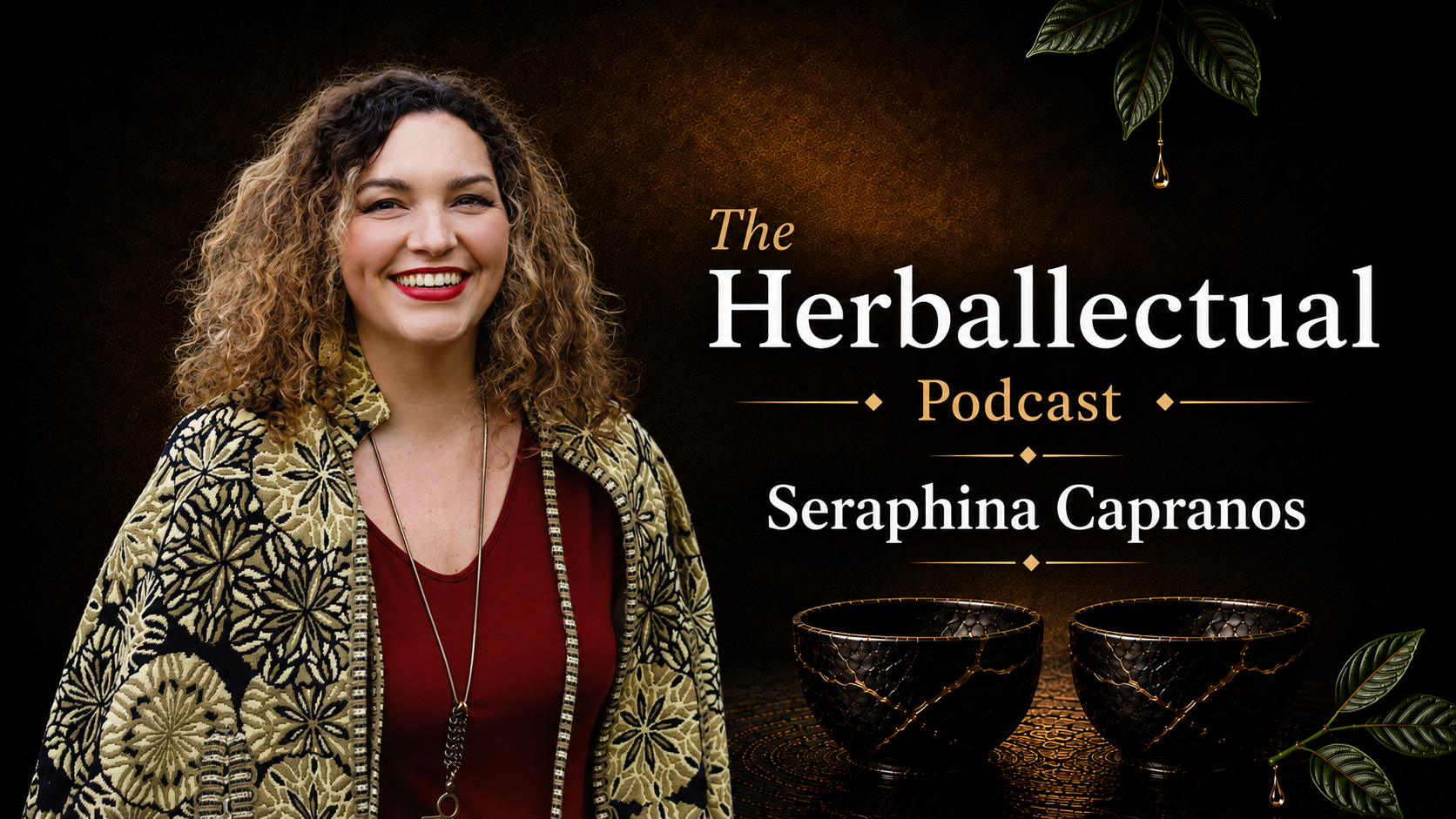
In this episode of The Herballectual, I sit down with my dear friend Seraphina Capranos, a classically trained homeopath, clinical herbalist, teacher, and self-described bridge walker. For more than twenty years, Seraphina has worked at the meeting place between clinical practice and intuition, herbalism and homeopathy, the material and the unseen.
We speak about the rift between medical herbalism and plant spirit medicine, and Seraphina's refusal to treat them as opposing worlds. She shares how a plant often arrives to her first as a felt sense, and how she tests that perception against clinical experience, lab work, and what the person in front of her is telling her. We move through the reclamation of the word witch, the pressure herbalists can feel to edit the more mystical dimensions of their work, and the seduction of certainty that turns one system of medicine into the whole truth.
Along the way, Seraphina reflects on homeopathy, subtle medicine, and the knowledge carried by elders who are passing without anyone thinking to ask them what they know. In the end, she returns to an herbalism wide enough to hold the clinician and the kitchen witch at the same table.
-
Welcome to The Herbalectual, a listening chamber for the living field of herbalism. I'm your host, Melanie Pula, and together we are listening for the soul of herbalism A field can become narrower without ever deciding to. It happens through what it teaches, what it rewards, and what its practitioners learn to leave unsaid. A way of knowing or a practice that once belonged naturally to the work quietly moves to its edges until the edges begin to look as though they were never part of the center at all. Saraphina Capranos has spent much of her life refusing that narrowing. She is an herbalist, classical homeopath, clinician, teacher, and someone who has identified with the word witch since long before it became fashionable. For years, different parts of her life remained separate from one another, and over time, those parts began finding their way back together. We begin with the word witch and what it means to reclaim it without reducing it to a performance. We move through herbalism and homeopathy, intuition and clinical practice, the seduction of certainty, and the strange pressure to turn one way of knowing into the whole truth. I started by asking Sarafina why she thinks it matters that we reclaim the word witch. Well, I think it's important to reclaim it because we can. We're living in a time and a place where we're not at risk of arrest, we're not at risk of even worse, some kind of persecution like our ancestors were. And the word witch is related to the root word willow, which is a flexible tree, as we know as herbalists, and it's a medicine that we use in herbalism. And since ancient times, witches have been known as those who can bend or shape fate. We can twist energies, we can adjust, we can ma- we can mend things together as witches. And as herbalists and healers and wisdom keepers of old traditions, pre-Christianity, this is what we were doing. We were the ones who knew the land, the witches. And as herbalists, if we're willing to reclaim this title, shall we say, for those for whom it speaks to, it's an opportunity to reclaim all the ways in which we're a healer. We're not trying to model ourselves after medical doctors. In herbalism, there is this polarity, right? Some herbalists want to go the way of the medical doctor, the white coat herbalist, and I can see reason for that. But at its very root, being an herbalist, just like being a witch, is one who knows the way of the land. We know how to speak the way of the land, we know how to interpret the messages from the land, we know how to use and be in communication with the seasons, with the medicine that springs from the Earth, not just for healing physical ills, but also for spiritual sickness. 'Cause we can't separate the mind, the body, and the spirit. That's very modern language. And as witches, as healers, as herbalists, we know that illness, just like in health, it impacts every level of our being That's really beautiful. I love how you relate that to the willow tree and then to healing, and I can really see that reclaiming the word witch, like how that can become, you know, a, an, an, an almost like a metaphor in a lot of ways for being an herbalist. And I, I wonder, like do you ever feel that it also can limit us in the sense that, like we're all multidimensional beings, like so much more than a witch? Do you ever feel like that term can sometimes like relegate us into, I don't wanna say a caricature, but like into a box kind of thing? Absolutely. Yeah, thanks for bringing that up. Well, firstly, I think it's important to acknowledge there are as many herbalists as there are people working with herbs. So some of my best friends abhor the word witch. That's not at all a word that they would use to describe themselves as an herbalist. Some prefer and identify more in alignment with the clinical or the medical herbalist, almost some might say the opposite of the witch, hedged witch herbalist. So I think it's important that nature prefers diversity, and that includes d- a diversity of definition of herbalist. But to your point, I think absolutely we have to be careful to not pigeonhole the idea of an herbalist being this hedge witch in this caricature, almost Disney or Instagram style way. I think that does limit the definition of herbalist, and it limits the definition of, of a witch, too. There are many ways to be a witch. And I wonder how it's almost like, in a way, in which is like naming the mundane. You know? It's like naming the... like, like bringing magic into the ordinary and kind of like enlivening it, right? And making it something that is like sacred and powerful. But then I also wonder how sometimes that it can become almost like a performance, like an Instagrammable kind of, you know, show that, that is put on. Which like maybe there's a, a piece of inspiration there, so that, that becomes kind of enchanting, but then I also worry a little bit about that becoming a, a new kind of caricature, right? That's not so like Disney forward, but that becomes this other kind of performative way to show up. Yeah, well, as some of my peers and I call it, it's, it's like making it fashionable or trendy Yes. Yeah And, and it makes my heart sink. On one hand, it's so interesting we're speaking about this today. W- I was actually in the top of a village in Crete just last month in Greece, and one woman rolled her eyes and said, "Oh, I'm so tired of witches all over Instagram." She doesn't identify as a witch herself, but she can appreciate those of us who do, and she said, "It's just so exhausting, and everyone just claims that title." And we had this really interesting dialogue, and I said, "You know, on one hand, I appreciate that so many women now are feeling this call. Perhaps they feel that, that memory that lives in their cells of their ancestors who walked this path, who knew how to cool a fever with herbs, who knew how to create a ritual or a ceremony for a young woman having her first child who might be afraid, for another who knows how to perform a ceremony or anoint a body with oils once they die, like the ways of the witch." I think a lot of women and men too, and non-binary people are remembering this, and so when they see something on Instagram that speaks to this, it awakens something within them. However, just like anything that becomes overly commercialized and popularized, then it becomes diluted. So I went through this period Where I hid that part of my identity. And then when I started to see it all over Instagram in the early 2010s, I began to kind of come out of the witch's closet, if you will, more and more. And then just recently I began to retreat again, because I don't wanna be associated with those Instagram witches. There is a kind of dilution. And how do you convey the depth of our practice or the initiations I've had to go through, or the rites of passages I've had to go through by my teachers and my mentors to walk this path, especially in such a public way? And so I dance with this. Do I put that forward in my public identity online or don't I? And I'm still not sure. I keep it somewhat in between. And do you think that also happens with herbalism or is happening with herbalism, where there's such this huge wellspring of people interested in it and using it in various ways, but also, you know, Instagramming it in a, in, in that same kind of manner? Do you also think that herbalism is subject to that same kind of fashion-forward interest level? So I do feel that many people who were following herbalism, excited about herbalism, maybe threw themselves into it from a, again, a consumeristic perspective and positioning have left it, and I've watched this online as well. And it's so incredibly fascinating. Once again, I wanna, I wanna emphasize, these are in... I'm seeing this in individuals who are not rooted and had a strong, sincere, authentic connection to the practices to begin with And those individuals, I've watched these, some of these social influencers abandon herbalism, and now they're throwing themselves, interestingly, both feet into homeopathy, and they're discounting herbalism and fully believe that homeopathy is now their one true medicine. Or you're seeing people abandon natural medicine altogether, and they're throwing themselves back into allopathic or conventional medicine, both feet in. It doesn't matter from... I'm speaking now as a homeopath and a witch, which is requires a second sight or a way of seeing. It doesn't matter what somebody is throwing themselves into, it's how they're doing it. So when somebody has this, "This is my one true God," whether that be a religion, whether that be a s- a spiritual practice, whether that be a system of medicine, that level of lack of flexibility and humility to understand that life is complex. Sometimes you will need antibiotics as well as energy medicine and meditation, and perhaps guidance from a spiritual guide. Uh, but this all or nothing mentality, I think is what cuts us short and leaves somebody feeling incredibly vulnerable. It's not sustainable. Yeah. And I guess, you know, like you said, people are reaching for something deeper. You had mentioned fear, but I'm, I'm also wondering, is there something else that you think that is also underlying that? Like, is it self-discovery or is it like the divine, you know, that always like reaching outside of yourself? Yeah, exactly. I think it's a, a mixture of all the above. I think people are searching for the ineffable, the divine, the, the, the why and the what, and hold those deep existential questions. And when we don't have the answer to that, when we don't feel a sense of connection and purpose in life, and purpose I don't mean what you do for a living, but something deeper. Why am I here? What am I doing here on this planet in this lifetime? When we don't have a sense of- Why people do feel a deep constitutional fear and a lack of place and a lack of grounding, and that is what they're trying to fulfill. It isn't so much an ideology, but a sense of, I need a purpose. People need a sense of purpose in life. And when they don't have that, there is this incredible insecurity that is deeper than our ego insecurity. It's, it's spiritual. It's a, it's a spiritual sickness, the sense of a lostness that we have. And so, yes, a lot of modern people who were raised without a sense of deep belonging to the land, without a deep belonging to community and a sense of purpose are searching. And unfortunately, how they're searching is through social media. And what do you think is the essence of healing in the sense that, you know, so people are, are searching and they're looking for some form of maybe purpose or something else. But then beneath that, I almost feel like there's this wanting to be healed on some level, right? And that takes the form of maybe the, the spiritual sickness or this kind of emotional hole, but then also even in physical ailments that we, we look for, you know, either herbalism or homeopathy or traditional medicine or conventional medicine to help us, uh, uh, on our healing journey. But what do you think is the essence of that? Like, the healing process. Do you have a sense of it at all? Yeah. I think the, the essence of a healing process is to feel a sense of okay-ness in all that we are and where we are. Uh, it w- so I'm gonna back up just a moment and qualify that and say that in homeopathy, healing is a sense of freedom. It's not the absence of disease. It's feeling and embodying a quality of freedom, and that quality of freedom is on all levels, mind, body, spirit. So freedom is childlike. If you think about a small child before they've been overly domesticated, they are so incredibly present, feel a sense of joy. And a child, they're not-- they may not know as long as they have their basic needs met, they don't know or perseverate whether they're wealthy or they come from a high class family or a lower class family or caste. It's a sense of okay-ness and deep presence. And in homeopathy, we believe that we're all trying to find our way back there. Not to be to our childhood, but, but rather to be so present, taking incredible appreciation for the sun that is rising and the food that we have available, and to feel that deep sense of connection and belonging to the Earth and all of the Earth's inhabitants. So healing, uh, or I should say illness, uh, I'm not talking on a psychological level necessarily, but on a cellular level, illness is a sense of separation. Something is not okay. And it could be communicated... I'm using common language to describe something that could be said scientifically as well. When we're, let's say in an autoimmune, if we have an autoimmune disease, the immune system is attacking itself. It's attacking its own cells. Uh, that's the conversation that's happening in the body. If we look at that same conversation that's happening in an autoimmune condition on the psychospiritual emotional level, we're attacking ourselves. And I wanna be very careful here. I am not at all suggesting that if you think incorrectly, you're going to get an illness. Illness and health is so much more complex than that, but these are the conversations that happen in an organism on multiple levels. And so in homeopathy, we're wanting to give a remedy to stimulate that self-healing mechanism within that interrupts that conversation that's happening in your immune system or interrupts that conversation that might be happening on a subconscious level that is inherited. So to answer your question, healing is about mending this sense of separation, that sense of I'm not okay. I'm not okay on an intrinsically deep level. I'm not talking on a superficial or conscious level, but on a very deep level, I'm not okay And that not okayness, to just put it in very simple language, is what drives people to seek and consume spirituality or consumerism or plastic surgery or whatever the latest trends are that we see that we glom onto. But what happens is because that seeking is not really being able to be fulfilled through that superficial means, it drives further, "I'm not okay." And that's what creates more of a separation, and we're seeing evidence of that in our modern culture and all the ways in which it can act itself out. That sense of I'm not okay ultimately becomes destructive, uh, destructive with our ideologies becoming overly rigid, where you're seeing young children become sick and die even because their parents are so avidly anti-modern medicine that they won't give their child an antibiotic or surgery when it's needed, right to the other extreme, where there are overly medicated children whose bio- microbiomes are disrupted because their parents won't consider something like organic food or feeding their child vegetables. So a- again, it's not the what, but it's the how. It's what's driving that individual. And do you think intention is needed for healing? Like, do you think that we have to choose to heal on some level in order to fully heal? Or is it, is it both? You know? Is it... I- is, is intention something that, like, that we have to choose to heal? On some level, yeah. On some level, I do think so. There has to be a willingness, a willingness to live. There does. The, there is. There needs to be a willingness to live on some level. I'm thinking... As you ask that question, I'm thinking of people who I've worked with in my practice who would, would describe themselves as absolutely not spiritual and not religious, an atheist maybe, or very rational people. And in those individuals, and I work with a number of people of that walk of life, if they have a willingness to live, which in our language we might call that an intention, yes, an individual needs that to heal. Likewise, I've seen individuals who aren't even that sick, but they've lost their will to live. They've lost their will to live, and they die, and it may shock everyone. Because we need that will. Our will is connected to our spirit, our life force. It's that inner light that we have within, which is why people who can overcome incredible hardship and illness, and others succumb easily. Yeah. I think that, um, the, that choice and, like you're saying, free will are undervalued tools in healing- Yeah and process. Mm-hmm. Do you think herbalism can learn anything from homeopathy? Oh, yeah. I'm so passionate and lit up about this. I just, Rosemary Gladstar just asked me to submit a, a chap- write a chapter for her new book on homeopathy for herbalists specifically, which I was so excited to do. I do. I, I think that's the future actually. I think the marriage between homeopathy and herbalism Is part of the future. I think homeopathy will become more and more popular in the future, and I'm talking, like, over the next 100 years, because we're gonna move in the direction of energy medicine and quantum healing. I think that's where healing is going. We're in the very... We're in the real infancy of that, but that is the future of medicine. And you even see that to a degree in modern medicine, especially in Europe, where they're using more qu- like, more higher end technology vibrational healing. Right now it's through lasers and different frequencies, even the way in which they're administering radiation. But that's going to evolve massively over the next 100 years. So homeopathy will be far more popular because it works on the scale of vibration. But I see homeopathy and herbalism as a natural marriage. They're yin and yang. Herbalism is the physical level. We're working with the beauty of herbs, and the sensuality of herbs, and the constituents, and the aromatics, and the color, and the fragrance, and all the, the beauty of how we love and why we love herbalism. Um, so I love using homeopathy and herbalism together in my practice. It's incredibly rewarding. What I can't do with one modality, I can do with the next. As I'm working on a physical level, because I work with such complex diseases in my practice, I'll be giving herbs to support the organs and help the organs function and the immune system. And then I'll be giving homeopathy to remedy, and shift, and create that deep change in that constitution. And whether it be touching the epigenetics, or the constitutional inheritances, or the ways in which we're thinking that are incorrect, or if somebody has a lot of anxiety, right? Homeopathy can really get at that on the physical and the emotional level. Yeah. And when I, when I hear you speak, I, I think, um, a lot about water and how the role water plays in homeopathy, um, and, and which is a big passion of mine with tea. Um, and I wonder if you think that water is going to have a, a really, play a really big role in, you know, the future of healing and also herbalism. Absolutely. Yeah. I mean, it's the universal menstruum. It's the best menstruum. I still prefer water-based extractions in herbs. So that is infusions, decoctions, teas. That is my all-time favorite medium, because our body speaks that language. We're mo- we're made of water, so it's a natural synergy. I do think so very much. Absolutely. I think that's part of the future of medicine. It's almost like a circle, right? We're returning to the roots in so many ways, and yet it's different. More like a spiral than a circle. We're returning to those roots of vibrational medicine, which is what our, many of our ancestors used, and water-based extractions, and we're gonna go back there When you work with homeopathy versus, you know, working with herbalism, do you feel like you're switching paradigms at all? Yeah, I do. Yeah. Mm-hmm. And do you think that there's a paradigm inherent in homeopathy that could inform herbalism and how it evolves? Yes. Yes, this is where I'm deeply passionate is I would love to one day, maybe this will happen when I semi-retire, but I would love to teach the homeopathic lens or philosophy, if you will, the healing modality to herbalists. I would love to do that. I do drip some of that because it's just who I... It's in my blood, it's in my bones. So when I'm teaching herbal programs, longer, more in-depth herbal programs, I'm bringing that in just because that's how I work. It's like a Western herbalist who was trained in Chinese medicine, they can't help but bring some of those teachings into their Western practice because it's who they are. It's the lens through which they see. So I have a lens that is deeply informed by homeopathy. I think it's an incredible lens to have. It's benefited me in my personal life, even outside of practice. I would love passionately to, to teach that to herbalists. I think they would get it and in hot minute. We don't really have a model. We don't... In Western herbalism, there isn't really a model. It's been borrowed by practitioners who are trained in TCM or Ayurveda or maybe even the ancient Greek model are taught by Paracelsus, but it's borrowed. It's not really... Or Native American perhaps, some of those models if herbalists are trained or have come up in that culture. But across the board, we don't really have a strong model and system within which we work. I would love to bring the homeopathic lens in because I think it's a natural fit and it's universal, it's broad, and it also is complementary to Ayurveda Chinese medicine. Because within homeopathy, it's w- it's widely used in India, so a lot of the Indian doctors are using Ayurveda and homeopathy together. So it works. It's universal. It's a w- it's simply observing nature. It's, uh, it's based on the laws of nature, but it's been refined so beautifully and so elegantly that when you're looking at a patient through that model or looking at life through that model or nature through that model, it just clicks. Yeah, and you know, I feel like this brings us back to the witch wound and, um, you know, the persecution that so many herbalists have experienced in the past and that we probably all carry inside of us still as this kind of intergenerational trauma. And the vibrational multidimensional core of herbalism that I think so many herbalists are apprehensive about harnessing and naming and claiming. And I feel like, you know, this is like the lost language of herbalism in so many ways that is the thread, I guess, that would lead us to the diagnostic modality that everybody says herbalism is lacking, that is probably already there. We're just not quite ready to accept it. And so I, I guess related to that, you know, the, there, there's a tension that I would imagine is present between homeopathy and herbalism. Do you think they genuinely disagree anywhere, or i- is there just this tension that you've made peace with? I don't feel a tension in my own practice or, or my trainings. However, there are clashes of egos that once existed probably in the 70s and 80, 80s as the renaissance of natural medicine was rising again in North America. But ultimately, I find them incredibly complementary. However, I do wanna acknowledge that over the many years I've been in practice, well over 20 years, going to conferences and different seminars in, in each, in, in the homeopathic community and the herbal community, I've of course naturally observed a disdain for one and the other, right? So there are, there is, I would say, a small Margin of homeopaths who are staunch homeopaths. They, they look down on herbalism. They think herbalism isn't really creating deep change in the constitutional pattern of a patient. I think that's a small population, but that exists. Likewise, in the herbal world, there have been egos and identities who dis- have disdain for homeopathy and call it hocus pocus, or say that it doesn't have any real... It's like herbalism wannabe, or they'll say all kinds of things. I think both of those attitudes are a lack of deep understanding of one another, which is why I'm so passionate about being a homeopath. I'm classically trained. I went to school for four years. I did two years masters in homeopathy, so I have a lot of deep education with some of the best teachers in the world, and I love to bring that in- that knowledge to the herbal community. Likewise, I've had incredible herbal education with some of the best teachers. I've been very lucky, and I sought that out at a young age. I went to Emerson Herbal, uh, College of Herbology, and then, you know, I've worked with Aviva Romm and different teachers over the years. There's so much that each profession has to offer the next. It's incredible. Do you think that herbs could also be used at this kind of vibrational level? The philosopher in me would like to say yes. I believe in all possibilities. I'm not sure, I think is my most honest answer, and I think it's because I can't remove the homeopath in me which knows the power of potentization. So are the herbs capable of this? A resounding yes. Most homeopathic remedies are made from herbs. It's the herbs at themselves that are doing the work. But when we turn them into a homeopathic remedy, there's a different aspect of the plant that is liberated through the very process of homeopathic potentization. And that's brings us back to vibrational medicine and where I think the future is going. What do you think the wellness industry is getting wrong about herbalism and homeopathy? What gets clicks and views is having a sensational opinion and statement and having a real strong opinion. So what I observe on, in terms of the wellness culture and what we see on social media is these absolutisms that we see. I think that is what they get wrong. The, the longer I'm in practice, the older I get, the less absolute I am. The more patients I've seen, like I'm less absolute than I was as a graduate fresh out of school two or five years into my practice. I almost don't recognize myself because if you talked to me fresh out of school, I would be here ranting in these absolute statements that are hard and fast because I wanted to believe that. I was very anti-allopathic medicine when I graduated until I saw people die in the a- without the absence of some medical intervention. I was absolutely f- pro-free birth until a woman didn't get medical attention in time and she died with her baby. Like, so you know, I would say that when I see these hard and fast rigid absolutisms, and those are often the people who gain a lot of followers because we wanna believe in something so strong, staunch Hardcore belief systems have a kind of charisma to them, and it's dangerous because life, if we observe nature, nature's diverse. Na- diversity is the environment and the conditions upon which health arises, diversity. And I'm not saying you always need to have a bit of everything in your healing journey or regimen, but being reasonable and being grounded doesn't get the clicks, if you will. And so unfortunately, we see people who lead with this, these certain opinions, and then they have tons of followers, and I see a lot of them come into my practice, or they reach out to me with these incredible wild opinions, the followers that is, the young people who are inspired by these leaders. And it, it's, they're, it's so ungrounded. It's so ungrounded. Yeah. And I, I heard this quote, I was listening to a scientist speak the other day about how the science that gets the most publicity is the science that's the easiest to explain. Yeah. But often it is the science that also i- is not nearly as absolute as, you know, it's portrayed to be. And so then we end up, you know, yeah, living in this binary with these kinds of like, quote, unquote facts that, and are actually, you know, theories and development. And so You got it. Yeah. It, it ends up just being the generation of lo- knowledge, like how knowledge becomes generated and also which ideas, you know, get funded and which ideas become the foundational pillars of the narratives that we hold. Uh, so I, I find that really fascinating, and I like the way that you explain that as well. So what role do you hope herbalists play in, in the future of medicine and healing, and what do you see as the future of medicine and healing? Mm-hmm. I think herbalists are not going anywhere. I think we're gonna get stronger and stronger, and I think we're hopefully on our way of there being an herbalist in almost every household. That's my wish, that's my dream, that herbalism just was natural and normal in every household. And I'm hopeful that this will come to pass as well, that herbalism doesn't get regulated, but those who are medical herbalists and seek to get that level of advanced clinical education and practice, that they have respect and high regard in our public system. Like it used to be in England, in the UK, uh, really good education, respect amongst all kinds of health professionals. I do hope that medical herbalists and those, that high-level clinical herbalism is, is strong and, and well-regarded in hospitals even. That would be the ideal. And at the same time, home herbalists, witches on the edge of the forest herbalists still also have high regard and respect, and that they don't go anywhere. I really hope and pray that regulation of healthcare does not push those h- healers out. I think that's really important, and that's something that I pay, I pay close attention to, is regulation, especially of herbalism. It... Herbalism lives in the gray zone, as I believe it should. I kind of separate out the clinical herbalists who go to medical training and do require higher level of education and maybe certification or licensure even. But I don't want herbalism to get so regulated that we lose the indigenous healers and the wise women and wise men and wise people who are doing that really important work in neighborhoods, in villages, in homes. Herbalism belongs to the people, and it should stay there. It should really stay there, and I hope that it does. And in terms of my belief in where we're going, like I've referred to a few times, I think over the next 100 years, vibrational medicine, it'll be the future. I really do think it's gonna be the future. I think pharmaceutical medicine will become more homeopathic in a way, where we're gonna use smaller and smaller doses like they already do in chemo and radiation. I've helped people through chemo and radiation for the two decades plus that I've been in practice, and watching just those treatment modalities and how they're less, they're less problematic on a person now than they were 10 or 20 years ago, which was utterly traumatic when somebody was going through chemo and radiation. They're using smaller doses. People can, you know, still go home and be ok- moder- moderately okay after treatment, and it's because they've refined, um, the, the medication. So I think it's gonna move. Allopathic will become more homeopathic, if you will. And homeopathy, the true homeopathy will have a strong role as vibrational medicine, and acupuncture, herbalism, I think that will also play a huge role in the future of medicine. I completely agree with you, and, and I also love your vision for herbalists in the future and, and the sovereignty really, right? Of, of having a variety of herbalists being able to practice in a variety of ways. So I really, I really appreciate that. And I guess alongside that, how has been the process of fully claiming your voice? So was there a moment like that cracked you open, you know, in a way that felt irreversible? Or was it more like a gradual softening into yourself? As you ask that, I'm brought back to some of the very first classes I taught when I was in my 20s, and I had this gr- terrifying, gripping stage fright, like debilitating stage fright. And yet my longing to share both what I knew, what I was learning, like as a, as a young homeopath, as a young herbalist, but also wanting to share some of my stories. I've had a lot of really unique experiences, especially my teens and early 20s around shamanism and my apprenticeships and my family. There was so much I wanted to share, and it's almost as if the spirit of the teacher, the vocatio, the vocation of being a teacher outweighed my stage fright. And I remember my colleague at the time who was an osteopath, we were, we were closing up our clinic. I was maybe 26 or 27 teaching one of my first classes, and I almost had a panic attack. And I took the homeopathic remedy Gelsemium for it, and I remember she's an osteopath, and she just put her hands on my body, and she said, "Why are you doing this? Why are, why are you really doing this to yourself?" And I, and I remember saying to her, my passion and my... There's a sense of urgency to share that far outweighed my self-consciousness, and I knew I wanted and needed to overcome this. So that-- I'm speaking more to public speaking and teaching, which may not be exactly what you're asking, but I would say that's definitely part of it. This urge, this, this push to share and to be one of the many, many voices that is here sharing this timeless wisdom that feels part of my deeper purpose, which has nothing to do with the livelihood. It's kind of separate. It's just a deep, profound calling. And I remember as I got older, in my 30s especially, which I think is so much about defining who we are, our 30s, there was just this experience of letting my ego, my self-consciousness, I'm not pretty enough, or I'm not well-spoken enough, or I'm not charismatic enough, all those voices, just allowing them to step aside and allow the deeper meaning and the deeper calling to really step forward and, and lead in my life. Yeah. And I love how you say like it's almost like the pain of not doing it is greater than the fear of doing it. Yeah. So it's like the, the scales tip at some point. When did you realize that herbalism wasn't just about healing, but about remembering? The memory that comes to mind always when I'm asked a question like this is being a small child looking up at my grandmother as she would prepare her linden tea after dinner from her trees right in front of her home, and I would hear stories about her working with herbs as a child, or her mother giving her herbs, and my grandfather telling us about how his family would make cough syrups when there weren't any doctors nearby in their village in Prussia where he was born. So when I was a child, I, I felt a sense of being held by the plants. The very same herbs that my grandparents had and took, I was using as a child. They were giving them to me. And then as I got older, plants began to not only symbolize, but become this incredible comfort and this, like a weaver weaving me back into the land where I came from, allowing me to have a connection to my grandparents in a place that I never visited where they were from. It, it just, it was this profound remembering, I would say, that plants were always with us and our companions, and it was almost as if I could tell time by plants How does sovereignty feel for you, like in your nervous system? It feels like a, a sense of coming home, a sense of arrival. It's a profound sense of being home, both in our, in my body and also on the land, and knowing that everything I need is all around, all around me. As you've deepened into your pl- like work with plants and maybe become more settled into s- your own sovereignty, do you feel like that's changed your voice and the way plants speak through you? I would. It's almost paradoxical, or perhaps not paradoxical at all, is the more quiet we become, the more settled in our own system we become, the more we're available to receive information. I think about there was a chapter in life where I thought if I read more or if I went, read more books, attended more conferences, sat at the knees of more speakers and teachers, I would somehow receive more wisdom. But interestingly, it's the opposite. When I threw it all to the wind and I just went for walks in the forest and worked with my herbs and quieted my nervous system and felt at home as you're describing that quality of sovereignty, it was in that space where I, this, this space opened up for more information and for me to arrive at my own understanding that when n- that was no one else's understanding. And I think that's a very important threshold for any herbalist or anyone who loves plants to cross, is that plant herbal medicine, plant study is embodied. Yes, we need the books. Yes, we need to meet and be at the knees of many teachers, but really it's an embodied practice, and the plants end up being our primary teachers. I guess y- y- like what you're describing, it sounds like a little bit of the difference between information and knowledge. And, and the more we embody knowledge, the more it becomes wisdom. Yes. So, you know, being in relationship with our own wisdom as we tend it, which is really beautiful. Do you ever feel like you edit your own voice or, or even at the greater landscape of herbalists, you know, edit, edit our voices to be more, like, digestible to others? If so, what do you think would happen, you know, if we, if we stopped doing that? Yeah. I wonder about that. Yes, I do. I wonder if we do edit ourselves. If we didn't, this is something I think about a lot, is I think if we didn't edit ourselves, we would be more witchy and more wild and more wondrous than perhaps we can imagine. I really feel strongly that as we open ourselves to plants and plant medicine, and when I... Just for the listeners, when I say plant medicine, I'm not speaking about psychedelics. Sometimes that term- Mm-hmm ... is associated with that entirely, but plant medicine, herbal medicine, there is an evolution that happens. Plants initiate us, and they help us evolve and become more of who we're meant to be. And they're spiritual teachers. I think anyone who's using herbal medicine frequently, and they're open to the teachings of plants through their own body, and they're really listening to their body, there is a spiritual evolution that plants nudge us on toward. And as we open to that, I think we open the doors to a very profound understanding of life itself. And so that's what I mean. If we were unedited, I think we'd be moving into the world of mystics and mysticism more than we already are. And why do you think we edit ourselves? I think there is a part of herbalism, there's a dimension of herbalism that- And herbalists that want approval from the over culture, they want approval from the conventional medical system. They want to be seen. I, I love medical herbalists. I have a lot of that training in my background as well. But I think the medical herbalist community, some of them, they want that approval. They're... We wanna be licensed and registered and have insurance companies cover our services. And while that would be incredible, I think the sacrifice of that is we give up this more mystical side, this more ephemeral, and the, the quality of spiritual initiation that plants are really guiding us through. And that's, I believe, the split, is wanting to be green medical doctors or even become akin to naturopathic doctors and read lab work. And once again, I'm one of those people who does a bit of both, and I love that. I love that about my practice. I love the way that in one session with somebody I can be talking about their hemoglobin and their ferritin levels, and then five minutes later be talking about their dreams and where they're, where they believe that they're caught in their family karma, and maybe give them a meditation or a shamanic journey. I love that part of being an herbalist, being an unlicensed practitioner. I'm not a medical doctor or a naturopath, but I do think we... how can we not have some pressure, if you will, by the over culture, but also by our peers to want to move more in the direction of being licensed. Yeah. I really wanna dive into this, um, even more with you. So before we do, I wanna ask a few other questions about how you relate to plants and in your own practice. And, you know, when you meet a plant, what do you feel first? Do you feel emotion or memory or information? Mm, I love that question. When I'm working with somebody in my practice, when they're talking, when they're describing their symptoms, I'll feel a plant. It always begins with one. And this happened yesterday actually. I was speaking with somebody, and as they were describing their very complex condition, ashwagandha came to me. It was a feeling. And then when I thought about that plant, immediately two others that support the action of ashwagandha came to mind, and it's a feeling So yeah, it, it's, it's a sense, it's a feeling, and it's a quality. Plants, they come to me, sometimes it's their virtues alone. There's no one way. So for some it's very physiological. I'll just know that they need the chemical makeup of a plant. But no herb is just chemical makeup. It's also, also the personality of the plant. It's the essence, it's the teaching. So for example, ashwagandha belongs to the Solanaceae family. It's a member of the nightshade family. And as a homeopath, what I know about the nightshade family, and also historically in old alchemical books, that family is really good for nightmares and night terrors. So ashwagandha happens to be a plant that I use for people who are burnt out and have insomnia, but they also have frequent nightmares or parts of their psyche and events in their past that they haven't fully integrated. And so ashwagandha's working on that level of the psyche and helping them integrate their shadow, but it's also helping on that physiological level as an adaptogen that almost functions like a nervine. Do you feel like herbs come to you intuitively first, like as a general principle, and then the information starts, you know, making the connections after that? Yes, exactly. Exactly. And how do herbs speak to you? Like in the felt reality of, you know, your, your body, your awareness. It's a sense. It's very subtle. It's a sense, it's a feeling being around them. I've had experiences in life where people have said the name of a plant, it's not one that I've ever worked with, and I would be flooded with the sense of that plant, the personality of that plant. And it's like I'm tasting it, or it's as if it's moving through my body. So it's, it's a sense. That's, that's the mo- that's the best word I can use. I don't necessarily make the claim that I'm clairvoyant or anything like that, though I certainly have had a lot of extra sensory experiences happen in my life, and certainly with plants. But I would say it's as if there is a emerging on a, on a dimension that I can't quite explain. It has been very profound. Something I used to test myself with is I would, in my... around the age of 30 when I was stepping more into my professional work life, I remember I would test myself by either reading the name of a plant, going into a meditation, and then writing down everything that was coming to me to see, like, w- was I losing it? Was I imagining things? And to my amazement, it was usually accurate. And then I would test myself by tasting a plant that I knew was safe, not knowing anything about it, running it through my body, so y- following the taste, and once again, writing everything down. And I do this with my students, in fact, and it's always so much fun because our bodies know plants. We've co-evolved with them. So once again, I would be accurate in everything that I was feeling and sensing, and I would always compare it in open books later. So I'd say it's a sense. It's a knowing. Almost like clairsentience, where, where you feel it, you have that knowing of it, and, and then you get, like, the, the sensations of, like, taste or, you know. Exactly. And that's in fact, I don't talk about this a lot because I don't wanna mislead people, but it's actually how I understand people's ill- illnesses too, is when they come and see me, it's very similar. I feel it, I sense it. I can sometimes see as well, but I always back it up with confirmation, right, through their lab work, through what they're describing so that I'm not just relying solely on my intuition. Not that I don't trust my intuition, I do deeply, but I always like to create that balance. I'm a bridge walker. I walk in, in both worlds, and I like to back it up, both to offer comfort and reassurance to my patients, but also to myself. It took me a long time to even ident- to even let people know that I identify as a witch, or that I was in a coven since the age of 12 or 13, or all this whole other side to my life. Being in shamanic apprenticeships as a teenager, apprenticing with a medical intuitive at 17. Like, all of that I've really only opened up about in the last few years, despite being in this profession for 20 years, and it's because of what you're saying. There were many years, and in fact, I have some old brochures of when I first started my practice, and I'm literally wearing, like, a white coat, and my, my brochure is very, very conventional and conservative because I wanted to be taken seriously. And I had it, it, I had it like that for many, many years, probably the first 12 or 13, 14 years of my practice. But it's only really in the, in the last five to eight years where I began to open more with my more esoteric teachings and not shy away from letting people know that there is this whole other side to me and so many of us who are herbalists. Yeah. And so this makes me think about something I've heard many times, and also recently from herbalists that have extensive experience with living plants, processing plants, teaching, that would be maybe considered, you know, experts in their field even, and who have said, "You know, I don't hear plants," like, "They don't speak to me." And in the context of, you know, listen to the plants, which we hear a lot, like, um, let the plants guide you, let the plants lead you, but, but they don't feel like, like they hear, like hear the plants or that the plants speak to them. How would you respond to that? I think they do speak to them. What I observe in these conversations, as some herbalists are saying that, is I think they have an idea of what it must, needs to look like in order for plants to speak to us. But it can be, as I describe, you take a, you take a sip of a tea and you have this sensorial experience. And if you slow down your nervous system and you be with the taste, the flavor, the sensation, and you open, the plant will give you more information. But we have to get out of our own way. I think that's a huge part of it. We have to get out of our own way, get out of our own ideas of how we think it needs to look or be or hear or sound when plants are speaking to us. The technique, if you will, that I, I've tested on hundreds and hundreds of students is simply slow down your nervous system, bring your breath down to the pace of nature, and open, and keep opening, and the plant will speak to you, to us through our own body. Yeah. I guess that, that goes along with there's many ways to receive information, and it's not always auditory, right? As like sound, like a voice in your head that is speaking or, or that you've even, like, in your external environment that you hear. So for your own practice, what role does shamanic journeying play in it, both in, like, your practice with clients, but also your own personal evolution with plants? It plays quite a, quite a significant role. With the patients in my practice, I certainly don't offer that to everyone. Usually it's someone has known me because they've taken some of my programs, and then they, and then they decide they would like to work with me professionally, and so they know that aspect of my offerings. And sometimes when somebody's in a real crisis or a trauma state or they've received really bad news, it can be very useful to help bring that person back into their body, bring them into presence, and prepare them to receive their plant formula In my personal life and in my personal practice and other teachings, I use quite a lot of my classes as a way to enter what I call whole time, as a way to bend time, if you will, to meet the spirit of a plant in that nonlinear consciousness. And I think it's a beautiful way because once again, it's all about our nervous system. When our nervous system is slowed right down to that place that is almost dreamlike, we're open. Our ego can take the back seat, and we can open to a whole level of understanding. And when we're in that state and then taking a plant into our body, very profound things can happen. And I'm wondering, like, for herbalism itself, like, do you feel like it's evolving, you know, more towards like a multidimensional or consciousness-based place? Um, and if so, what do you think that next octave of herbalism is gonna look like? All rivers of herbalism are amplifying, like all the way from the spectrum. On one extreme, it's the medical herbalism. On the way, on the other side, it's plant spirit medicine. I think all of those octaves are getting higher. I think they're all gonna get brighter. However, the homeopath in me also believes, um, because I work on such a subtle level with plants through homeopathy, my prediction is in 30, 40, 50 years from now, we are gonna be working more and more with subtle medicine. I think that is the future. Subtle medicine, subtle energy, quantum physics, that is the dimension we're heading toward. And I'm not an astrologer, but Pluto is on, you know, Pluto's in Aquarius for the next 80 years or something like that. So I think that's, that's the future of medicine. I completely agree with you, and I feel like, you know, herbalism as a community has such an opportunity to really step forward at this time and, and play a larger role in our evolution, in our sovereignty. I wonder if you would speak to where you feel like the rift in modern herbalism is, assuming you feel that there's a rift, uh, and then how we might begin to build bridges across it. I mean, because I have a foot in each world, I would say that the material herbalist, so the materialism of herbalism, meaning those who work very clinically, there's a rift between the, the, the strictly clinical and the plant spirit medicine, the energetics. I'm describing them as opposites, but they're not. I believe it's more of a circle and more of a, a, a spectrum of holism really. But that's where I see the rift and, you know, the, the medical herbalists are critiquing the energetic practitioners who are using drop doses, for example. Ver- and, and the, in the other direction, those who use only drop doses or only folk medicine might be looking down upon, um, the medical herbalists. But There's room for both, and here's my take on it, is I've been a clinician for 20 years, and there are some patients, there are some people wh- for whom they do not respond to medical dosing. They just don't. They don't respond to 5 mil or 10 mil of a certain formula or tincture every day. It throws off their whole body. I've had this experience many times. I've learnt through my own mistakes. I have individuals in my practice, they only respond, even on a physical level, to drop dosing or more energetic dosing That's because of their inherent constitution, that's because of their makeup, that's because of their own unique body and sensitivity. Whereas you have other individuals in practice where they only respond to the medical dosing. My statement to the community world, or to the herbal community is let our clients lead. Every body is unique. Every client is unique. Some work best on the ethereal or the energetic plane. Some require the medical plane or the medical dosing only. Then there are those for whom r- really benefit from both. So I think we need to stop being, uh, mimicking ourselves in response to mimicking ourselves as the over culture, because the infighting that we're seeing in our own community is a microcosm of the larger macrocosm. So I wish we could pause there and just have some self-reflection in that way. Honor diversity, that is what ultimately what herbalists love is diversity. Diversity is in nature. That's how we have healthy ecology, healthy ecological systems, and we need that within the herbalism as well. There's a place for everyone in all the different kinds of practices. Yeah. That's beautiful, and I absolutely agree. And I guess alongside that, do you feel like there's ways that the herbal community consciously or unconsciously closes its gates to new voices? And what do you think it would take to open that gate wider? Oh, lovely question. Yeah, I do think so. I think especially in American herbalism in the United States, there's a little bit of an... There's a, you, the influencer co- culture, I would say, has played a big role, especially in the, in the United States. I'm based in Canada, although I do teach a lot in the US and abroad. And I s- I think in the last ten years or f- maybe 15 years, especially with the advent of the internet and Instagram, we're seeing more and more of that, where those with larger follower, followings are given more, um, more clout, if you will. But there are so many smaller herbalists in towns and villages who don't have any social media presence, who are brilliant, doing brilliant work. And so I do wish that there was more of an understanding of that and more embracing of smaller voices and, yeah, more ways. I don't know what the solution would be. Sometimes I wish we had one centralized forum or hub where we could each Just lift each other up, but there isn't anything like that, and I'm sure problems would arise with that idea. But I do wish that there was more of an international knowledge sharing. But then I also wonder about information or, or just the, the, um, voices that are maybe unconventional and, and this goes a little bit into that, you know, the way that herbalism, whether or not it is open to, um, you know, continuing to evolve and kind of widen its range of voices. Hmm. Do you feel like there's gatekeeping in terms of what is familiar and predictable versus what is, you know, maybe a bit more of a risk for people to take? Yeah, I do. I do think so, and this is where I love to spend my time. If I am reading the voices of herbalists, it's less, lesser known voices. That intrigues me, definitely. I think that's the root worker. Uh, so many of us herbalists are root workers. We're on the ground, we're grassroots, we're lesser known. Many of us are hedgewitches living in small places in the countryside, doing really interesting work. And I do think that there is gatekeeping and, you know, I'm not skillful in the... I wish I had the answers. I'm, I'm not skillful in knowing how to manage those gates. Mm. But I wish there were people, uh, if you know any, introduce me, because I'd love to see how that's being done. I don't have a model for that. I think maybe that's what herbalism is lacking. I don't know if there's any outspoken voices speaking to this issue that you're so eloquently naming, but I wish, I wish I had a solution. This is something I sit back and I watch a lot. Yeah. And I mean, I guess alongside that, you know, part of me, I wonder about people who are new to herbalism and who maybe don't see themselves represented, and not representation in such a visual way, but in an ideological way. Yeah. Would they feel like they have, you know, an I- ideas to share, they're making new connections that haven't been made, so there's not a template for it. And because of that, perhaps would not feel like they belong or there's a place for them, or even not venture to even use the word herbalism, herbalist or herbalism. Yeah. Because there's no, the representation of, of somebody who works with plants in their way, and then perhaps because it's, it's risky for others to go behind that or, or like stand with that person. And in the end, you know, the diversity of herbalism, there's a loss, right, in, in that, so. Yeah. Absolutely. Yeah. Is there something that you feel like you wish that more people in herbal circles would talk about, even if it's uncomfortable or even if it's, uh, you know, unconventional? Yeah, I think it's, I think it is, what I long for is more knowledge sharing around the grassroots herbalism, like the, the wise women, the wise men, the wise people who are, are working with herbs in ways that are the outcome of oral traditions. I'm curious about that. Mm. I'm, I'm really interested in herbalists who learnt outside of schools. I don't want that knowledge to die. I don't want that knowledge to die in the elders who are passing. There's a lot of people leaving the planet right now, and I long and I thirst for that kind of knowledge that it survived because I think there's so much that different cultures are carrying, so many, so much wisdom, treatment of diseases, spiritual sicknesses, emotional and psychic attacks. Like, there's so much that traditional wisdom holds, and I long for that knowledge to be shared and amplified. Yeah. That's beautiful. What does true belonging feel like to you in herbalism? True belonging is when those who have been around for a long time take the hands and lift others up who are coming up behind them. A quality of mentorship, if you will. And honoring and respecting different voices, being curious and open rather than Assuming that there's only one way or a right way to be practicing herbalism, a respect for different countries and cultures and traditions, a respect for granny medicine, a respect for new ideas and new thoughts, and experi- individual experience and allowing the, allowing a place like a living room, a communal space for all of that to be shared. When you sit into your deepest truth, like what kind of space would you want to build? The kind of space that I would wanna build is one where it's a gathering place, where the young and the old are sharing knowledge. The old are learning from the young, the young are learning from the older. So it's multicultural, different ages, and there's a way in which we can have that cultural exchange. I would love, uh, an, a magazine where right from people who have no education but work with plants in their own way can share their experience, and alongside somebody who's maybe a medical practitioner and using herbs, like where everyone belongs and everyone is interested in what the other has to say. That there isn't a hierarchical model, but there's an honoring and a respect for how plants speak to and speak through each, each individual. And what would you teach if you knew that you couldn't be punished or exiled or misunderstood? What, what would you choose to teach? I would teach my way of how the plants taught me to experience them, plant spirit medicine. I call it a plant communion practice. I would teach that. I would also teach homeopathy for herbalists. There's a lot of herbalists who look down on homeopathy and say very disparaging comments about it, but I think it's the other side of herbalism. So I would bring that to the herbal community if I wasn't afraid of being judged. That's what I would do. And I would teach my plant spirit communion practices to the medical herbalists if I believe they wouldn't judge me for it, and if I believe they would be open to it because I think it would hugely benefit them. Not that they had, would have to change how they practice, but I think it would give them a greater understanding of the plants themselves if they could open to that. What do you feel like the plants would say to us in this conversation if they had a seat at the table? What do you feel like the plants want us to know right now that is just important for, for humanity to hear? I feel them saying, "Just go outside and lay with us and listen." They're saying, "Bring us your sadness. Bring us your grief. Bring us your longing. Bring us your sense of unbelonging, and let us show you our teachings. Like be with us. Don't just talk about us, but be with us." I just got chills when you said that, so that, yeah, message is really potent right now. And what ancestral threads are most present in your life and in your practice? Well, my grandmother's still alive at 92, and doesn't take any medication, only believes in the herbs and her pound of butter a day she eats on her white bread. Not really a pound, but looks like it. Um, the ancestral threads that run through me and is this sense of daily routine, a daily rhythm that is very much connected about, connected to where you are in place. I think about my grandmother today, and she's a huge influence in my life. She gets up, she has her tea, she has her coffee, she greets her plants, she greets her cat. And there's something comforting to the rhythm of every day, a- as opposed to yearning, aspiring, future thinking, ambition, planning, which is the modern world. There's something in that everyday practice, that everyday routine, which is so about place and presence, and eating the food that's seasonal and local to you, and doing your laundry, and putting herbs in with your, in the dryer with the lavender. Like, there's just something about that that my grandmother imparted to me. And creating beauty in your home, creating beauty with plants in your home and in your bath. It's the everyday little things that I think actually make a life. It's not just the striving and the yearning and the building, it's the everyday. The tending. The tending, yep. Yeah. Yeah. Yeah. Exactly. Beautiful. Then where can people find you and learn more about you and the work that you're doing right now? Yeah, thank you. So my website is seraphinacapranos.com, and I offer all kinds of online classes and mentorships a few times a year. Lots of teaching there. And also Instagram is the same, seraphina.capranos. And what, are there any, uh, projects that are coming down the pipeline that people can look forward to? Yeah, so I've co-developed a six-month herbal program through ecoversity.org, so please join us there. We al- also offer a grow your own food program. And then I offer Rose and Root Herbal Apprenticeship, which is that bridging of the science and the mysticism of plants. That's also online. And I'm also writing a book, but that's might be take a few years. Amazing. Oh, I look forward to that. That sounds so great. Seraphina, thank you so much for the depth and clarity and grace that you've brought into this space. I think there's something in the way you speak that's very grounded and etheric, but also very precise and deeply felt. So for my final question, uh, what is herbalism? Herbalism is a way of life. It's a way of being in sync and listening to the land, and being that r- in that reciprocal relationship of listening to the land. And as you hear the land speak back to you, you gather herbs, you turn that into medicine. Herbalism is a way of healing the whole being, and it includes the land. And I think that relationship is so important. It's using our, our birthright. It's drawing upon the wisdom of our ancestors. Plants are our ancestors, so we're using their bodies to heal our bodies. And as we compost the leaves from those teas, we're also returning the body back to the land. So it's really living in that sacred web What I love about this conversation is how Sarafina refuses the binary that has shaped so much of modern herbalism. She holds the clinical and the mystical together while remaining wary of the pull toward absolutes. Sarafina calls herself a bridgewalker, and perhaps that is what allows her to recognize that a paradigm left unexamined can become a boundary. In the end, Sarafina defines herbalism as a way of life, and I think that's something we can all agree on. You can learn more about Sarafina and her work at sarafinakapranos.com, where you'll find her teaching, mentorships, and Rose & Root Herbal Apprenticeship. You can also find her on Instagram at saraphina.capranos.com. Stay tuned for the next episode of The Herballectual, featuring the Seed Sistas. Thank you for being here and for listening, as always, for the Soul of Herbalism. I'm Melanie Pula. This has been The Herballectual