
7Song: Pragmatism in Clinic, Crisis, and Classroom
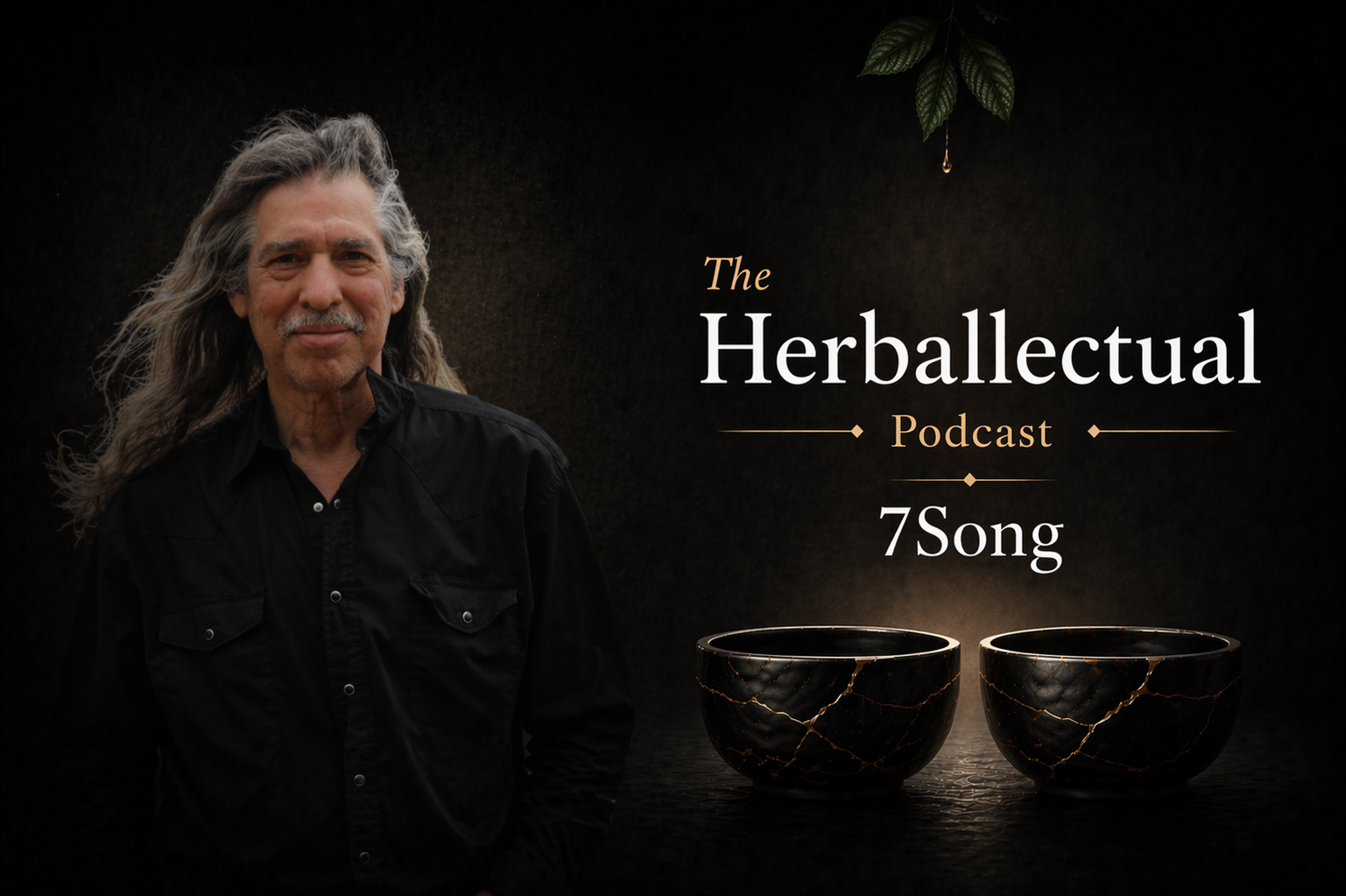
What does herbalism look like when it leaves theory and meets the world?
In this inaugural episode of The Herballectual, I sit down with 7Song - herbalist, educator, long-time clinician, and one of my early teachers, to explore what holds in practice. We speak about the making of herbalists: how students are formed, what must be unlearned, and why clinical reality reshapes early idealism. From free-clinic work to disaster response, from the economics of teaching to the ethics of wildcrafting, this conversation traces herbalism as it lives in bodies, classrooms, and communities.
Herbal pragmatism is about discernment, autonomy, and choosing what serves the person in front of us. Together we reflect on livelihood, lineage, diagnostic orientation, and the long arc of learning.
-
Mélanie Pulla: Welcome to the Herballectual, a listening chamber for the living field of herbalism. I'm your host, Melanie Pulla, and together we are listening for the soul of herbalism. One of the quieter tensions in herbalism is the one between what we feel and what we can honestly say we know. Between the reverence that draws us to the plants in the first place and the rigorous clear-eyed discernment that serves the people sitting across from us. Most herbalists spend years learning to hold both. Some never quite manage it. A few make it look like second nature. I first 7Song in 2000 when he was one of the teachers at the California School of Herbal Studies. I had the chance to interview him live at my studio last summer when he visited Nelson, B.C. to teach at the Canadian Herb Conference. It was the first time we had sat down together in 25 years. 7Song has been practicing clinical herbalism for over 40 years. He works at a free clinic in Ithaca, New York, teaches at his own school, and has worked as a street medic at disaster sites and political events. He brings clarity and practical discernment to the herbal field, along with a sharp wit, healthy skepticism, and a wonderfully irreverent sense of humor. What I appreciate most about him is that he listens to the land, to the people around him, and to what's actually happening right where he is. Welcome to episode one of the Herballectual. I started by asking Seven Song if there was a moment where herbalism stopped being a theory and started being real.
7Song: It started off being pretty practical. So I guess if you divide like being a clinician and working with people that you don't know versus just having a lot of knowledge, then definitely the Ithaca Free Clinic was, uh, a big vision for me. I, uh, started studying herbal medicine in 1981. Ithaca Free Clinic opened in 2006. So much later. So between 1981 and 2006, I treated hundreds of people, but way more informally. So people would come to my house or I'd see them in the street, or I'd go to their homes or frankly, I've, uh, treated lots and lots of students. I've been having an, um, herb school. I am and have been open to treating the students, whether in front of the group or by themselves. Then when the Clinic opened in 2006, I started seeing people. From a very early start, like 1981, there was some practicality, gathering plants and putting in people. I was never a theoretical herbalist. I've always been so many. Gathering plants and putting those plants in mind or other people's bodies. But it became much more structured. Uh, working in the clinic.
Mélanie Pulla: Was there a moment where you like, you saw work or you saw an effect or something where you were like, okay, this is a tangible result or was it just like a gradual thing over time?
7Song: I think more gradual. I think that over the course of time, realizing the importance of what a clinical setting brings to people, I mean, every once in a while, yeah, it's something remarkable. One time I was seeing this person and they were on multiple narcotic drugs prescribed for sleep, for pain. So they're telling me their story, they're telling me about the medications they're on. And I thought, I don't know if herbs are going to work because they wanted something for pain and sleep. But they were already on barbiturates and opiates and opiate analogs. So I thought what herbs going to do? I was absolutely wrong. So they came back, gave them some herbs. They came back and started saying they got off two or three of their drugs. They basically went down from like five or six to two medications. And then using herbs. It's been years since I've seen them. So that, that was a surprising event. But that doesn't happen that often. People feel better often with herbs. Uh, but that was a time where I was thinking, do herbs really do anything? Because of all the medications and their strong effects. So, you know, I'm glad that we live in a world of modern medicine. Medication, surgeries, even radiation, I mean they have their places. But then you start to see, oh, herbs can also infiltrate into these areas. But really it was always more subtle. Like sometimes like from home, kind of, uh, light footedness. You know, I leave the clinic and feel like, oh, I had a positive experience, my patients had positive experiences. So, you know, your very initial question was, what do I look forward to? I still look forward to working with people. I want to figure out more first aid situations because now that I'm no longer working to rainbow gathering, I really enjoy crisis help and then maybe be able to do more street medic work. Again though I'm older, I'm more cautious. But I like uh, spontaneity. This spontaneity in a consultation, you know, it's not, it's not, uh, a predetermined, you know, conversation and outcome. So those are things, you know. So I'm slowly moving away from running my herb school and I am concerned. This is not what I'm looking forward to. I'm like, I need to fill in time. I look forward to Continuing working on my database and fleshing that out. I mean, that's something that'll happen for the rest of my life and will never be filled out. I mean, it's something I will be continually working on and then figuring out places where I can take photographs of salamanders and such.
Mélanie Pulla: So what's the weirdest thing somebody's ever asked you as a herbalist? Was there ever something that threw you off or that just sticks out in your mind?
7Song: Well, that's an interesting. I mean, more often it happens less now. It didn't throw me off. But very commonly when I would say that I was an herbalist, people thought I sold marijuana, which is the old name for cannabis for those who don't know, for those who are whatever generation, whatever. And also they would say, oh, like chiropractic and massage or something. And it's like. So it didn't throw me off, but it was just like, I would think, not really. I mean, I understand that those are therapies that are not always mainstream, even though both of those are licensed, while herbal medicine is not. So I work a lot with doctors and medical professionals, and every once in a while, one of them will ask what I think is an excellent question, which is, why should we use herbal medicine in the current world? Now that we have pharmaceuticals and medications, why use herbs? So I divide that into two camps. Some of them, they're really just saying herbs are stupid, and then I'm not interested in the conversation. They're really just saying they're antiquated. We have these new things, and then other people are just asking, why would I use herbs when we have, uh, all these other options? And I really think that's an excellent question. And it's not the easiest question to answer either. Right. So for me, like, the answer to that question is one is autonomy. Right? So you can pick plants. Most people don't, but some of us do like to pick plants and make our own medicine. So that gives us some autonomy. But I think really the real answer is, why should we have all these other forms of medicine available? It's just choices because you don't know what's going to show up. I mean, every once in a while, a new drug will show up made from a plant, or a new practice will show up from some other practice. And so when we shut things down, um, for instance, in my case, herbal medicine, we're missing avenues that we can explore. Like when the Flexon report came out in the early 1900s. More like 1920s, when the Flexner report came down and basically shut down all herbal schools and glorified medical institute medical colleges. So we had this period in the States from let's say 1920 or something to uh, 1970s. So again, this is mostly conventional in Latino cultures, in Native American cultures. Herbal medicine has thrived and has been there all along. But where I come from, more of a scientific herbal medicine and more of a mainstream conventional, uh, medicine. I thought about what happens if we didn't shut that down. What happens in 1920, whatever report came out. Flexner report is something anybody can read about. Basically. Abraham Flexner went around to different colleges and thought which one should be. And he based a lot of them during the. What looks modern, what scene. Yeah. So what happens if that didn't happen? What happens? The herbal medicine had from 1920s, let's say to the 1970s, had been mainstreamed and universities studied and pharmaceutically trial it. How many new things could have came out of that? So I think the question of uh, why use herbal medicine? Is it one asked in a thoughtful way? And then again, I think as long when we have choices, we don't know what direction these choices will take us. And also provides autonomy. And frankly, a lot of people dislike it. A lot of people I know like herbal medicine. But the thing that I don't care for is idea of natural versus unnatural. So you're asking me like a question that people ask that I. It's not, it's a statement that people make that I, uh, very commonly in the free clinic is like, I don't really want. I only want natural products. I don't think that kind of polarization, natural versus unnatural is really healthy. I think it's what is helpful for us at this time. So it's not really. It's not about industry incorporation. It's just about why really divide that and also how do we divide that? So here I am drinking some lovely tea. Um, at what point does it become unnatural? If I stick in an alcohol, I don't make a tincture, does that become unnatural? If I do a little more lab work on it and I extract the. Is that unnatural? So the one part I don't really like that often kind of gets brought into the subject is natural versus unnatural. Natural.
Mélanie Pulla: So it's more like what's the best medicine for this person at the time, in whatever capacity it's available.
7Song: Exactly. What would really help? What would work and probably won't because humans, uh, is collaborative medicine. There are forms of medicine I don't really appreciate or don't practice or don't recommend, I tend to move more, quite frankly, more medical medicines. A lot of my patients are on medication I can't prescribe. Obviously, I'm an herbalist, but the idea of, like, having people thinking, what are the best options for those people? For a short while while, about a year or two or three in the clinic, we would try to meet once a month. It was mostly nurse practitioner, a nurse, myself as an herbalist, and sometimes the acupuncturist. And we'd go over cases and think, what is the best. Sometimes called a chronic care program. We delineated specific chronic care, like, uh, heart disease, diabetes, some mental health issues.
Mélanie Pulla: So, like, an integrative model, like, as much as possible.
7Song: But it didn't work that great. And then when the person who ran and left the clinic, it stopped. But that really makes the most sense, right, you think? And we work together with this person, but it takes time. So once a month, you know, and we're all volunteers, A lot of doctors really never came know, what can we do? This person's on these medications. Maybe can we switch these medications? Or where do herbs fit into this? Where does acupuncture fit into this?
Mélanie Pulla: I kind of want to circle back to emergency medicine, Because I know you've worked a lot in crisis zones, um, festivals, disaster relief. I'm really curious from your experience, what herbal care looks like in states of chaos.
7Song: I don't usually go when it's chaotic. So hurricane Katrina comes in, or there's been a lot of interruption during an event. What's needed then is safety, right? And maybe grief counseling and food and medication. So during the heart of the event, really, safety is a factor. I mean, herbs can probably play a part, but the bigger things are needed. Housing is needed, Clothes are needed, food is needed. So generally, when I come in, it's been a few weeks after a crisis has happened, and I hear the question, understand it, but I'm absolutely not there during chaos. Herbalists can probably be helpful. When you go to these things, you move around a lot, and so you have to be ready to pick up and leave if another, uh, event is happening, Another weather event is happening? I mean, it's always chaotic, but it's not chaotic because you're in the eye of the storm.
Mélanie Pulla: Do you find it dramatic how you would, for example, teach a student to stay grounded without romanticizing the drama of the event?
7Song: One thing I want to say about these events that's really nice is you have people from the whole spectrum. You have people that might Lean very hard. Right. But are there to help. And people that lean very hard left that might be there to help. And in general, politics are not an issue. You don't really discuss what FEMA could have done better in the United States. So there's a tendency of working together. There's often a lot of law enforcement at these things because things have to be protected. And in general, you have less of the antagonism that you find at some other situation that's disaster. Events are very different. So there's something called disaster tourism. Right. So when I went to Katrina, I helped out. I worked in a, uh, first aid station. And then when I had some free time, I did drive around, I did take photographs of the houses that were destroyed or the beautiful sunsets or sunrises at Standing Rock. So I wouldn't say don't do that. I mean, you are there. I mean, there are definitely people who come for social media exposure, and so they're going to come. They might feed people for a day and be film themselves feeding people for a day and leave. I'm not sure that's terrible, but it's certainly not at the heart of what you're trying to do. I have gone to some political events and my students have gotten arrested, which is pretty uncomfortable. As a teacher, I don't rarely go to get media exposure with this. I don't play up the romanticism of these events. So the people I'm working with are teaching. I don't think they have, oh, we're going to do this and it's going to be fun or chill or the opposite, you know, or gory. And, you know, because you have no idea really what's going to happen. You can set up a first aid station. You'll be there three days with nobody showing up. Uh, people just go into a more medicalized first aid rather than herbal care. I mean, the best is of course, combining them. I mean, you learn, you have to learn to be grounded. You have to take your medications. Like if you're on your own medicines, whether it's herbal or pharmaceutical, it's really important to take them because, uh, they're ungrounded. And so you want to stay grounded. And then people will tell you stories. That wrench. About two months after Hurricane Helene went to Asheville, North Carolina, went to help out, and there's still plenty of people without housing. It just disrupts your body. Right. And so one of the more common things you saw is disruption of menstrual cycles. Uh, of course you have anxiety, depression, but also Exacerbations of pre existing conditions. All of a sudden you had your inflammatory bowel disease under control and now it's not under control because you're in a chaotic situation that you have parameters are not clear. I guess I'm not around event tourism so much. People go like a standing rock. Lots of people went to just witness it, but I think that could be helpful. And also it increases the non police presence in these situations. It shows numbers. Yeah.
Mélanie Pulla: And what's the hardest part that people don't necessarily talk about, about being in those places. Would you say it's like staying grounded and taking care of yourself or is there something else that is unexpected?
7Song: Well, I think one of the harder things that just never really thought about is just lack of access to the foods that you need. I don't have a special needs diet in general, so it's pretty easy for me though. It's Standing Rock. One thing I am, I'm a vegetarian and for a couple of days at Standing Rock it was only meat food. And I think I eat skittles every day. And you know, like skittles once or twice is quite nice. But as a meal, Skittles excellent. Now maybe for your kids they would like Skittles for breakfast. I need some vegetables, I need some rice. But for a lot of people who have to really watch what they're eating, you know, you might not find anything. And so one unexpected thing I think for people is digestive problems from that. So, and this is before, before we even talk about mental health. The other is just where are you going to sleep? And so if you're used to sleeping in your own place, you're not sleeping in your own place. It can be loud. So that can play onto your mental health and lack of sleep. For some places with lots of police presence that could be really disturbing. So depending on the color of your skin will also matter how much activity can happen against you. So that's something we talk about like if you're white presenting, you uh, might want to be at the forefront because unfortunately you might be attacked less. Where if you have darker colored skin or other pigmented, you might, you know.
Mélanie Pulla: Yeah. And I can imagine like that you wouldn't think of that depending on where you come from. Right. Depending if it's not even something in your kind of experience.
7Song: Yeah, it's something we talk about. So I guess I want to say not like full on anti police of any type. I mean they play a role in our society. But there are some very racist and very mean law Enforcement who obviously get into it for reasons that, uh, you know, really make things very unpleasant for lots of people. So part of it is protecting people that might get more harm in these
Mélanie Pulla: situations that might be vulnerable. Yeah, yeah, for sure. What is it that you feel like is just, uh, super tenacious and that you trust it under duress under challenging situations?
7Song: Lobelia and flora, it just works really fast. M. You don't need that much of it. I mean, lobelia is also a, ah, parasympathetic agent, so it can calm people down. But it's so specific for asthma. And when you're in these situations, many things exacerbate asthma. Right. So pollen or dust in the air, so that's really common of pollution in the city. Stress brings on asthma. Alterations in diet can bring on asthma exacerbations. So something like Tulsi, for instance, very nice and calming. It helps some people, but it's much more mild. Right. And so something like Opelia has more strength to it. You get a quicker return with your medicine. You can give it in the field. So that would be one plant.
Mélanie Pulla: You bring a really specific tone to the herbal field. Ironic and sometimes sarcastic. How do you see irony functioning in work and teaching?
7Song: So there's a plant called anemone, and that's a plant that's really helpful for panic attacks. When I take an immunity. I've only met one of the person that happens to answer the question partially when I take anemone, it makes me lose my sense of irony.
Mélanie Pulla: Oh, really?
7Song: It flattens my sense of humor. And I feel terrible because irony is the sustenance of my life. I think that human beings are a very difficult species on planet Earth. And I am a human being and, you know, there's no way I'm projecting that. I am also a part of the humanness of the planet in many not great ways. Irony is so important because I feel like my species is so problematic, that irony is what keeps me going and kind of like, you know, irony is what's inside and sarcasm is what comes outside. Right.
Mélanie Pulla: Oh, um, Interesting. Right.
7Song: So my irony makes me sarcastic, Right. Which I am, um, politically also. I mean, I'm a New York Jewish. Right. So I think that my culture has a lot of irony and sarcasm and cynicism. So in a sense, irony helps get me through because I'll watch humans do really crazy, unfortunate, uh, things or, you know, just very lacking critical thinking at times. And then I want to just think, okay, I'm human, they're human. It's not so Much a compassionate moment. It's an ironic moment. And I think, okay, we're all in this together. I imagine I will always be ironic or at least feel ironic. And that, uh, actually helps stabilize me.
Mélanie Pulla: And it sounds like it almost takes the charge out of things that you can't even imagine kind of why they happened. And then it's just ironic.
7Song: Yeah, I think people operate from different perspectives. Like some of the people I work with operate from compassion. Like I feel like I care for people, but I don't think I have a compassionate Persona. So I think there's many avenues, uh, of how people interact with other people. So I guess I'm saying come from irony. That's my way of interacting and it's my way of caring for people.
Mélanie Pulla: Do you find that humor sometimes diffuses a moment where somebody either might be resistant to something or only if it's fun? Yeah.
7Song: So, yeah, humor, more attention is not fun. Yeah. So I use it and I'll sometimes use it in clinical situations, but if it doesn't land, it brings awkwardness. So I was starting to say, as you know, I use humor regularly, but I do tell people if you're not funny, don't try.
Mélanie Pulla: Yes, yes. Yeah.
7Song: So use your strength. I can diffuse. I mean, if it's really tight, maybe not. You know, you have two lines. You have law enforcement one line and two, and you're trying to get through an area. Maybe then I mean, you know, it's not like everybody's going to fall down cracking up, laughing. Right.
Mélanie Pulla: So you've shown a lot of students over the years what's something that you often see new herbalists misunderstand about how to learn herbalism.
7Song: So I've been running a school since 92, and one of the major changes in the school is the age of the students. So initially the students were between 22 and 24. So you'd have some younger, you'd have some older. So but I would say the first couple of years of my school, your median age would be 24 years old. Now median age is like 35 years old. And so the reason I'm saying that is a 35 year old has a different perspective in the world. You've been hurt many times. You know that you bounce out of that hurt. You know that when things go wrong, that has happened to you multiple times by now and you have survived. And also, there's just so much more about herbal medicine that's available for people than, you know, starting in the 90s when it was, you know, like, you Just had a couple of choices of books. Now you have lots more choices. There's so many online things. I mean, people could be listening to this. They could be listening to a lot of diverse herbal voices. So I think that people are more informed, uh, that come to herb school today. You know, what's happening right now is I'm having minor ironic laughter. Is getting a profession in herbal medicine. Because now schools are more likely to say there's a chance of you making livelihood. It is very difficult to make a livelihood as an herbalist. I know lots of people. I've had lots of students. I teach at lots of schools. That is absolutely a minimum. The only positive thing is most herb schools are not that expensive. So if you go to an herb school and spend four, five, six thousand dollars. And you don't practice, you can eat that. For some people, of course, for other people, that won't work at all. But that's very different than having, like, $70,000, $100,000 of student loans. That means that when you leave, you're going to have to get a job to pay that back. So that happens less in herbal medicine. On uh, the other hand, you don't get a thorough an education. One thing when people commonly like, what can I do after leaving herb school? And the answer is get it. You know, getting some. Getting a job and then m continuing your education and then slowly moving into it. The vast majority of herbalists who make a livelihood is through teaching.
Mélanie Pulla: That opens up so many questions. But I want to come back to, like, do you find age has, um, an effect on the expectations of how is this going to be a livelihood? Like, if you come in younger, you think, I'm going to be nervous or less as a career, versus if you come in older, you think, like, I'm going to weave this into what I already do. Or segue into something that's a bit more, uh, kind of like an adjacent profession?
7Song: No. Exactly. So if you're 35 years old, 45 years old, and going to herb school, you probably have a job. And, you know, if you're 45, you also probably have a career. You know, in the loose sense of that word, whatever you're doing, you've been doing it a while. So m see a bartending. You know, you've been making a livelihood now for 20 years and making probably reasonable income doing that. So the question then is how you incorporate that. I just think a lot of younger people who go to the program are just less career oriented at that point. Sometimes they've had Like a little bit of college or even finished college and gotten their initial degree. And so they're just like reaching out where the older folks often realize money is important. I've made money and how will this help me? But again, there's lots of older people in my program and in other programs, not just my school. I teach at other schools. I've noticed our age has gotten. People are older now, there's still always some younger students as well.
Mélanie Pulla: And that maybe they calibrate their decision to go to herb, um, school in the context of what they're gonna do with it already. Maybe when you're younger you're kind of just like, I wanna learn about this. And it's, you know.
7Song: Well, that actually is kind of similar, I would say. Uh, just before I came in here I was looking at some applications and so a lot of the people are like, I've thought about herbal medicine my whole life and now I wanna do that. Like I run two programs and I want to differentiate. So one's a weekend a month program and one's three days a week for six months. They're both six months. One's three days a week for six months with uh, long field trips. And so the weekend program, most people are not really thinking about making the live, they're just adding it on. Right. Because. But those are the people. Like, you know, I did this with my grandmother and I've been interested in herbs. I read a couple of books. But now I want to get more thorough into it. And so they do a weekend program which is not really going to train anybody to practice though they can incorporate it more if they have some information. And they're already an rn, registered nurse or some other profession, some other medical profession, hospice care. A lot of times the environments won't allow herbs. Depends where you are, uh, where people that go for the full time program are more likely to think about it as more integrating it bigger into their life, making a livelihood.
Mélanie Pulla: Mhm. Do you feel like there's a discussion or there needs to be discussion or there is a discussion about the ethics of how much people charge for herb school versus how much. And I'm thinking of some very expensive programs that I know are out there, for example, and if you're not getting skills that you can roll into something else, like potential, uh, degree that there's an ethical consideration based on what kind of revenue you can actually get out of the profession.
7Song: My first group of thoughts is I really don't know any wealthy herb teachers. The people who have most money from herbal medicine have big companies. And so there's two, yes, basically two wealthy herbalists out there that employee. And actually those people make is the people who work for the large herb companies actually do research and development. They actually make good livelihoods. And also their self representatives, their sales reps, make good livelihoods as well. But as far as herb teachers, I mean, I spend a lot of time with people who run herb schools at their homes and they are not making that much. So to answer your question is like my school is less expensive because I'm the teacher. And so basically my only salary is to myself. You go to another herb school, you have three or four teachers. Now you have three or four people, five people, uh, especially if you have administration. And all those people want to have real incomes, otherwise they're going to have to have second jobs and not put as much time. So I think there is an ethical consideration theoretically. But again, I think even though herb, um, schools can be expensive, Most of the ones that I'm involved in, I mean, maybe they'll buy a house, right? But it's going to be an average sized house. They're basically going to fit right into middle income people. That'll change a little bit with online. You can make much more money doing an online program because your expenses are way lower, right? Meaning you don't have to rent a building. And once you get your set of, uh, classes together, you can, once you have it and you start to put your classes that have already taped online, then you start. That's when you can do financially well because your projects are done. And then you can do other things as well to supplement your income.
Mélanie Pulla: And so that's going to be kind of. My next question is why do you think it's so challenging for herbalists to really step in, like herb students or people like recent graduates or whatever, to really step into becoming an herbalist. Is it livelihood or is there something else as well that you feel is like an obstacle?
7Song: So right now we're talking from Canada and Nelson, um, there are differences between what happens in Canada and what happens in the United States because of our healthcare systems. Right? So in Canada, there's plenty of flaws in the healthcare system, but it is also basically free. Right? So if people want to see an herbalist, they have to pay out of pocket because it's not covered. Uh, in the United States, you're paying out of pocket. Unless you have good insurance, you're always paying out of pocket anyway. So there might be a tendency to want to. You could pay the Herbalist or you can pay the doctor, uh, where that you don't have, or the uk.
Mélanie Pulla: Why do you think it's so hard? Because I look at my cohort of students I graduate with and how many are making a living or how many are even herbalists, and I, I think I can think of maybe one. I would imagine that's over the years you've seen a lot of herb students. And it seems that there are some obstacles, not only carving out an herbalist, but really, um, owning that as a title. Like I'm an herbalist and being out in the world. You know, as an herbalist, I'm not
7Song: a good business person and so I don't teach business skills. So some herbalists, like I've had former students that have good business skills and so they figured out how to make money doing it. I would say the majority of herbalists, people go to herb schools, don't have strong business skills. Last night I had dinner with somebody who owns a restaurant and clearly has good business skills and also studying herbal medicine. And I suggested to them if they wanted to get involved, they should teach business skills. Uh, so one thing is just like, how do you make money doing this? The second is herbal medicine is not generally valued, uh, by itself as a medical discipline. And so people don't usually pay to see an herbalist. So an herbalist to make a livelihood is probably going to charge anywhere between fifty and a hundred dollars for a visit. And even though it's just another out of pocket expense in the U.S. uh, most people are not used to paying that much to see an alternative. They're not paying that much from massage therapy. It's not a societal norm to pay herbalists. You might be a naturopath, you might be a massage therapist or a chiropractor, but somehow people are not wanting to put that money and I make it worse. And the way that I make it worse is really straightforward. So I work in a free clinic. And in the free clinic I will see all local people for free. And I'll see people by telehealth, meaning by Internet, for free. And so I'm a m more well known herbalists than some other herbalists. And yet I practice for free. And so that devalues other herbalists. I mean, it's a real consideration. I'm not going to change it. I like working for people for free. And that's what I can afford it because I run an herb school that makes just enough to do the free thing. Just to go a little bit with this is when it's telehealth, I never send medicines. You have to pick them up or have somebody pick them up and send them to you. So if people are local or if they get to the clinic, however they get there, all the medicines are free and refills are free as long as we don't send them. So in a sense, I feel like a part of the problem, right? Because here I'm saying seven Song Office free medicine. You know, you finished a couple years of school and you want to practice and you want to charge $65 for a consultation in some people's minds, while there's other people who are doing it for free.
Mélanie Pulla: Well, I wonder also like, uh, if there's either people witnessing, like sitting in on your consultation or if you're doing more, more consultations that are introductory or shorter, that people kind of get a taste for it and they're like, oh yeah, I like this herbal medicine thing. Now I want to go and have my. The full experience with an herbal consultation. So in a way, you might just be a gateway, right? You might just be. You don't think so?
7Song: That seems very positive irony coming out. That's true though. I will see people for years. Okay, so there's no. It is a full. So even though consultations are only 30 minutes, I can see them, you know, a couple of times a month or a bunch of times a year. So they actually have full consultations. More commonly, people have seen an herbalist and can't afford it and then they contact me. I don't really know a way around it because I want to see how herbal medicine works in the world. And so I'm doing it for free because I like to do it and because I want to invite everybody to use herbal medicine. But also, you know, it's the selfish part I want to see. I've been studying how to put plants in people's bodies to make physiological change now for, you know, 40 years. And a lot of what I read I don't trust. A lot of what I hear, I don't trust. So what I will trust is working directly with people. And even there it's hard to know somebody has Lyme disease. And let's say they have a lot of fatigue and joint problems and memory loss. And you give them herbs in three months, later they feel better. But is it the herbs? Do they make other changes or is it just in remission? Even with hands on, it's difficult, but I think mostly people just not used to paying to see herbalists. And in The United States, we're not licensed, and so no insurance covers us. People like licensing and, uh, I mean, frankly, sometimes that, uh, licensing means that you've had more practice. So here's a whole other trickiness, right? Anybody in the US can call themselves an herbalist. Anybody in Canada can call themselves an herbalist. There's no legal framework for an herbalist. You can say, I'm a registered herbalist. And that's might mean something to a group of people. But actually, because there's no formal training in herbal medicine, meaning there's no accredited institutions for herbal medicine, anybody can do it. So that means the person who read a book or two might be practicing and charging for it. And then people go to them and might think that was not that in depth. And now, uh, maybe not going to an herbal. So the fact that anybody can practice. So I'm not a pro am. An inclusivist. Inclusiveness.
Mélanie Pulla: Inclusivist.
7Song: Inclusive. Thank you. Inclusivist.
Mélanie Pulla: Yeah.
7Song: So I don't really want to. And also, I mean, I hang out with some traditional people and I certainly don't want to take away their rights. That's over the top. I want them to practice, and I want to be. I want to watch that practice. So there's a bunch of roadblocks to having herbal medicine being, uh, standalone herbal, having people pay for it. Again, herbalists will make some money teaching. That's the vast majority. And even product selling makes very little. In fact, it's a lot of work for not usually a lot of money. And then there's a lot of shitty products out there. There's just a lot of stuff on Etsy that's just like chaga, whatever. You don't even know what mushroom is in there. And so then you have people buying m all these weird products, and then people make outrageous claims. I was in the farmer's market the other day, beer. And somebody was saying. Talking about a product and saying how it'll make a quick change to their mental functioning. And that product does not do that. It's pretty hard to make. I mean, you can make some quick changes to mental functioning, but it's usually on the downside, right? It's not usually. Not usually like giving them like so many movies these days. Like a pill with something that comes super smart. And then, well, there's always a side effect. That's the movie.
Mélanie Pulla: Do you think that herbalism is relegated as an adjunct profession or should be an adjunct profession? Or is that how we think of it in the sense that it doesn't have its own diagnostic tool, I guess, is where I'm coming from. And so we're integrated, right? You, uh, always end up being integrated, whether you're integrating with ALPAC medicine or with some form of traditional medicine from a different culture or from your own culture. Is it by nature like an integrative profession or adjunct, I guess is the other piece.
7Song: First, I want to say these are really good questions. I really appreciate it. I Often people ask me more about me M. And I'm not that interested in me. So the tricky part of that question is that one thing we can say is pretty clear is that people have been plants in their body for physiological, for changes in their health. Since we've been fishing, right? Since like the earliest days. Fish. Everybody listening to this, you can imagine little fishy mouths opening up and closing and breathing in, planked in, and maybe knowing what seaweed or what other plant, if they have an infection or they got bit by another fish. So there's really no question that, uh, I assume all cultures, um, have used plants as medicine. So because of that, is it adjunct?
Mélanie Pulla: Right.
7Song: Since it's one of the early. I would say, like the earliest forms of medicine are probably like, touch for health and counseling. Like in a very primitive way of somebody saying, I hurt my knee and you're like, oh, I feel bad for you in whatever language. And then people, you know, like trying to manipulate the bone back in the body and first aid or. And then pretty soon after that, I mean, the next medicine is going to be plants, right? That people put a plant in their body for a very long time. And so it has been standalone M. And now we're adding the newer diagnostics to it. And then it's just like, whatever your culture. So my diagnostics are very physiological. Like, I'm looking at people labs, I'm asking questions, I'm looking for inflammation as opposed to an energetic. Western herbal medicine tends to incorporate other forms of diagnoses, whether it's Ayurveda, tcm, Western, um, science. Since people have been doing it a long time. There's always been some form of diagnostic. But I mean, we're all incorporating new diagnostics. Like is that, ah, COVID virus in your body or is that a bacteria in your body?
Mélanie Pulla: And I am talking about Western herbalism when I ask that, because other cultures, like you said, plants are integrated from the beginning of time, they're integrated forever. In Ayurveda, it's a very old profession where plants have been integrated. But in Western herbalism, we're looking to Some other modality to tell us what's wrong essentially, or what the issue is. Either they come in knowing or you're looking for diagnosis, diagnostic tool from somewhere. And so then some people incorporate, you know, pulse analysis or tongue diagnosis, right? Because you're looking, if you're the practitioner and somebody doesn't know whether wrong, you're either going to like, outsource them to get a diagnostic or integrate tools into your own practice. And then it opens up a whole other kind of question, uh, about like the ethics of extracting diagnostic tools outside of their traditional framework, which we don't need to go into if you don't want to, but because that's a whole, uh, other thing. But then it also to me begs the question, like, you know, is it a standalone practice or is it always integrating other things?
7Song: Well, in some ways, modern medicine, right, is an offshoot of herbal medicine, right? So yeah, it's not like herbalists, you know, so let's say Western Europeans or more modern people. And I'm not sure, you know, people are more science involved. So like, let's say the late 1800s, people are, uh, taking apart lobelia and they're looking at lobeline and saying, oh, does this affect nicotinic receptors? So in a sense, like they're growing diagnostic tools out of herbal medicine and then it just gets incorporated into a different branch of modern medicine. I often hear that the failure of Western herbal medicine thing that I practice is our lack of diagnostic tools. It's very common. And you hear from Arya Veda, you hear it from tcn, mostly those two CO versions. Whatever diagnostic feels best to you is not what feels best to you. What comes more naturally, what you can learn, how you can absorb it and how you can practice it. So for me, that's physiological. That's basically basic medical sciences. I don't really know if I'd buy it because in a sense, again, like I was just saying, herbal medicine was of course around before our modern, uh, pharmaceuticals. And so the herbalists weren't the scientists and they were looking at this and they were so they didn't have the tools, they didn't have, have microscopes strong enough to see bacteria. And so in a sense, what I'm doing is a, uh, form of diagnostic. That's been part of all along, by the way. I've never really thought this before.
Mélanie Pulla: Well, and it sounds like, I mean, in a way, it's almost like it's a full circle moment. We're coming back to the origins of, like you said, Western medicine. I like what you said about like, if you're gonna choose a diagnostic tool or borrow something from somewhere, like, choose the one that. That lends itself best to your ability to learn and master it, essentially, which might be different for everybody else. Is that a fair paraphrase or.
7Song: I think so, yeah. I mean, you have to be able to evaluate like. So whether you call it assess or diagnose, there's also medical diagnosis. Of course people are looking at, ah, you know, checking your blood levels for sugar or whatever. But then there's a whole other systems, you know, and treatments that might, uh, use herbs or might use community. They're very different.
Mélanie Pulla: I guess my last question on this piece would just be like, do you think that's an important part of herbal education. Is to discern what modality of diagnostics. Usually you would adopt kind of whatever your teacher does.
7Song: So when people apply for my school, I mean, the thing to do is to tell them what the diagnostic. I mean, I'm not usually saying this is my diagnosis, but I am saying this is, you know, as opposed to going to a school that has a much more spiritual orientation and maybe spiritual evaluation. My school is going to have less of that. It's going to have more of a, uh, physiological evaluation. And, uh, we only get into part of it in six months. You're not going to learn all these diagnostic tools. So when you think about going to a school, you have to think of like, is there evaluation formula? But often you don't know well, and
Mélanie Pulla: often you don't think about it. And this kind of leads to my next question because it's like, like we were talking about earlier how, you know, in herbalism, um, there's no blue check mark that says rubber stamp. You're an herbalist, you did it kind of thing. You've been approved. Uh, even though we kind of do because we have the EHD and other things that have put some credibility, I guess, into it, um, by certain people's standards. But so much of herbalism ends up being lineage. Who did you study from? Who are your teachers? And this kind of thing. And at least within the herbal community, perhaps I don't even know if people outside of it know that much about who are the teachers. But I think about sometimes people want to curate a certain kind of lineage. Like study with certain kind of teachers based on name recognition. And then that segues into like, are people evaluating the right kind of criteria when they're choosing a teacher? Or are they going for name recognition based on like, I studied with. So and so as this way to build credibility into who they are, Rather than actually seeking out the people that are having the diagnostics kind of frameworks that lend themselves to, like, how you really want to practice.
7Song: I don't know many people that go to a teacher to brag about, uh, who their teacher is, which is kind of. Yeah, some m teachers are better at marketing or making themselves known, which is marketing. And I think that that's what draws people more than like, oh, I studied with this person or, uh, that person. Because really, outside of the world of herbal medicine, it's a small pool. Most people don't know. One of my main teachers is Michael Moore. And during his day, he's been dead now for 14 years. But I would say it did give me some credit. But only amongst herbalists. Nobody else cares. I mean, everybody else thinks I'm talking about the film, documentary or the million other Michael Moores that exist in the world. So I don't think that most people do it to say, oh, I studied with this person. Like, for instance, here there's one main teacher around Nelson. And so almost everybody studies with her. You know, in the states, she would be less well known. So I think they're doing it because that's your. That's your teacher. That's your local teacher.
Mélanie Pulla: Because, I mean, we do that with universities, right? You're going to go to a university, you're going to say, I went to Harvard. I went to, you know. And that builds credibility into your career trajectory. And so this is the same kind of idea. I wanted this herb school, which is known for this. But then, because so many herbalists run their own herb schools, then it defaults to, like, I study with this person and this person. And I just. I ask specifically because I feel like sometimes, perhaps as a young herbalist, you don't really know where to turn. And I wonder if people are making. And this circles back to, you know, your ability to actually eke at a profession or even, like, become an herbalist is because you want to study with somebody who really, truly practices the kind of herbalism that is how you want to practice in the world. Do you see a, uh, parallel between herbal schools and then, um, the draw sitting with certain kinds of herbal schools versus, like, universities?
7Song: I don't think. I think if you said, I went to arm of it versus the California school of herbal studies versus the Vermont school of holistic herbalism. Like, if you're being hired by a large herb company, maybe they care, but their values can ask you questions. Some people do want a degree. So there's only two herb schools that actually give a master's and a bachelor's. So you have those things existing, but that's a very small group of herbalists. And also those are way more expensive because now you're getting accreditation. But the accreditation does not call you an herbalist. It says you're a master of science. And then whatever colleges, it makes a very big difference. Well, only for like five or six really. So, you know, if you say, you know, Harvard or Yale or one of those, then it matters men, then it just tumbles down pretty soon after that. I rarely hear like pissing contests. You know, I went to this school sometimes a little bit, but I think, you know, I study with this person versus I study with this person. You know, if I hear it, I know this is how you're going to think about herbal medicine. You have to be more energetic, you're going to be more physiologic, you're going to be more spiritual. But I think in the general public, nobody, you know, they look at any kind of diploma on a, uh, wall and it really doesn't indicate much to anybody.
Mélanie Pulla: Interesting. I've always thought that since the lineage ends up being your only way to kind of like orient yourself in the field, that it's so important to make decisions based on the kind of herbalism you want to practice versus who has the biggest Instagram following, like you said, able to market themselves really good. And then you end up kind of getting sold a little bit of bill of goods rather than looking at what is that kind of herbalism that they're studying?
7Song: Yeah, sometimes it's tricky. There's some schools that give you a master of herbalism or something like that. That's a terrible expression. I don't know if anybody wants to be a master of anything. There are schools, they're pretty much all online, that offer master herbalism classes. And people do that because they don't really know anything. But it's really the same as with college in the sense of, you know, there are people, many people these days, that are driven to know where they want to go to school. But often you go to some liberal arts school and you learn what the next step will be. I think that's true with herbal medicine. So you go to go to your local teacher or do something that just shows up online. Hopefully it's not terrible. Then you're like, oh, my next step will be this.
Mélanie Pulla: Mhm. Yeah, I can see that. Kind of a more emergent kind of process. Has there been anything you've had to unlearn in your whole experience? Sort of, ah, herbal education. Once you've kind of gone into practical studies and you've realized that was really
7Song: not, uh, I think the biggest one is that we will cure disease. Sometimes you hear like, oh, we can cure this and we can cure that and we can help this. And the reality is it's very difficult. Trillions of cells. Sometimes our cells function well together and sometimes they don't. So I think one of the things is just sitting with the fact that we will do the best we can, but often that person will still be in pain or they will still have whatever chronic disorder they have. But we're going to help keep it in check. Once you start working with strangers, it all changes, right? Because when you work with family, most people will be friendly towards it and they will give you positive feedback. And then you start working people also, you should always start with people have colds and flus because they're going to get better unless they have some inherent other issues. And then you start working with people that they're not going to get better. And then you start realizing like it's going to be tricky. And then also you start thinking what other modalities are necessary. Because my very earlier whole training was much more positive and herbs can make like help everything. But then I said with Michael Moore and he dispelled that in a way that was really helpful for me because he's correct. But it's funny, like right now, uh, there's a couple of people that are really trying to bring that head, brought Michael Moore's teaching back to him, which I appreciated because he's getting lost.
Mélanie Pulla: Mhm. Yeah.
7Song: But that's just going to happen to all of us, right? I mean, only a few people get to go for glory for a couple of centuries and have a state and a district named after them or something like that.
Mélanie Pulla: What's the thing that you've only learned by failing?
7Song: Uh, everything. It's mostly health crises that I thought that herbs would really help. Like one thing that's really hard to treat is tinnitus or tinnitus. And every once in a while, some you'll get better. Um, maybe it's the herbs. So I just. One thing I've learned by failing is trying to treat a couple of things that seem very intractable with herbs. Other people will say they've had success, but I question that. So that's just one of the things. Does tinnitus really impact quality of life? Depending on how severe it is. One continually fails and then hopefully the failure is not terrible and you pull yourself back up. I remember getting a really mean letter. This is 19, uh, 84. I'm practicing. I gave some herbs to somebody and then they wrote me a letter how dirty I am. And uh, so I want to say that I was often very dirty. This is not a very positive take on my dirtiness. And also about the herbs, I think I just gave them poke, which is something I use pretty sparingly. I don't get that many. I mean, sometimes for my political views, I get people who are pretty agitated and think I should follow their political view rather than my political view. But that was one of the first times and it hurt. I mean, I'm new at it. My first school was 1981. So um, I'm just practicing now. But fortunately I never had to encounter that person again. Yeah. So I'm not really sure it's a failure, but ah, harsh feedback. Yeah.
Mélanie Pulla: What's a plant you respect but you secretly don't enjoy working with?
7Song: I would have to change the terminology.
Mélanie Pulla: Mhm.
7Song: There's not a lot of plants that I don't enjoy working with, but there's a lot of plants that I haven't seen work as well. So classic 1 is St. John's Wort for depression, like the plant, the poster child for drug herb interactions. And I would say that having given seeing lots of people who are depressed, that St. John's wort is sometimes effective, but often not effective. Other herbs work way better. So I don't dislike the plant and I still use it mostly for nerve repair. I mean that's where St. John's wort really shines. There's a bunch of plans that I've heard have been specific for the thing and you give it and it's been really helpful. I got somebody to give me some clues to how to use hibiscus or roselle. Same plant at this conference I was just at, which was lovely. So lovely. I'm learning like that's the language.
Mélanie Pulla: Canadian lingo.
7Song: Yeah, Canadian. Canadian, yeah. Yeah. I don't think I've ever called that Eastern lovely before. Like that. Uh, there's actually a lot of plans that uh, I've heard have been really helpful for things. St. John's word is just one has not worked so well. And specifically for mild moderate depression, has
Mélanie Pulla: the reverse ever happened where there's something you've totally changed your mind about, like from 10 years ago or something?
7Song: Oh yeah. I don't know if I Can come up with one. Like one herb that I thought was like light to medium weight, but now I think it's kind of heavyweight, you know, positive would be chamomile. Oh, interesting. I would think so. I've never not liked chamomile, and now I just find it so effective for so many different kinds of digestive problems and for sleep problems, inflammation. I was also not into rose when I first started using the herbs. You could put rose glycerin in almost anything. For most people, it will taste better.
Mélanie Pulla: And do you find it effective, like further, like as good medicinal or.
7Song: I think it has a physiological action. It's hard to tell. Every herb school should just have a bottle of rose glycerite.
Mélanie Pulla: Yes.
7Song: Where students can use it because people take it and they like the flavor. And maybe it's altering something and reducing anxiety or depression. Or it's just a flavor that's.
Mélanie Pulla: That helps you happy. I don't know.
7Song: Right. But it's hard to. I mean, then where's the discernment? Like, if it makes it feel good,
Mélanie Pulla: you're going to feel good anyway. Is that right? Yeah. So what's your relationship with wildcrafting and when do you know when it's time to stop?
7Song: At the moment or in my life.
Mélanie Pulla: In your life?
7Song: Well, it's getting there.
Mélanie Pulla: Yeah.
7Song: So I've been wildcrafting the whole time, ever since 1981. I travel around most of the United States and, um, mostly the United States. Just because you can't bring plants across borders. I sometimes get stopped at the borders. Recently it happened I was bringing some. I actually gathered plants and Alaska, United States. But of course you have to go through Canada, get back into the United States. So they took my Luba Ursi away because it was still a plant that you can't ascertain where it came from. I like wildcrafting and so I definitely gotten over it. Especially in more recent years. Got a lot of pushback for wildcrafting, uh, because of the destruction to the earth. I could just be really clear. If you want to stop the destruction of earth, stop, uh, housing developments and stuff. That's where it happens. So, yes, herbalists might overpick some plant in region. We certainly have overharvested ginseng and goldenseal. No question. But as far as, like a lot of other plants, it is not us that tends to do it. So I'm not trying to say we should damage the land wildcrafting, but I'm saying if people are concerned, I would turn your eyes towards Development because that just obliterates things for generations. So I like wildcrafting. It's to me it's like kind of one of the hearts of herbal medicine. You know, you make your own medicine, there's your autonomy. But so I have a few things. So first I'm a botanist because I felt people gathering the wrong plants now and forever. But that won't happen with me because I'm going to get out a very technical flora. I'm going to key that plant out to the species, make sure I'm not getting a look alike. That's a rarer species. So you know, like the most common one. People gather a Actea, uh, podocarpa rather than Actea, uh, racemosa. They look a lot alike. I'm not really sure if one is better than the other, but if you're writing a label and you're having a botanical name, you should be the correct one. So I think part that makes me feel better is that uh, also I've traveled really extensively gathering and not gathering in us. So I won't gather if it seems like the populations are being depleted. But overharvesting of course exists, but it often not exists for the individual. Sometimes for saw palmetto, often they'll hire groups of people to go into the woods and gather all the fruits. It actually doesn't hurt the plants that much. Salt palmetto is a long term perennial. But still at that time of harvesting where you go in with a bus of people and gather all of it and then the plants can't reseed themselves. Once you start the wildcraft, you realize it's difficult like it is and it's no way to make money. I've never really wildcrafted for everyone. So I'll gather something for somebody. Usually not for money, usually for like they want to do like uh, they want to do gas chromatography or something on the plant. So yeah, people gathering plants wildcrafting for money is, doesn't really usually exist because it's a lot of work. So usually when people say they wildcraft, it's usually a small select place that's dear to them. But I will call companies up. So like if I'm going to get slippery elm, I'm going to call that company up and I'm not going to get it from them until I get a very specific answer where it's being gathered from. Because I don't know anybody growing slippery elm trees. And so you want to know like, is this a plantation? Is it one person? So I think One thing that we can all do is put the company's feet to the fire and ask them, where does this plant come from? Damiana. I've called up the companies like where are you getting this from? Since it was all wildcraft bodily hawk, Tagal fightum or Devil's claw. Now it's finally being cultivated because it's mostly picked in some deserts, uh, in eastern Africa. And it's a desert plant. Desert plants are particularly vulnerable because they have a. It's hard to make a livelihood in a desert. So that's one thing. As far as personally, I'm just getting there. I mean I'm 67 years old and it's just, it's a lot of work. If anybody's listening isn't interested. You know, if you go to my website and just go to handouts and look at my wildcrafting, there's a whole bunch of stuff puff. But you said puff and it's insecty. It's hot or cold. Maybe you forgot to bring snacks. Hopefully you have enough water. Maybe there's enough plants. I mean you can drive for days to find the plant and not find it or find stand and you just can't gather it because ecologically it's not responsible to gather that. And then you're like, okay. But rarely is it a total waste because usually you're in some beautiful place. I mean most of the wildcrafting is going to be. You're also going to maybe looking for bears and joining their presence or avoiding snakes. I mean I love snakes. So it is contentious. But I think there's a large anti wildcrafting movement. I would move that movement into anti development which is very hard to stop. So it's much easier to call out an herbalist in wildcraft and say stop that than saying whatever large warehouse or whoever is going to uh, deforest the forest. That's where you get real changes of the environment. But uh, ask your herbalists. Where did you get that from? If they say I got it from this company, ask them. Did you ever ask. And sometimes I just grow, you know, rose and tulsi, you know, are pretty much always grown. You know, unless somebody's doing it privately for their own use, maybe their own patients might be growing it. So I think it's just, you know, thoughtfulness about where we're going to get our plants. I'm often very glad when they heard the synthesize a drug. So for instance, when they started using U Y E W for cancer which is commonly used these days, I mean Taxol is, is a common drug. Initially like, oh, damn. They're going to like these are beautiful shrubs and they're just using the bark. So you're just wasting all these old hundreds of year old plants. So actually I tend to be. Yes, they synthesize it now. They can leave the wild plant populations alone or don't need to big ag it anymore. Yeah, we're good at that. We're good at synthesizing as humans.
Mélanie Pulla: That's such an interesting viewpoint and I can see where you're coming from with that. Do you always key out plants or there are certain plants? You're like, well, I know this. You know what I mean? Yeah.
7Song: At this point maybe there's hundreds if not thousands of plants that I know. And so if I see them, I'm um, like for instance, I don't really gather buttercups, but there's like four or five that grow on here. And so I'll look at them and say, okay, this is Ranunculus bulbosa. This is acris, you know. So again, I don't use buttercups, but I will still key them out. I'm looking at this Napeda cataria outside your window. I wouldn't key that out on that.
Mélanie Pulla: That's it's pretty straightforward.
7Song: It is. And also just, I mean plants have ecological niches so it's fun. Like when I'm driving, I can name plants out the window, but it's not always because you see the plant. Well, I just know we're in this wetland or what ecology is in. Because some plants can grow in multiple ecologies. Like red maple does great. But most plants are actually pretty limited whether it's disturbed soil or non disturbed soil.
Mélanie Pulla: What's a plant that you've made a pilgrimage to see?
7Song: Damiana is one of my favorite relaxing herbs for people. And it was mostly being wildcrafted. And it grows in southern Baja California. There's some also in some, um, other areas actually grows in Puerto Rico. I was just there five or six years ago. I went to visit my friend out there, Abby. So I flew to Los Angeles and then we got in m her vehicle. We only had seven days to do this. So we drove 1,000 miles to the tip of Baja. Because I want to see Damian in the wild. I'm m going to say if people are interested, I have a whole blog about my adventures in Baja. Uh, of course we looked at other plants, but really both of us wanted to see it and we didn't know we were going to see it. So we Were both a little bit anxious because I've never seen it. Most of the photos of Damiana in most literature is the wrong plant. It's all. It's all Turnera omifolia because that's a wheatier Damiana. It's not really whatever you want to call common names or common names, but most of the time, so I want them to see what the plant looked like. And all the pictures I have were pretty much inaccurate. I knew that because I've seen the other ones. And so we're driving, we keep stopping, we're getting really. We're in the South Baja California, Mexico, and we finally found the plant and we just were like so ecstatic. Just one plant, like, you know, doing all kinds of weird ceremony stuff with our hands and taking photo, both of us, both photographers and just taking pictures of ourselves with this first Amiana. But it wasn't very common.
Mélanie Pulla: Celebrity plant. It was like a celebrity.
7Song: It was, yes. I could probably find that one plant if I drove down there again the side of the road. But then we spent days looking for it and it was really pretty uncommon. I mean, sometimes you'd find it like in a gravel field, you know, I didn't explore all of Baja, you know, all of southern Baja. It doesn't go north. And of all the times I've ever made a pilgrimage to see a plant, Damiana is the one. We were so ecstatic. Yeah. Yeah.
Mélanie Pulla: I'm glad you found it.
7Song: Yeah, I'm really glad I found it. And then we got to smell it fresh and flavor. Then we didn't gather much. It wasn't much to gather, but we actually gathered just a couple of twigs. And then we met friends in Southern California, uh, in the national forest, and one of their kids. It was in the couple of tweaks we had of Damian and one of their. It was in a paper bag. One of their kids would throw it in the fire. We stopped it in time. Right. If the fire would have smelled good for a couple seconds.
Mélanie Pulla: Couple of seconds of joy. If a new conference gave you a microphone and 15 minutes to rant about anything, what would you rant about?
7Song: I would rant about the importance of critical thinking in healthcare. Critical thinking is the basis of it from my perspective. And I would say that even with spirituality or other forms that are less, I would still think critical thinking and evaluating not in a specific diagnostic matter. But I think we just have to stop. And what are we doing here? What's our goal with this person? That kind of critical thinking?
Mélanie Pulla: Do you think there's A shortage of that.
7Song: Humans have a shortage of critical thinking. Yes.
Mélanie Pulla: As a general species.
7Song: Yeah, as a general species. I'm thinking politically, yes. I think we have some very. Yeah, we need to kick that up.
Mélanie Pulla: Is there something that you believe that you think would get you kicked out of polite apothecary circles?
7Song: It probably would have happened. I mean, I'm saying that we're lovely now. Yeah, I don't think so. I think, like Covid. Like everywhere else, divided. People vaccinated. Anti vaccine. Anti vaccine. Conspiracy. Different conspiracy. Lack of conspiracy. Yes. There are things that would get me kicked out. I don't want to. Yeah, there are definitely things. Mostly it's treating people badly. That would be the simple one. So that would. If I started m. Yeah. Doing all the ways that you think of how to be an asshole to other people, uh, then that would.
Mélanie Pulla: But nothing that's like a core belief that you have kind of thing.
7Song: I wonder if I have core beliefs. The kind of question is, is there something that I hide that if I brought out, would make me a, uh, pariah, uh, to the community? I swear a lot. I mean, so far, I've only sworn three times.
Mélanie Pulla: Yeah.
7Song: And one of them was, like, piss or something. Not that swearable. I was really fortunate to start this on a deserve conference. And the person before me, this local indigenous person, swore a lot. Like, a lot, a lot.
Mélanie Pulla: Oh, yeah.
7Song: So I was so glad, because then I got to.
Mélanie Pulla: She paved the way.
7Song: Yeah. Yeah, exactly. With me. People feel okay to tamp it down with somebody who's local and, uh, native. I think nobody wants to interrupt their language and tell them how to speak. So I think, yes, I do have to. I'm teaching again in the Okanagan, and the person wrote me because they saw me speak at this other conference and said, if I can tone it down because it might be religious people.
Mélanie Pulla: Oh, um, interesting.
7Song: But I can't tone it down. I mean, I could have avoided my four, uh, faux pas of, uh, salty language darkness.
Mélanie Pulla: Well, there's something cathartic about.
7Song: It's just a part of my life. I mean, I'm just thinking, um, where I'm from in New York, it's just standard speech to use these words.
Mélanie Pulla: If someone didn't remember anything you said but walked away carrying your tone, what tone do you hope they would carry?
7Song: How do I say this? I think practicality in healthcare, it really goes with critical thinking. I would hope that they feel like instead of being wishful thinking in. In helping people, that it's really what works. And what doesn't work? Because that's always the problem. It's very easy to teach what works, even though we have very little data on the herbs that really work for specific things. Um, but we often don't get into what doesn't work and, well, what doesn't work for that person. So I think what I would like, if my tone would be, let's be earthy here. Earthy, meaning let's look at this person and really, you know, evaluate and, like, grounded.
Mélanie Pulla: Is that what you mean by practical
7Song: is really, you know, not wish fulfillment, but what's really happening with this person and listening, like, did they act? You know, so I just treated that person, and they said they felt better. But did they? Or were they just saying that? Because it's two humans, uh, talking to each other, and people often want to be polite, especially up here.
Mélanie Pulla: Yeah, I see what you're saying. Like, what's the tangible, practical result as opposed to just the surface level interaction?
7Song: Yeah. Patients will sometimes come in and say, I took this sleep medicine. It really helped. And that might say, did you also take anything else? They might say, oh, yeah, I took ambion. And you're like, that might have been a part of it. So I don't have to get into it. I'm not there to patronize.
Mélanie Pulla: I get that. Yeah. Yeah.
7Song: I don't know if the herbs work as well. Being brave enough. This is really true. When somebody comes, says something works, you have to be brave and really think, did it? Because we want to know, did it work? And so maybe there was some part of it, but it's really common that somebody will say it worked, and they'll ask a few more questions to find out. Actually, they're still not sleeping.
Mélanie Pulla: Interesting.
7Song: Yeah.
Mélanie Pulla: How do you see that implemented in a practical way, in a livable way in the future?
7Song: I guess if people start to see herbalists as a viable medicine and start paying for. I mean, that's the problem, right, Is you want to practice an herbalist and you can't make any money. And so then you have to get a different job. I don't know if this would happen or will ever happen, but herbalists charging a reasonable amount of money that supports themselves, and people feel uncomfortable paying that amount of money. And then we'll collect data. Right. So all of a sudden you have, you know, 50, 60, 70 herbalists in the United States that are making the livelihoods primarily as giving plant medicines to people. And if they're practical, we can share that information and say, this is where I've seen chemical work. This is not where I've seen chemical work. This is where I've seen shop where I work. This is not where I've seen shap where I work. So to go with this, one thing that would really change it is data collection. So as much as those warning boxes on drugs scare people, those companies do not want to put that there. They don't want to say, this is going to give you diarrhea. Right. But they have to because of the law. Um, there's lots of loopholes and all this. I'm not saying these warnings are good, but herbal medicine has no warnings. So when you get this, none of them say, this might cause a headache. And we can't say that. That's illegal for us to say that. But also, one thing that would change the whole deal is if we had excellent data collection, because that's what's happening there. Pharmaceutical companies have to collect data again. They massage the heck out of it. But it's still there. It's, you know, a couple people have died from heart disease. It's in the black box, warning on your herbs. Herbalists, we have informal data sharing. But if there's more herbalists making their livelihood from herbal medicine, collecting data in a very shareable way. And then we do that. But here's the problem. Whose information do we collect? Everybody. I wouldn't do that. There are people that I feel they do have very strong wishful thinking in their herbal medicine. And so then only one group of registered ergos from some organization. That's pretty limiting. With medical people, that's easier because all doctors have a similar training. They have six to eight years of training. So I'm not saying they're all good, but they have a standardized training. We have zero standardization. Our training. Anybody can call themselves a herbalist. Well, I love data collection. I don't want to be the person saying, we will take from these five people these 20 people. And then there's not that nervous practicing. And so we have. Yeah, so that would make a big change. That's what I would like. I would like data collection and purple sharing, if possible. Especially with disaster relief. Having methods of getting people to drive because sending stuff is so expensive. So, you know, Los Angeles fires were just a bigger disaster. Uh, but there's always stuff. There's always floods and hurricanes and tornadoes and events happening. And one thing I think would be really helpful is we had herbal collection areas like to send boxes that we have a sense of how to use. But I don't think That'll happen.
Mélanie Pulla: Do you think we also need better ways to organize the information that's already out there? The knowledge, I guess I would say that herbalists already have.
7Song: I don't know. I mean, it's pretty. I mean, there's lots and lots of books on herbal medicine. I don't know how that would work. Organizing the information that people have. I mean, I have a database that I've been putting what I hope is practical information that's in its infancy, but still online on my website, I think there's a lot of information, I think teasing it, uh, apart and finding out. Yeah, there's probably ways, when you're saying to make this information more useful. For instance, something that's very unuseful is like herbs that are good for kidneys. Like you often hear, this is good for gi. This is good for your kidneys. It's good for your brain. It's really. What, uh, does that mean? Right? What is herb good for the kidneys? Are we talking about the destruction from sugar, from diabetes? Are we talking about, you know, infections of the nephrons? I mean the herbs are probably nice for the kidneys, maybe help clear urine. But even that's ah, specific. We don't have to be super specific. But it is more helpful when you think, what are herbs for the kidneys? It's more like, what are herbs for nephrons that are being destroyed by virus? What are herbs that are good for nephrons being destroyed by extra sugar and diabetes?
Mélanie Pulla: Yeah, I guess I have one last question for you. In your own words, what is herbalism?
7Song: Have I been talking in other people's words this whole time?
Mélanie Pulla: I guess I'm saying like, it's so easy to define. You know, look it up in a dictionary.
7Song: Herbalism is, oh, I would be super simplistic. I would say herbalism is the practice of giving plants as medicine.
Mélanie Pulla: Okay.
7Song: You know, and then you can run anywhere you want. But I think basically that's the basis of herbal medicine. So instead of other things or other touch for health or anything like that, I think basically once you say I'm giving you plants, that that's a form of herbal medicine.
Mélanie Pulla: Awesome. Thank you so much for walking through these questions with me, Samsung. And, uh, I hope this conversation becomes part of the ongoing field of herbalism, not just for students and practitioners, but for everything that comes next. And so, uh, thank you so much for showing up.
7Song: You're, as I always say at the end of these things, you're very welcome
Mélanie Pulla: to learn more about sevensong and the Northeast School of botanical medicine. Visit sevensong.com his website features an extensive searchable database, the Archive of Seven Song's lived experience with plants built over 40 years in clinic, crisis and classroom. Stay tuned for episode two, which features a conversation with Tad Hargrave of Marketing for Hippies. Thank you for listening. I'm Melanie Pulla. Uh, this has been the Herbalectual.