
Tad Hargrave: Marketing as Devotion
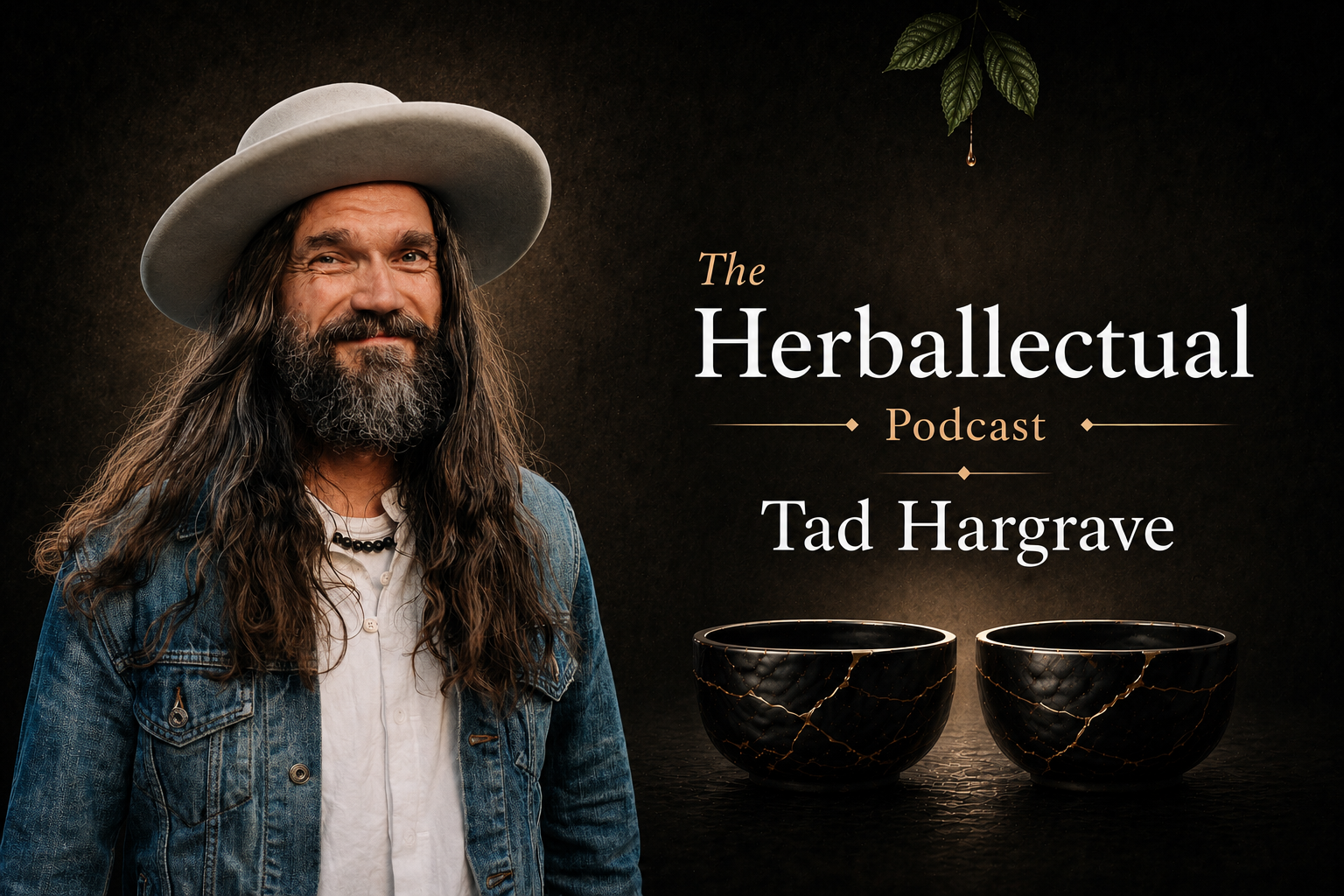
What does it take to do soulful work in the world without losing yourself to the machinery of selling it? In this episode of The Herballectual, I sit down with Tad Hargrave - founder of Marketing for Hippies, longtime teacher, and a steady voice for purpose-driven work, to explore the tensions herbalists carry around visibility, value, and livelihood. We take apart the binaries that keep us stuck: ethical or effective, soulful or strategic, pressure-free or successful. Tad makes the case that these were never opposites at all.
We speak about the fear of being seen, the difference between vulnerability and exposure, and why honesty draws the right people while persuasion repels them. From niching as a craft to the longings that quietly shape our work, from livelihood to the question of what it means to charge money for something sacred, this conversation traces marketing as it lives in bodies, relationships, and communities. Tad returns the market to its older roots in kinship and the living world, and shares a very beautiful definition of herbalism.
-
The Herballectual
Episode Two: Tad Hargrave
Mélanie Pulla: Welcome to the herbalectual, a listening chamber for the living field of herbalism. I’m your host, Melanie Pula, and together we are listening for the soul of herbalism. For most herbalists, the word marketing arrives with a flinch. There’s the work itself, which feels sacred and relational, and then there’s the work of telling people about the work, which feels like a betrayal of everything that drew us to plants in the first place. We sense the dissonance, yet rarely address it. Tad Hargrave is the founder of marketing for hippies, a long standing and widely respected resource for purpose driven entrepreneurs who want to grow their work in ways that feel honest, ethical, and faithful to the work itself. He teaches a model of marketing that resists pressure in favor of truth telling and relationship. This conversation moves through the quieter tensions herbalists carry around visibility and value, how to share our work without reducing plants to products, and how to make a living while remaining faithful to a deeper purpose. What I appreciate most about Tad is that he explores the deeper questions, uncovering patterns that keep us locked into smaller ways of thinking. Welcome to episode two of the herbalectual. I started by asking Tad whether becoming visible means stepping into a kind of performance.
Tad Hargrave: I don’t think performance is inherently inauthentic. I mean, we think, you know, if you go to see your, uh, favorite band, they’re performing, but it’s not inauthentic. People perform activism, and it’s not necessarily unauthentic. A lot of activism is a performance. The demonstrations, the theater, the, you know, the publicity stunts, they’re not bad, they’re not unethical, and they’re a performance. So I would just make a distinction that there are different kinds of performances. There’s some that are fun and authentic. You know, my friend Tucker Gomberg, rest in peace, he was an amazing activist in Canada. He had this eye for publicity stunts. When he wanted to talk about, um, the waste management crisis, he got on a river with these bags full of garbage and just started throwing them into the. And he’d called the media there when he wanted to talk about the, uh, troubles of finance. He dressed as Robin Hood and went in front of the stock exchange and it was a straight performance. And of course, he’s not really Robin Hood. It’s not really. He was going to collect the bag as a garbage afterwards. But there was a authentic, uh, performance. And so, uh, sometimes with marketing, there can be a bit of a performance, but that’s not the enemy of authenticity. Sometimes it can be the expression of it. There is also Then this. Yeah, the fear of visibility. Now, I’m curious. What do you think is the relationship between, uh, kind of inauthentic performance and this fear of visibility? Do you see a relationship there?
Mélanie Pulla: Well, it’s interesting, and I love right off the bat how we’re teasing apart the nuance of performative clips, because I feel like it’s often used as a terminology that’s like, with a negative connotation, like, oh, they’re just performing. And I can hear when you’re saying there’s like an alignment, an aligned almost performance, where you’re kind of like, um, showcasing your authentic self in new ways versus maybe the other kind of performance, which is like, more contrived and inauthentic, that perhaps people who are afraid of being seen will. Will default to an, uh, inauthentic performance or showing up in a way that maybe is more contrived.
Tad Hargrave: What’s the relationship between the fear of being seen and showing up inauthentically?
Mélanie Pulla: Because I think if you fear being seen, you come out as awkward. And so to avoid showing up awkwardly, you would put on, um, like a Persona.
Tad Hargrave: We want to come across smooth and successful and polished. Yeah, I think this is one of the spells that we’re under. I’m thinking about doing a video on the drive in. There’s this thought of, well, I want to come across professionally or successfully is usually the terminology. And my question is always, why? What do you think that’s going to get for you if you come across professionally, if you come across with no holes in you at. No flaws? Because part of the challenge is there’s nothing to connect to. There was a magician, David Williamson, and he would do a lot of tricks in restaurants. Uh, he’d wander table to table in his early days. And, uh, one of the things he realized, he said, you know, we have to remember that we show up, we’re doing miracles in front of people, and we’re incredibly impressive because you’re doing something not only can they not do, they can’t explain how you did it, they can’t explain when you did it. They know you did something at some point, but they can’t reverse engineer the thing. And so, uh, it really borders on the edge of the miraculous. So he said, you have to do what you can to humanize yourself immediately. So when he’d do a trick, he would fumble cards. It wasn’t that he wasn’t capable of looking very slick, but he would intentionally fumble. He’d drop a coin, he’d pretend to injure himself when he was tapping his shoulder with a wand and all in this attempt to humanize. And the slick is not trustworthy. I think we can all testify that to our. In our experience. There’s a great book by Jerry Spence, uh, called how to Argue and Win Every Time. He was a trial lawyer, enormously successful. And he told the story about one trial where the. The accused fellow showed up on the stand and he was in this designer suit and the hair was slick. I mean, not one hair out of place. And he had this very poised kind of posturing look about him. And Jerry said that was how he lost the trial because the jury couldn’t connect with him. So people tend to fall into one of two traps, I think, around this fear of being seen. One is people collapse, make themselves very small. So maybe they don’t go on social media at all. They just don’t show up, or they posture, they puff themselves up. They’re going to make their hair just perfect. They’re going to script everything. So it’s just exactly perfect. I think our people in the holistic scene tend towards collapse, but they notice that doesn’t work for them. I said, God, I’ve collapsed for so long. And look at all these people succeeding. They seem so slick. So I’m going to try this. But that’s still the trap. Either one of those is a trap. We imagine, I think sometimes posturing, this, fake it till you make it dress for success, look confident, appear successful. We think, okay, that’s the alternative to collapsing. But it’s not an alternative. It’s the twin. It’s the other side of the coin. And there’s a sort of third column which is, um, composure. Collapsing is a lack of confidence. That’s how it reads. Posturing actually reads as an overconfidence, which nobody trusts, nobody can connect with. I mean, you can just look at almost every politician for this kind of posturing. And then there’s composure. And composure is a more of a. You’re comfortable in your own skin. Which brings us back to this comment of I wouldn’t want to be awkward. And I said, but why not? What’s wrong with awkward? I want to seem successful. It’s like, but people don’t necessarily trust this. But people do trust human, and they trust people that are comfortable with being human. Because we think successful people have this, like, aura of walking around, just dripping success, of talking about their success all the time. I was on a flight. This is 20, maybe 25 years ago. I’ve never seen it since, but it was Three seats at the back of the plane facing another three seats, kind of had a little box thing going. And the woman next to me was reading a paper. So this, I guess, would have been in the early 2000s, because it was George W. Bush who was in the headlines, and he’d done some insane thing again. And I remember I looked and said, fucking Bush. She said, yeah. So we started riffing on that, and I just said, what do you do? She said, oh, I’m a musician. I said, what do you play? I play guitar. I said, do you write songs? You just play? So I write songs, too. Is it professional or is just a site? He said, no, that’s what I do. And I said, oh, do you have a band? I do. And does the band have a name or, uh, what’s the name? Band’s name. She doesn’t really have a name. I said, oh, like Dave Matthews Band. She said, kind of like that. I said, what’s your name? She said, bonnie Raitt. So that was about eight questions to even get her to tell her name. But if you met some famous film director at a party who everybody knew but you, and you just wind up say, oh, yeah, I’m, you know, my name’s Ted. What do you do? Ah, I’m, uh, trying to make it. In the film biz, there’s a certain level of success that you reach where you’re not hustling for it anymore. The approval you actually enjoy being with people who don’t know you, uh, and who aren’t treating you in this way and fawning over you. So Andrew Tate, I don’t know if you. Andrew Tate, he’s sort of in the manosphere, but Andrew Tate is a teenager’s version of what a man should be like. It’s a sort of unevolved machismo. And I think we have a similar thing in our mind of what a successful business person would be. But it’s coming from not having succeeded and coming from these images that we see. Oh, that’s what it’s supposed to look like. But success really actually looks like the who are awkward and okay with being awkward, you know, and when people are unsure about the direction to go. Bayou Komolafe. He had a great line where he said, you know, this. This suffix, linguistically, Ward, has something to do with a way of movement or direction. So forward, backward. But there’s also awkward and awk is a kind of to the side, skewed off. And that’s a legitimate direction to go. If you’re not sure what direction to go. Awkward is. Is all right. And awkward is human. And it’s more trustworthy. Quirky is interesting for people. You know, I read a book about acupuncture, and I made a case that the central shift in modern medicine is the shift from fertility to sterility. And I think this is what happens in marketing, too. You get people who are very quirky and interesting, then they go through the marketing machine and they’re sterile now. There’s no fertility. There’s nothing interesting. They’ve become a carbon copy of everybody else. But awkward, you’re going to be awkward in a way that’s authentic to you.
Mélanie Pulla: And I love how you’re talking about, um, posturing, because I almost feel like that’s the more accurate word for performative branding. It’s actually posturing when you posture that there’s something that’s about bravado. Right. So it’s this false kind of confidence that you’re putting on. And that’s the show. Right. That I guess I was trying to refer to.
Tad Hargrave: Yeah.
Mélanie Pulla: And you mentioned something about the humanity and like, being human as a way for people that, that it just opens up, uh, something to connect to. Right. When you, you have this humanity. And I wonder about showing up in a way that is in your humanity. But, like, what is that line between vulnerability and being overly vulnerable where you’ve. You’ve exposed too much. And I, and I know you’ve said before, um, show the scar of the wound, which I think is, like, really brilliant. So I, um. That’s a lot right there already. So I’d love to just hear what you have to say.
Tad Hargrave: The first thing I would say around being visibility is there’s no pressure to be visible. You know, there’s no pressure to have a business. It’s all choice. So I think sometimes people feel a sense of internal pressure or, or worse, pressured by maybe a business coach. If you’ve got to reveal yourself and get out there and be open and you don’t have to. You don’t. You just don’t have to do anything. There’s a lot of ways to, to do things. And yes, there’s a certain level of visibility in being an entrepreneur, but I mean, you can keep a job for a while. You don’t have to leap into this. You can titrate it and probably should going in. And there’s a difference of being visible versus becoming visible. You know, you can allow the visibility to appear slowly over time. It doesn’t have to be all at once. You don’t have to go on and tell your most traumatic story. Also, you don’t have to speak about the traumas you’ve been through, but you can speak from them. If you speak from them, you can credit people with the ability to hear that you’re speaking from something real that has some heft to it without needing to go into every gory detail or any details about it. But, uh, credit that your people will pick up on this. And then in terms of sharing things. Yeah, the general guideline that came up to m me, I mean, this is. I don’t know if it’s any advice to anyone at all, but if I had to give advice, if I was pressed, I’d say, don’t share your wounds. Share the scars. The scars are already healed over. It’s something you went through and you’re on the other side of it. Because the two times I’ve been really truly vulnerable on social media, I instantly regretted it. And it didn’t take a lot. 1 or 2 comments, well intended but poorly aimed, were devastating. And why? Because I was actually vulnerable. There was a wound and it was still open. And so they had access to my insides. And so the, the careless comment goes deeper, uh, than it should then with your friends and therapists, with them you show the wounds and not just the scars, because that’s the other side of it is it’s very easy then to. With our friends, it can be the posturing. I’m okay, I don’t have any problems. Let’s just look at all the scars. But no active wounds. And of course, we all still have active wounds. But in terms of social media, I think that’s probably where it crosses the line. And then you get a vulnerability hangover. The other thing I think connected to this kind of performative or posturing is why are you sharing it? Because I’ve seen some coaches share stories and it’s like, uh, oh, the reason you shared that is to get people to buy something from you. It was a hook that you use to create an emotional state so that people would buy. So I would just be very mindful. Why am I sharing this? But also sharing anything, you know, what’s, what’s the purpose of anything we’re putting out in marketing? Is it to get people to buy or is it to help people get to the truth of if it’s a fit or not? Is it to create this buying energy or is it to help them discern if you’re going to be a fit or not? Because if our focus is on the truth, it’ll be ethical. If the focus is on the sale, it won’t be.
Mélanie Pulla: And I feel like that goes a little bit into, um, this idea of creating kind of like a sensationalist language. Do something that is like, uh, attention grabbing or doing it in order to evoke a certain reaction from other people. Why do you feel people do that?
Tad Hargrave: Because it works in the short term. This stuff really works. And people, they’ll say it doesn’t work, but it works. I was in England, I remember people saying, oh, this American garish, loud, high pressure in your face. Marketing, we don’t like this over here. I said to them, you invented the tabloid media. You invented the garish headlines. That started here.
Mélanie Pulla: Yeah.
Tad Hargrave: Not over there. You started at first. You were the home base of it. And so don’t tell me it doesn’t work when you buy those papers and they’re still in business because you’re buying them. So it works at a certain level. Yeah, it gets attention. But to me, the challenge is if you’re saying inflammatory and polarizing things in order to create a polarized response, if you’re doing it, you’re also creating more divisions in society unnecessarily. You may be using sort of a dehumanizing language. So I think there are consequences larger than us that need to be tended to. And it should be said that you, if you’re just telling the truth, that will probably be polarizing. But again, it’s why are we sharing it in the first place? Am I sharing it because it’s a tactic that I’ve been told is going to grow my following, or am I sharing it because I can’t imagine not saying it? That somebody has to say that it’s the emperor’s new clothes and nobody’s pointing out the king’s naked and somebody’s got to say it? And okay, I guess it’s going to be me or I’m going to join in on the chorus of that. That’s very different than I’m going to say something so that I get seen as a leader. That’s the posturing. That’s the. An inauthentic performance.
Mélanie Pulla: I guess the question that comes up for me because I’m hearing you talk about the language that we use and I’m wondering, how do you find language that feels honest and magnetic without being manipulative or contrived and that has that resonance that people are actually seeking?
Tad Hargrave: I’m not looking for language that’s magnetic or if I am, well, let’s then use it in the full sense of magnetic, in that there’s a North pole and a South pole. It attracts and it repels. I’m, um, looking for a language that’s honest and a way of describing things that my ideal clients would say, oh, my God, that’s me. And everybody else would say, not me. If I stand up in front of room and I articulate what I do, and 80% of the people in the room say, that’s not me. That’s success. And people say, ted, oh, God. Only 20% of the people, or, you know, maybe it’s just two people in a room of a hundred give a hard yes, and everybody else says no. You could look at that as a failure. But, okay, maybe I’m a guest and I just got thrown on this stage, but maybe that was the truth. In the room, there’s really only. There were only two people who were a fit. I didn’t control who came, and I’m just trying to tell the truth. And then you let the chips fall where they may, and people are going to respond how they respond. But the notion of trying to control people’s reactions, trying to manufacture a certain response, I mean, that was Noam Chomsky’s, you know, grand contribution, you know, manufacturing consent, which is what so much marketing is, is trying to. And of course, then it’s not consent at all, because they don’t know the tactics that were being used. I mean, one of the litmus tests you can use of. Is this approach ethical? Is this language ethical? Is. Could you explain it while you’re doing it? If somebody said, wait, why did you just say that? Why did you ask me that question? And, uh, if you were under a truth serum and you just had to reveal your intentions and secret motivations. But why that languaging? Why that wording, the notion of, to me, magnetic languages and trying to draw everybody to us. That’s part of the problem. Because why would you want to do that? Well, because I want to get the sale. Right. Okay. Because that’s the center of everything, is getting the sale. Now, it’s important to have an agenda for the process, but not the people. Like, yes, you need an agenda for the process of, I need clients. That’s true. But if I’m having an agenda for the specific person reading the piece I’m writing for, the crowd I’m talking to for the club, the potential client I’m talking to, if my agenda is to get them to say yes, I’ll communicate in one way. If my Agenda is just to share, you know, which is. That’s the etymology of the word selling. It comes from sharing, basically. And one rendering I’d heard is that sharing specifically in response to a request, so there’s consent at every step of the way. They’ve asked you to share something and you’re sharing it. But it’s more like I’m putting it down on the table in between us. And I’m saying, yeah, there’s this licorice mint tea. I really enjoy it myself. I think you might like it. And, uh, you know, But I tell you, I’m just going to go over there. You have to give it a try. And if you like it, you just flag me down or I’ll pop back in a minute. But I’m not giving you the sample of this tea to get you to like it. I’m giving you the sample of the tea. And I come back, I could come back and say, nodding my head, be like, how was the tea? And I’m nodding and I’m smiling. And, um, the clear message of the body language is, didn’t you like it? Wasn’t it great? Because I’m trying to sell it to you versus I come back and I say, and, um, I kind of do my handshaking from side to side and I squinting my eyes. I’m like, what did you think? How was it? You know, with an equivocating posture. And people say, but, dad, that’s such a disempowered language. That’s not magnetic at all. You’re being so unconfident in your product. Of course, I don’t know if it’s a fit. I don’t know if they like it. I really want to know the truth. If they don’t like it, try something else. And we’ll keep trying until you find something that’s fit. And if I don’t have anything that’s fit, I said, you know what? I just. I don’t have anything for you. I know somebody who’s got some other teas. Let me send you down the road, because I think they may have something you like. And maybe you just don’t like tea, and that’s okay, too. So, um, when we’re looking at crafting a language, I would say there’s three things to aim at that I would aim at more than magnetic. Whole thing is clarity. Clarity over brevity, Clarity over poetry. Is it clear? Is it understandable? And within the clarity, in terms of filtering, there’s three levels. The first is relevance. As Quickly as possible. I want to know, is this relevant to me? I don’t want to have to guess. I don’t want to read three pages because it’s not hard to nail, but it’s desperately hard. But it’s a simple matter with a lot of labor. But you can get to it in a simple way. For example, there’s a woman in my membership and she’s got a new niche which I love is, uh, the website is TheTinyViking CA and it’s support for parents of kids who bite, scratch and kick. Just you, you know, you’ve got this little kid who’s a Viking, and you as a parent are beside yourself because, sure, all kids do this sometimes, but your kid is extreme and I don’t want to control them, but I also can’t let this continue. And it’s physically hurting me. And they’re getting bigger and what do I do? And I’m so ashamed. And did I damage my child? And you have all of that. When I describe that, anyone who’s listening, who’s a parent, knows if that’s them or not. Yeah. So relevance is established. A woman in my membership, Nasanka, came up with a niche which was, are, uh, you co parenting with a narcissistic ex? You, you kind of know if you’re in that group or not. Uh, so that’s the first thing to aim at as quickly as possible. So if you sell products, I mean, just photos of products, just seeing photos. The wall of teas. Okay. And a teapot. I know you sell tea. There’s a photo of a cup of tea. I got it. The relevance is kind of immediately that level is established and a few words, you know, organic, fair trade, whatever. Ah, uh, that’s the kind of tea. And then if it’s a service, it’s going to be you name the problem or the result that you’re helping people with right away. Second thing is then credibility. Just why should I trust you? And this is more the point of view piece where you’re. This is so critical. We’re making the case not for them to buy from us. We’re making the case for an approach. We’re saying, look, whether or not you buy from me, this is how I’d approach the problem. Whether or not you buy my tea. This is the criteria I would use for buying tea and for drinking it and enjoying it. We’re making a case for something bigger than us, whether or not they buy from us. And it’s a line that I use a lot. I Mean, it’s just. And I recommend people weave it in of just look, whether or not you buy from me and then whatever follows it, you just tell them the truth of you’re trying to take care of them and support them. And so we’ve got relevance, we’ve got credibility. Third thing is value. Then it’s really looking at, okay, can I come up with offers that are so good, people just say, shut up and take my money. You know, we’ve all seen those where it’s like, God damn, that’s so good. You know, every Facebook will give you an ad and you’re mad because it’s so on point, it’s eerie. And you buy it. And part of you is grateful to the algorithm. Part of you is angry and furious and suspicious about the whole thing. But we know when there’s an offer that’s so good, like, oh, that price for that thing. I can’t walk away from this. This is so great. That’s what we want to aim for in terms of the value. So if you aim for those things, then it’s just trying to be faithful to those things. Give the best languaging and articulation to those things as clearly as possible. And then again, we let the chips fall where they may. People are going to opt in or out, and that’s fine. But if I’m aiming at how do I make this really magnetic, what I’m probably going to do is be loose on the details. I’m probably going to skip that middle step of credibility. I’m going to hit the relevance very hard. Isn’t it hard struggling with what you’re struggling with? And isn’t the pain awful? And wouldn’t you secretly want this? And don’t you deserve this? And imagine this. I’m going to hit this kind of island a where you are, be where you want to be really hard. And then I’m going to say, here’s the offer and here’s how we’re going to lower the risk of taking that first step. That’s the kind of magnetic thing. But you’re missing that central step of filtering. You’re missing the central step of giving them the information that they might need to discern if this is the approach they want. And if you do make it, you’re going to lose a lot of people. If you make that case, there’ll be a lot of people who opt out. I mean, it was. That was not going to be a fit anyways. Those people would have been nightmare clients. They. They wouldn’t have been returned customers, and it’s probably better to filter them out. It’s like a romantic relationship. One of the things I’ve said is, you know, for dating profiles, start with a deal breaker. If you want kids soon, you start with a deal. Uh, just tell them that you want to get married in the next few years, and that’s what you’re aiming at. Tell them if you just want to have fun and hook up and party, Tell them that. Whatever. The thing is that you think, if they knew this, they might not want me. If they knew this, if they don’t want this, it’s not a fit lead with that. It’s magnetic in the opposite sense that it will repulse people that you don’t want.
Mélanie Pulla: I love that. I really appreciate that essentially definition of magnetic, how it’s resonant on one side and then repelling on the other side. And I wonder about how to be honest in a world that has so much polarity and essentially censorship in what is, um, considered appropriate politically correct. Um, and I’m thinking especially in terms of verbalism, there’s always a big divide, but also just the greater world, because so many are concerned about offending, concerned about putting people off in a definitive, permanent way based on things we shouldn’t say.
Tad Hargrave: For example, well, okay, so there’s a few things. There are certain dangerous ideas that could be put out. And somebody being concerned about. That’s a sane thing to be concerned about. That’s not a sign of some disempowerment. That’s a real. Oh, you get it. You understand the times that you’re in. You understand the consequence possibly of these things. So that’s. First of all, second of all, of course, there are consequences to not speaking out. There’s a few levels of that. There’s an unconscious question of what’s the worst that could happen if I spoke out? Okay, let’s really consider that. Great. Now what’s the best that could happen if you speak out? At least hold those two things equally. Because, uh, there are real upsides to saying the scary thing. You might be canceled by your friends and family. You might be disowned by certain people, but your people will also find you. It’s also worth wondering, is this the kind of thing that I need to speak up about? Could I just speak about this with friends and family and my community? Can I share it with my clients once I meet them? Can I go, uh, about marketing a way that I’m reaching, the kind of going to the events and conferences where the kind of people who already believe that are going to be hanging out and get known in that scene. And that’s where I get most of my client base. Could I speak sort of in code in my website in such a way, you know, referencing certain people that uh, if you know, you know, and they’d be really excited and other people might not even know what those names mean or those phrases mean. So you can do that kind of thing. But it is, you gotta ask how thick your skin is because there, there is a very real consequence. But I will say this, the blowback, you will be canceled with certain, uh, things. And then those people who come at you with their knives out, you block them and move on and you bless and release and it doesn’t last forever. And then you find your people and you can just block people all day long. If people are going to come at you with that energy, with no courtesy, with no regard for you as a human and dehumanizing language, and with a kind of rank entitlement to some interaction with you based on an opinion you have and trying to be the thought police, you can just block those people and they’ll call you fragile and they can just scream into the void. Thank you very much. As much as we’re talking about, don’t coerce other people, it’s important not to coerce ourselves, that there’s some right thing to do. Who knows, if you’re young and single and you got a lot of, you got thick skin, that’s one thing. But what if you’re very thin skinned, you’re very sensitive, you’ve been through a lot of trauma recently, you got kids and there’s going to be bigger consequences. Maybe you shouldn’t be on the front lines. Maybe that’s somebody else and you can be the one backing them up. You can be the shoulder they cry on when they come back from the battlefront, you know, and take care. There’s a lot of roles that are needed. Not everybody needs to be on the front line. Not everybody should be on the front line. That’s the way a lot of people get damaged is they go out too soon and they’re, you know, you don’t give a wounded person a sword and say, run out onto the battlefield, go into the front lines because, uh, they’re not going to help the battle. And uh, they will be taken down right away. And now you got to deal with that. And now we all have to deal with you having been this from this rash decision. Uh, so I think we got to Know ourselves. And God bless the people who do speak up and, you know, who are on the front lines of all of this and, you know, being a voice for these things. So I don’t know, because of course, all of us can probably think of things we don’t speak out about because we’ve done the math and it’s like, is this. And maybe not me, not now. And this is, I just think, the deep human wrangling that we all have. And that’s been around for humans from all time of when is it time to speak up and when is it time to stay quiet? And there’s good sense in both. At different times. There really is a time where our staying silent is the greater danger than us speaking up and vice versa. There’s a time where it’s just shut up and survive and get through this time. And don’t be naive about what will happen. I mean, there’s a time where you just got to protect your family. And, you know, I think about all the people who maybe fled Russia or communist China or Nazi Germany because, you know, if you try to face the juggernaut directly, it’ll crush you and throw you into a mass grave with everybody else. And then, you know, maybe you can be more good elsewhere. And then God bless the people who throw their bodies onto the scrap heap, trying to just slow it down a little bit to give the ones who are fleeing a chance to flee. And so I don’t know, but I think they, the. The important thing is that people really listen to their hearts. And whatever your heart says to do, do that thing. And if it’s to speak up, you do that. And if your heart’s saying no, don’t speak up. You don’t speak up. Don’t go against your conscience. Don’t compromise your heart. Life is short. And if you go against that and you live with a closed heart, well, there’s your guidance system gone. So I think we have to listen to that above all.
Mélanie Pulla: Yeah, I’ve heard you speak about become visible slowly in alignment with, uh, what your nervous system can handle. And to calibrate that so that you don’t essentially just fry your systems just from becoming too visible too fast. What are some other marketing traps that you think well intentioned herbalists fall into and how can we avoid them?
Tad Hargrave: So if you’ve got island a and island m B and then the boat takes them from one island to another is, um, our business. It’s just talking about herbalism as the boat and the, you know, I joke, I Commonly do in a town like Nelson is, you know, herbalists come up. I’ll just say, are there any other herbalists in town? Of course, you know, you throw a rock and you hit an herbalist here or a yoga teacher. And so if you’re the only herbalist in town, well, maybe you can just talk about the boat and that, uh, is going to work. But I would say here’s the math on that one. This is the formulation. If there is for some reason a very high demand for the particular boat you offer. Brene Brown is like, herbalism is the thing. And suddenly herbalism is hot. And everybody wants their own personal herbalist. Okay, so then you, you, uh, you’re fine for a while. You don’t have to figure out anything more about your niche. You’re just kind of in demand because you do that thing. So high demand and low supply and nobody else in town is doing herbalism. Well, baby, you’re the one. That’s it. Roll with that for a while. I mean really genuinely, just roll with that for a while. Enjoy it. But it won’t last because eventually there will be. The demand will go down, the trend is gone, and the supply will go up. Because as far as I can tell, there are more herbalists every year because the colleges keep pumping them out. There’s more colleges and there’s more trainings and there’s more certification. So that will continue. So, okay, so that’s the first thing is just talking like no discernible niche, nothing unique. The trying to be everything to everybody is the death knell. That’s probably the biggest mistake. I, uh, was on Yolanda Joy’s podcast, the herbal Entrepreneur. The last one we did was about niching. I think it’s one of the most important things an herbalist can think about is what’s the role I want to play, what’s the thing I want to be known for? What’s the unique contribution I want to make. There’s a lot of ways to look at, uh, this in herbalism, but it could be is there for like, I know an herbalist who, she specialized in Hashimoto’s thyroiditis. It’s herbalism for that condition. So that’s very niche. And you think, oh, that’s too niche. I don’t know. In a world where there’s a lot of people who have that who might be searching it, looking for natural solutions. My guess is, uh, over time she’s going to do very well with that and have a very word of mouth based business of people seeking her out and a better chance of helping them because she’s picked one issue that she can then become very good at treating. You know, so you could narrow down, but you can also think about, are there other things I’m weaving together? So it’s like, yeah, it’s herbalism, but also hypnotherapy or herbalism plus counseling or herbalism plus grief work. Herbalism plus, uh, there may be other strands of your life that you could bring in that suddenly make your work more unique. So that’s, to me, that’s the biggest blunder. And kind of every other blunder follows on that one is being a generic herbalist in an era where there’s an unending supply of herbalists with more all the time. Because then I’m just like, great, okay, you’re an herbalist, fantastic. So are ten of my friends. Why are you relevant to me in particular? Why are you more relevant to me or are you? And how would I even know? Well, I just think, you know, the plants are amazing. And I just think, you know, the plants kind of, you know, it depends on your condition. It can really help anybody with anything. I’m just back in the day, maybe there was a two week window where that was really appealing. But it’s, it’s not anymore because there’s so many options. Why don’t I just go buy them from the store? You know, why don’t I just get this tincture here? So the niching thing I would say is the, the fundamental issue. So I was talking with a fellow, Sean, who, uh, does plant medicine work out of Portland. And he said, I noticed when I post about, uh, plant medicine journeys, kind of, uh, the toxic people who comment or other people who do this work. I said, have we saturated the market? And I asked, I said, sean, when’s the last time you went to a Walmart for Costco? I went to Costco two weeks ago. I said, sean, that’s the real world. What you live in is Portlandia. What you live in is a fucking bubble. Like the market. You think it’s saturated, but you haven’t even met the real world. You’re staying in your spheres. And this is what happens. You can see in the yoga world, in the herbalism world, you pick your modality. Let’s imagine with herbalism there is a certain number of people who are, um, going to be into herbalism in any town. The usual suspects, they’re the people just buy from everybody. And if all the herbalists got together, compared their list, there’d be A bunch of overlap. But in the sum of it all, that’s the crowd. So we can imagine that’s the pie. And now we’re dividing that pie amongst us and we come to some uneasy truce. We say, okay, I got enough people. You got enough people. We’re fine. Well, damn it. Next year, there’s five more herbalists in town. Just moved here from calgary because they heard there was no work here, so they decided to move to Nelson. Anyways, they come here and are they greeted with the open arms that they were hoping for? Well, no, there’s this. Wait, you’re going to take our clients and, um, you’re. There’s only so much pie. So now I get less pie because you’re here. But okay, you accommodate those five and. And it’s an uneasy truce, and it’s okay. I can’t make quite as much from herbalism, so I’m going to get a side hustle. The next year, there’s 10 more herbalists and they show up. Now, those five, they’re just as bad as you were in welcoming the new people. All of a sudden they got the, you know, and on and on and on. And what I’m saying is you can make more pie. I’m saying there may be communities who’ve never even heard of herbalism that you could be reaching. For example, people with hashimoto’s thyroiditis might be searching. They come across them. What’s herbalism? What’s this of plant medicine for my condition? So you could pick a particular issue, I think about, um, Tommy rose. And he had Recovery 2.0, and it was, uh, yoga meets addiction recovery. So he took yoga to this crowd that maybe had never seriously thought about yoga, but he bridged those worlds. You could do like yoga for anger issues, yoga for the Christian crowd, Yoga for and on and, um, on and on. You could take the modality of herbalism and bring it to a community that is totally fresh. And then you become the go to person for that there. And there’s no competition and you’ve made more pie, and now there’s more people into herbalism. And to me, that’s the way it grows. Not everybody fighting over this allegedly scarce, limited piece of pie. I’m not saying it’s limitless. I’m just saying there’s more opportunity than we credit.
Mélanie Pulla: Yeah, I feel like you just pulled all these threads together of like sterility, scarcity and niching and that the more sterile you show up, the more scarce you feel like it is because you’re not really speaking to anybody in particular. You don’t have a niche. You’re not really doing anything that’s unique or authentic. That’s interesting for people to kind of connect, uh, to.
Tad Hargrave: Right. And so then you say I was. Oh, I guess you can’t make a business as an herbalist. Yeah, because, look, I tried, and there was no response. Well, there was no response to your generic thing. There was no response to your. You sound like everybody else. This question of can I have a successful, profitable business as an herbalist? I hear this from every modality. And the first thing we should say is there’s no guarantees on anything. Uh, there’s no such thing, you know, as a sure thing. The most successful entrepreneurs in the world, they fail sometimes. They have a business idea and they’ve built a billion dollar business. And they have another one. They’re sure it’s going to hit, and it doesn’t. And they lose a lot of money. So we should just take, uh, that into account. That there’s no formula that I can give you or somebody else can give you. Where it’s a sure thing. And there are some fundamentals that if you pay attention to it, you got more of a fighting chance. The odds are more in your favor. I’ll go over what I consider the seven things. So in the order of importance. The first thing we gotta start with. If you imagine a pyramid with seven levels to it, first of all, is ethics. It’s just starting off with this. Being a good person with a good heart. Which I think most your herbalists would be anyways. And you’re starting off with this commitment to the truth over the sale. Not that you don’t want sales. This is so important to underline. I’m not saying no performance, right? I’m not saying we don’t want our marketing to perform. I’m just saying not at the cost of our conscience. Not that we sell our soul for it. It can be ethical and effective. This is the, uh, dilemma, I think, that so many holistic people have gotten into. Is this unconscious assumption that I have to choose between doing something that’s ethical or effective. And it can’t be both. And there can’t be a marriage of the two. So that’s the first thing. Second is, do you have enough space in your life for this to happen? Because a lot of people, they say, I don’t understand why my business isn’t working. Well, how many hours a week do you work on? And you realize, either because they’re being lazy or distracted or they’re over committed or there’s genuine, you know, crises in their life. They actually don’t have time to make it work. I mean, I remember a friend of mine who lived in Nelson as an herbalist for years, moved to Victoria. He just said, I feel like I’m so busy and I don’t have much time. I said, how old are your kids? I think they were maybe three and five. I said, yeah, it’s your life. You got a few more years before they’re in school, and then things will change. You’ll have time. But right now you just. You actually only have that many hours. And it was, you know, a paucity of hours. Not many, not many at all. So sometimes we just actually don’t have the space. But that’s one of the first things I look at is how do you create more space for the business? Which means sometimes you gotta let certain things go. You gotta say no to certain things. Sometimes to make the business grow, you gotta put down the community endeavors for a while. You gotta get off that volunteer board. You gotta say no to your friends. The social outings that are half hearted, those have to go right away. And uh, sometimes even the ones you really want to go to, sometimes there’s, uh, such a thing as make hay while the sun shines. Third is the niche thing. You gotta stop. You got to. I shouldn’t tell people what to do. But if this is just. If you’re asking my advice, this is what it is, is there’s a need to. Don’t try to be everything to everybody. Become known for one thing. Look at the marketplace and just ask yourself what’s missing? What’s not here that I feel called to offer. And there’s a marriage of the muse and the market. And that’s the sweet spot we aim for. And then there’s the point of view marketing piece. And you start to think about, okay, what’s my unique angle on this? What’s my take on it? What’s my, my approach? Because what people want to know is how do you see it? I don’t want to know how your college sees it. I want to know how you see it. I don’t want to know how herbalists as a whole see it. What’s your personal take on this? What’s your diagnosis of my condition? What’s your prognosis, your prescription? I want to know all that from you. And then there’s the business model and the structure piece. And this is where, uh, so many holistic people were so resistant. We’re such freedom junkies. I just want to do my art and I want to do my. But the most important question I can ask there is, well, do you want a business or do you want a hobby? Because if you want a hobby, it’s do what you want, it’s great. But if you want a business, there’s uh, certain structures and architectures that probably need to be put in place. You need to really think through the offers because if you don’t think through the niche and the point of view and the offers, nobody’s going to buy it. And then what you’re left with is having to pressure people. But if you do those things, the pressure isn’t need it. Then there’s this hub, um, marketing piece that instead of trying to talk to strangers cold, which is I think how most people imagine marketing and sales, you’re finding where your people are and you go there, you’re finding who’s already connected to your people and you’re, you know, going through those networks. Like coming here to Nelson, we were having trouble filling with six people. And so I reached out to everyone I knew who might know it and see, are there hubs? Is there a Facebook group, a telegram, WhatsApp thread, something? Can you post this? Can you share this? And it did. And I don’t know the numbers now, but it was 21:23 yesterday afternoon. So that’s the hub marketing piece. Not just trying to slog it all alone, but partnering, community asking for help. And then last there’s uh, you figure out the tactic that’s going to work for you. So the sharing piece of figure out what’s the tactic you could actually do sustainably over time. There’s lots of tactics, they all kind of work. Pick the one you can do. So if you get those seven things, I know that was a lot. Very quick, shameless plug. If you go to my website, marketingforhippies.com starter kit, there’s a hour long presentation where I break down those seven things in a little bit more detail. But so if you have the ethics, the space, the niche, a clear point of view, a really robust, sustainable business model, you got the hubs, you figured out how to share it. If you have those seven things in place, your odds are dramatically more likely that it’s going to work. And if you don’t have them in place, it’s virtually guaranteed you’re going to fail. Because just if you imagine somebody trying to make it, their ethics are very dodgy. They pick your pocket in a second. They don’t have enough time to work on their business anyways. They’re way too busy scamming too many people. They have no niche. They’re just everything to everybody. They don’t have any particular point of view. Whatever you think, it was good. And their offers are poorly thought through. They’ve got no systems, no structure. They’re just approaching strangers cold and trying to get them to trust them. Uh, and they just have tried this way of sharing, that way of sharing. They haven’t figured out something, and maybe they’ve picked a way of sharing they don’t even like doing, and they kind of avoid it. You can see how that just fails right out of the gates. But if you get those things, you got a chance.
Mélanie Pulla: You know, I think that really speaks to the heart of, um, the paradigm shift in herbalism. You know, when I started studying, Michael Moore was one of my teachers in, in the. In 2001, I think. And his famous saying was, uh, a good herbalist is a generalist. And I trained generalists. And that was really, um, the zeitgeist at the time when there was not very many herbalists and maybe one community had one or two herbalists. And things had changed so much. And so I feel like, you know, in that, in that pyramid, herbalists generally have the ethics, you know, they’ll, they’ll create space, hopefully. But then I think niching really ends up being that point where it’s like, oh, do I need this? Isn’t this because for so long it’s been kind of this generalist idea?
Tad Hargrave: Well, what I would say though is there’s, uh, generalist is still a niche. But if you’re going to be a generalist, really own the generalist thing. And then you tell people, it’s like, look, somebody says, what do you do? Say, I’m an herbalist. I’m kind of a, uh, all purpose herbalist. So I’m the herbalist. I’m like your gp. We’ll meet. I can give you some basic things, but then I’m going to direct you to an herbalist who can help you more specifically with your issue. I’m going to refer you out. And then you just have arrangements with all this herbalist. Anyone I send you, you give me a cut and that becomes part of your business model. That can probably work, but you’ve got to then really own it that that’s what you’re doing. And not like, oh, no, I could probably help you with this incredibly complex issue. Yeah, I mean, let’s just figure it out together. Don’t do that. Just say, um, that’s out of my scope. But my scope is I know the herbalists. I know that. Here’s a baseline for you in the meantime. And now you’re going to talk to this person, this person, this person, and you send them out.
Mélanie Pulla: That’s so cool, because I feel like you just resolved an existential crisis for me that I’ve had ever since then. Because I’ve been like, oh, but it’s. That doesn’t apply anymore. And you know that. So that is a really very simple but elegant way of resolving that.
Tad Hargrave: All the herbalists that maybe have very specific niches in other ways, and if they know about you and they have a friend who’s really struggling, that herbalist might say, look, I don’t. I do the Hashimoto’s thyroiditis thing. I don’t know about your issue. I tell you what, go talk to Melanie because she knows all the people and she can hook you up, do an initial consultation, pay her, because she’ll. She’ll get you started, you know, some good basic health stuff. She’ll give you some delicious tea, and you’re going to leave there with a few names of people who take you to the next level. So you start getting referrals for that service, because that is a niche service. It’s like, you know, in Quebec, they call the decommission, the corner stores. And the. That’s a niche. You go there for your bread, your tomatoes, your lettuce, your milk, your eggs, all the basics. That’s what they’ve got. Uh, I was walking down Bloor street in Toronto years ago, and it just hit me. Every store was a niche store. There was nothing that didn’t have a niche. So the only question, though, is, okay, is it. Is there a demand for this? Have you found out who your people are and how to reach them? Everything is kind of a niche. And sometimes it’s like, okay, it’s a niche. But the three criteria I would give for a Target market are, one, are there enough of them who can afford to. First of all, is it clear? Like, can I look at it and say, I get it? Because there is such a thing as also just. I’m confused. You seem to have a lot of things going on, which is kind of its own niche, but I don’t understand it. And the confused mind says no right away. I mean, that’s just game over. If people are confused, it’s over. Second is, are there enough of them who can afford to pay you full price? And maybe in your community there’s not. So it’s a. The niche you’ve chosen is sort of unworkable. Maybe you have to go online with it. Maybe you’ve got to move to a bigger center or travel around to enough small centers. You got enough people. And third is, can you find them? Which is the hubs question, are there hubs? Do you know where you could find the people who are struggling with this? So yeah, if you’re doing the generalist, then you might just meet with every single holistic practitioner in town or in the area or connect with them and just say, hey, I’d love to know what you specialize in. I’m building a database of people for my clients. And, you know, I’m just kind of an all purpose herbalist. So if you know somebody who just wants to get started on herbalism and plants and they don’t kind of know where to go, you know, uh, that’s what I do. And here’s my info. You can do that and you could set up an arrangement. It’s like, if I send you somebody, can we have an affiliate? And if you send somebody to me, I’ll do the same. Or it can just be goodwill back and forth. There’s lots of models. That’s the question, is, you’re at a party, somebody’s standing behind you, or two people stand behind and they’re talking about you. Now, the ethical thing is you let them know you’re there, but you’re just curious. You let the ethics slide for a second, lean back just to hear what they’re saying. And they say, oh, yeah, what does Melanie do? Okay, what do you want them to say? That’s the niche. That’s your niche. The thing you really would crave that they say, oh, dad, does this, this, this, just fill in the blanks of what you want to hear and roll with that.
Mélanie Pulla: So for everybody out there, like that is listening and reflecting on what they want their niche to be or what they, you know, how to go about finding a niche. How would you recommend people discern their niche in a way that’s soulful rather than strategic? Or does it have to be one or the other? Can it be both?
Tad Hargrave: I think that’s the false binary again. Is it strategic or is it soulful? And it can’t be both. You know, where that structure is the enemy of soul rather than. We’ll look at the animate world around you. Structure galore and soul everywhere. Strategy everywhere too. Those flowers are beautiful for a reason. And the bees Are attracted. I mean, that’s a strategy I always have, but. Yeah. How does one begin this process of niching? Well, in the healing arts, I would say the. Not always, but it’s just almost comical how common this is. Is that your deepest wound is often a doorway to your truest niche. The thing you’ve struggled with the most and overcome. That’s probably a direction to go. That’s what I would counsel almost everybody. Like, what got you into herbalism? Was there some condition you had that herbalism helped you with? Or a family member? Consider just using that as at least the starting point. Second, uh, look out at the marketplace and really meditate on it for a while. I mean, make a map of all the herbalists in your community. Remember those old images where it was like a bunch of lines on a page, you stare at it for like 15 minutes and an image would just suddenly pop out. You do that with a market and you just stare at it. But with the question of what’s missing, what’s not here that I want to bring. I mean, I genuinely recommend you just map it out. Get, uh, a flip chart, piece of paper, Draw out who’s out there and who’s doing what, and literally just look at it. Put it up on your wall, or take it out into nature. Sit by a tree and put it on the ground and just stare without it. Turn off your phone and just look at it for a while and just see what emerges from that. Because your soul may say, ah, uh, this. Nobody’s doing this. You know, that’s the thing I want to do. And yeah, then you follow at least. And then you. I recommend you can date your niece. You don’t have to marry it right away. You could just say, okay, let me try a small experiment on that. Let me just see in reality. Because I may need to fine tune the impulse. I’ll just do. I’m just going to start talking to people about it. I’m just going to journal about it. I’m just going to think about it more. And I’m going to talk to some people. I’ll talk to some more people. Maybe I’ll host a little tiny workshop in my living room just for friends. Maybe I’ll open it up a little bit bigger. Maybe I’ll take on five clients focused on that just to see. So you just do a lot of little experiments. And at every point you notice, okay, what did I like? What didn’t I like about that? How do I need to fine tune it? And then you just start to Find it, if you’re willing to make bold, tiny little experiments and then do some deep reflection after, it’s going to happen faster. But I think a lot of the niching happens in retrospect. Uh, you just look back one day and you say, oh, I guess this is my niche. I mean, I remember in my early 20s sitting down with a mentor, his fellow John Robbins, who recently died, and I had a list of 20 or 30 directions. I could see my life going, and they were all kind of compatible. I could be doing improv comedy. I could be a magician. I could do running summer camps. I could be a motivational speaker. I could do the Celtic studies thing. I could. There were so many. I said, how do I decide? And, you know, he asked me some questions, but of course it’s just unknowable. And, um, you can’t really know. And he said, well, you’ll figure it out, which was so profoundly unhelpful. And, yeah, that’s, that’s the truth. And then years later, I just, oh, I guess this is what’s become my life. I tried enough things that didn’t work out. I failed enough times at the things that weren’t me. And then I found what was. Which goes back to, you gotta listen to your heart on it. And does this feel right? Both in the marketing and the ethics of it, but also what we’re offering. Is this what I want to do? Is this the way I want to do it? Because it’s possible to do work that you love in a way that you hate. So even the way you do it, you know, there’s, uh, just. It’s a really helpful exercise to every once in a while sit down and ask yourself, what do I love about my business and what do I hate about my business? And be petty and honest and you can burn it after. Never show anybody, but just tell yourself the truth. And a third column of how could I make it better? How could I make this more of the things I like, less of the things I don’t like. And maybe some third mysterious thing I haven’t thought of yet. But that’s the space thing. It takes space to step back and reflect and look at it. Because otherwise we’re caught up in the hurly burly momentum of this. This grand parade of life that never stops. I mean, you got to just get out of the parade at some point, find a quiet cafe and okay, I’ll get back in the parade in a minute. But is this the direction I want to go? Do I even want to Be in that parade. Maybe there’s another parade I’m going to join. Maybe I’ll just go out in the city where there’s no parades.
Mélanie Pulla: Do you find that it’s a bit of a trapping sometimes decide on a niche, design their business, and kind of do everything kind of in a vacuum, and then try to show up very well, perfectly branded, and then not know if they even like their choices. For example.
Tad Hargrave: Yeah, it’s not a good strategy. You can err, uh, on both sides. One is you stay in your head forever and you get the perfect thing, and you just never launch it. Or you launch it just like you said, too late. And then people just the is this. Or you go out, blam. And you never reflect on any feedback that you get. You go, uh, you know, so it’s a conversation that you’re having with the marketplace. What do you think about this? No, not quite that. Okay, you don’t like it. You know what? I don’t like you. You’re not my people. Okay, I go over here. Which is why I recommend these small tests, the little beta tests. The pilot programs. Just start with conversations, start with following. I mean, to me, with the ideal client, there’s two criteria I would have, uh. And there’s more to niching than just who. But I’d be asking, okay, do these people light you up? Does the thought of working with them just make you want to get out of bed in the morning? Two, are these people likely to make progress? Are you going to get good success stories from them? If either of those two things are off, just cut it. It’s not quite it. And the work, I mean, does the work light you up? Does the way you’re doing it lights you up? I mean, there’s six questions around these. It’s just like, it’s a who, what, where, when, why, and how. It’s strange. They’re the simplest questions, but they’re devastatingly hard to answer. Yeah. Who do you want to work with? Who do you want to help? I don’t know. What do you want to do? Everything. Okay, well, that’s going to be difficult. How do you want to do it? Is there a style, an aesthetic, a taste, a, uh, point of view you want to come from? Is there a different structure you imagine for the same what, but a different how is there. Where do you want to do it? Do you want to do it just locally, online? How big a geographic base are we talking? Uh, when do you want to do it? Maybe do it during certain seasons, but not other Certain hours of the day and not others. Maybe, you know, you could be the yoga studio that’s open at 2:00am um, that’s your. And you. I mean, we’ve all been. Probably most of us at a festival. And it’s 2am you’re coming down from the drugs and you’re cold. You didn’t bring the. You’re like, I should have brought the jacket. And I left it in the tent. I thought I should. And now here I am, and I’m cold. And then it hits you. Oh, you’re hungry. God damn, are you hungry. And you look over at the luminous, shining oasis that is the donair stand. And that kind soul, that bodhisattva, is there for you in your time of need. And you go over and you get that doneer. And it is the greatest thing you’ve ever had in your life. You know, this is timing. It’s just when that was the only thing that made you buy. They were the only one open. And it worked. And now why do you do it? Is there a bigger cause? This is a part of. That can be part of what you’re known for. Although they’re such simple questions, but they’re very, uh, difficult to answer. But it’s worth taking the time. And again, in the beginning, you just have to start with what’s clear. You don’t know everything in the beginning, but you know something. I remember I was at my colleagues, Jeffrey Van Dyke and Suzanne Falter Barnes. They did a, uh, whole weekend on niching. This woman came out of the room. I was sitting outside. She was so frustrated. I just don’t know anything about my niche. I said, I’m guessing that’s not entirely true. I said, let’s just start with what you do know. I know there’s lots you don’t know, but what do you know? I kept asking, what else do you know? Is there anything else that’s clear? And we had a whole page full of tiny written notes. And she looked at. It’s like, oh, so sometimes it’s actually. There’s so much clarity, people don’t know what to do with it. And so the brain kind of freezes and you think you don’t know, but just start with what is clear. Go from there.
Mélanie Pulla: In terms of growing a following versus cultivating relationships, is there a difference that you would, uh, recommend people lean towards? Um, you know, some people will build a platform before they need it, or other people will focus on finding resonant people and letting them come to them organically. I Mean, is there a recipe or is it to each their own?
Tad Hargrave: So this gets into semantics a bit. And you know, we’ll use words in different ways, but let’s just imagine there’s such a thing as people who don’t really know you, they’ve never met you, but they’re interested in your work. Something about your work seems relevant, incredible. At least you know, or at least relevant enough that it’s like, okay, I’ll pay attention and see if you’re credible and that some of those people over time might find you more credible. Some of them may spend money, so whatever you want to call that, there’s that group of people, then there’s the clients who are paying you, who you actually know individually, and there’s that. It’s good to make a distinction between those two because I’ve seen people talk about that first group as a, uh, this is my community. And maybe, I don’t know, is that, is that a community or is that a following? I think it’s good to be honest about our language and not to overstate things, which I think people do often create a false sense of intimacy of you’re my community and you’re my people and maybe there’s just your following. Maybe I don’t know what the language is, but there is something about that. It’s a very one way street. They know you, you don’t know them other than a general sense. One of my colleagues and mentors, Ari Galper with unlockthegame.com he said something so counterintuitive, but he just said, you don’t start with the relationship. Relationships come second. And again, this is that word relationship can mean a lot of things. But I think what he was getting at is back to the performative thing in the inauthentic way we call it schmoozing, where people are in quotes, building a relationship. But in order to get the sale, there’s a kind of schmoozing in order to build the trust to lower your defenses, get you to buy in the end, you know, guilt or. So there’s that and then there’s this approach of like you’re a doctor, like a good doctor, somebody who is a real professional is going to sit down and see if they can help you or not before they’re going to offer you any medicine, they’re going to demonstrate their mastery of diagnosis first. Uh, and I think this is the mistake people make is they try to help people too fast. Except you don’t even know this person I’m talking about One on one work at this point or. But even there should be some filtering. There should be some kind of diagnosis. Now that could be a generalized sales letter of here’s my take and diagnosis and if you resonate then sign up. But it could be the one on one. But it would look something like, okay, so tell me what’s up. Okay, you got that symptom? Got it. Uh, when did it start? When is it worse? Does anything make it better or worse? Okay, where in your body do you feel it? You know all these diagnostic questions. Of course, I think this is one of the major challenges with modern medicine is that diagnostic window is a five minute conversation. If there’s some drugs, by the way, I’m being paid on the side for it by a big pharma m. Uh and it’s not trustworthy. And uh, so the slow diagnosis that came to know of. Let me see if I’m a fit for you. Because in marketing, you know, okay, of course I think this skeptical cynicism we have is so much marketing is about getting. How can I take from this person? So we imagine, aha. The alternative to that is giving, which going back to your introduction of this generous thing. But I would say again, we can look at giving as oh, that’s the alternative to getting. But I don’t think giving is the alternative. I think it’s another twin because it’s often and it’s literally phrased like this by a lot of sales and marketing teachers. It’s the give to get strategy there M. We are, we’re back to getting. So I would just propose there’s a third G that takes us out of the game of that which is gauging. Whereas I’m just trying to gauge is this a fit or not. I’m trying to do the honest filtering. That’s the point of this conversation. I’m writing a sales letter so you can discern if this is a fit for you. I’m trying to lay it all out so that people who are fit will say yes, people aren’t, won’t. And if we have that honest conversation about gauging the relationship comes after that. That’s where the real okay, let’s get to know each other. Like for example, I heard this story about somebody, the friend of a friend, you know, this guy was a carpet dealer and very fine carpets, hand done, beautiful, uh, family run business and they’re shopping at the market. So they went into the carpet place and they looked around in a little chit chat. But it’s clearly idle Interest they left, you know, checked out some other shops but later in the day they come back. Now the conversation gets a bit more serious. It’s a bit more interested in this style of carpets and uh, what’s the price range of these things and uh, how big is that? Where does it made again? And ah, there’s a certain point where the owner could tell was a good at gauging as like this is a serious buyer they’re going to buy. We’ve kind of already tipped the point. And you know this. I got this from Ari Galberg. If you’re in a one on one conversation and you’re doing the diagnosis, there’s a certain point where if it’s a fit they’re going to say a magic phrase that’s something like do you think you could help me? Is this a solvable problem? Did you work with people like me? It’s something like that where they’re now opening the door, they’re giving consent to a deeper level of they’re inviting you in. Yeah. And the whole conversation changes. So what happened in the carpet shop? Was he, the owner could tell, he’s like hey, sit, sit. And he went, he closed the shutters, closed the door, locked in, closed. And he called his son to bring over some tea and the uh, tea went out on a table and there was this whole beautiful ceremony and he was like tell me about your family. Because the sale, he knew the sale had already happened. Now it was just formalizing. He could tell they’d already bought that garbage. But there was an incredible cultured elegance to it of not needing it wasn’t uh, in traditional marketing and sales it’d be like that’s the assumptive close. It’s not the assumptive close. He’s not making an assumption. His intuition, his vast years of experience and the whole family lineage has told him they’ve just buy. So now we honor that by now we build a relationship. Rather than using the relationship as the thin edge of the wedge to get in to build trust so that maybe you’re going to buy that the relationship building becomes another machination to uh, get the sale.
Mélanie Pulla: That was really great. I mean I think you just described a very honest organic process of cultivating relationships. That’s not extractive, that is resident and natural. And I guess that makes me think of, you know, when we have either grief coming from some unresolved trauma.
Tad Hargrave: We as the organic.
Mélanie Pulla: No, we as the entrepreneur have uh, other things under the surface that are driving us. A longing for maybe a longing for belonging or acceptance or a grief that’s unresolved, that we’re looking to fill something within ourselves. Do you feel that sometimes those distort the offerings?
Tad Hargrave: The person’s coming because they say, well, I’ve got cancer and I want help with that, or, you know, some condition, and we say, great, I’ll help you with the cancer. And I just want you as a client, but really I want you as the family I never had. Is it that kind of thing?
Mélanie Pulla: Yeah. Or. Or even just like, I want to help you with the cancer because I want to be a valuable person, because I feel like I’m not useful or. You know what I mean? Like some kind of brokenness inside ourselves.
Tad Hargrave: It does. It distorts and, uh, destructs. Because, I mean, Will Carlos, a colleague of mine, a Nova Scotian, fantastic coach on the spiritual front, he had, um, a line where he said, the basic idea is the more you need to help somebody, the less able you are to help them. Your need to save people compromises your ability to do the saving you would profess to want to do. The neediness shouldn’t be taken to other people. The neediness you take to the divine. Uh, you take to the, you know, the other relatives in the world that are older and they can bear the. The brunt of it in a way that another human being can’t. Another human being get incinerated by, uh, the longings that we have. So I think traditional cultures, uh, they understood this, and it was why they would take young boys in particular out into the wild. And that was your first wife, and you fell in love with her and you married her first kings in the Celtic, you know, think we just marry the land before you marry your wife. That’s got to be your first. Because that level of longing that we have as humans has to go there. Because if you put that on another human, I mean, they either submit to it and they’re a pile of ashes at the end, or they rebel, uh, you know, as they probably should. So, yeah, it does distort it. And I’m trying to remember what Will called it. It was the, um, I think. Oh, the helper’s paradox. That’s what it was. The helper’s paradox. The more you need to help, the less able you are to help. So, yeah, it’s the. The longings are for you to tend to, otherwise it does get projected. Uh, a colleague of mine, Betty, Colin Burgels, who does fantastic, uh, inner work coaching, who’d be great for your podcast for healers in particular, she signed up for a program before she met me. One of the headlines was like on the sales page was, come and find the unconditional love and community you’ve always been looking for. And it hooked her. That’s, uh, what we call over promising a little. That’s seduction. That’s uh, a kind of. I’m going to say this to get you in. And of course, it wasn’t that. And it couldn’t be that. I don’t know, was that coming from a person selling her unhealed stuff? Was it just a cynical tactic? But sometimes people do this. It’s like, we’re going to be this community and we’re going to come together and it’s going to be just the perfect. But, you know, from Stephen Jenkinson, who I’ve studied with for, uh, 11 years now, best things I’ve heard him say is this. You got to start with the poverty and the poverty, the cultural poverty, meaning it’s good to start with. There is no us here. There’s no we. There’s this premature use of the word we that happens. And talking about, oh, we’re a community that’s never, uh, in a way, that’s never been earned, it’s never been achieved. I mean, a community is an achieved thing. It’s something you’ve got a lot of time in the saddle together. You’ve come to some common understandings about things. You’ve gone through the cruc probably a few times and you’re now real tight at the hip. I don’t think membership site is that so. I mean, I’m just in my membership. I’m very clear this isn’t a community. I’m not aiming at community. I’m not secretly aiming at community by telling you it’s not a community. It’s just not that. This is a business membership. That’s what it is. And that, uh. Does community erupt from time to time? It does. Do people become friends and lifelong friends? It seems. I mean, who knows? But people have become friends from it. Has anyone hooked up or gotten married? No. Um, I’m hoping, you know, something to look forward to. But I think it puts a lot of pressure on myself and them. I don’t think that pressure helps.
Mélanie Pulla: Do you believe marketing can be a form of devotion m or. Or even cultural healing?
Tad Hargrave: Well, let’s imagine it this way. So the word marketing is a verb, and it has its roots in market. And the market originally was physical things, and it was the location, the time and place where the community Came together to show each other. Here’s what I’ve been up to since I saw you last. And there was a study that was done, which will be no surprise at all to anyone listening of, uh, you know, like Safeway versus a farmer’s market. And 10 times more conversations happen at a farmer’s market than Safeway. Zero shock. Probably a hundred times more than a Walmart or a Costco or something. So the market has always been a very human space. It’s been this space of immense conviviality and connection and music is playing and you know, you go up to a stall and they say, oh yeah, here’s the corn that we grew this year with those seeds you gave us last year. Thank you so much. And my daughter, she’s been learning how to make bowls and they’re not very good, but would you buy one just to encourage her? You know, this kind of thing happens at the markets and you know people by name, you have relationships, you’ve maybe visited their farm. And so there’s real love there and kinship. Now there’s this sort of online market and it’s a lot of services, you know, uh, at times. And so it’s a step removed. I would like to get back to a world of more physical things. But this is part of the challenge. I mean my retreat, I just did at the end, somebody said, they commented as if it was so self evident that it’s like, well, you know, the world’s so materialistic. And I said, honestly, I wish the world was more materialistic in that we took the material world more serious. That this divorce between spirit and matter to me is at the heart of it, a kind of consumerist culture. I would go with that’s a problem of looking at the world as fuel to consume. You know, that’s what a machine does. But looking at the world as alive, as animate and that, so everything’s alive and then everything you make has a life to it. So yeah, I mean, for, I think traditional cultures, there wasn’t that divorce of that when you planted the corn, there wasn’t like a goddess of corn looking over the corn. The corn is the goddess and you are planting her in seed form and she is dying as a seed so that she can turn into, you know, more corn to feed you. And so for traditional people, they’d be weeping, they’re planting like, thank you, thank you for being willing to die so that we can eat. And this inverted, you know, sense, uh, of nobility of it’s, you know, in the modern Western Empire. Humans are the top, most important, the most noble, the most connected to God, the most everything I’m thinking of this is Martin Grechtel, specifically in his book the Unlikely piece of Kucha McKeek. He goes a great. Have you read any of his work? No. M. Oh, it’s your new favorite book. But, you know, the plants are the most generous and noble because they die to feed everything. They keep all of us alive, and they give their life. And so it’s that. That becomes a form of devotion. The planting and the hunting is a form of devotion. And then the making of things. You know, there’s even metallurgy, uh, maybe even particularly metallurgy. In Africa, they’d be making metal out of the ore, and they would do it in a, uh, kind of a round hut. The herbs they would be putting in there with the process were the same herbs used in childbirth for women. So that was the understanding is something is being born and this enormous regard, uh, you know, slowness and ceremony in the process. And so then, yeah, you. You move that forward to, okay, now we start to come together into cities. But there’s still this memory of. Of trade and exchange, and money hasn’t entered the picture yet. And so we’re trying to figure out and size up what’s a fair trade, and do that trade in such a way that everybody leaves ennobled. Everybody leaves uplifted. Oh, I couldn’t possibly take all those apples for. For such a small. Oh, no, I have to add another chicken. I mean, those apples are so delicate. And they said, no, no, no, no, no, I couldn’t. Your chickens, the way you raise them, you feed them. I’ve never seen happier chickens. And I have to. One more apple for you. And, uh, you know, uh, for you. Such noble chicken raisers. And you feed us all and there’s this according dance of praise where the deal doesn’t happen, but everyone leaves with a smile. Everyone leaves with their heart beaming. The bonds of kinship deepened. And then money comes in at a certain point in this, you know, evolution of the market because it’s just too big now, and we can’t keep track of who owes who what. And the relationships aren’t there. But I think there’s a memory. And you could look to the etymological root at the beginning of material and market, you know, which is ma, which is mother. And this letter M, um, in Indo European languages, as this consequence of it says something about a substance with limits. And so I’m struck that, uh, all around the world, the first sound that most children make is ma. Ma for mother. Uh, like every language, it’s just mad. I don’t know if it’s everywhere. Everywhere, but it’s almost everywhere. And that those two letters are there in market at the beginning. That there is that. And, uh, this is the. The world is beautiful. And what we have done to the world is desecration of it. And we’ve created ugliness out of the beauty of. And part of it is our relationship with the material world and what we make and the relationship we have with all those materials, uh, and the willingness to proceed in the presence of their aliveness and treat them as alive. So if you’re a service provider said, but I don’t have any materials to do, it’s not that kind of market that I’m in. Okay, so you’re in a market where it’s. It’s the invisible that’s being sold. It’s you helping. And. And you’re in the. The troubling, uh, conundrum that you’re doing things that would have been freely given in a community, no money exchanged. You’re listening. You’re supporting, helping people solve problems. Okay, but then to me, the least we can do is be beautiful with each other. That we can. We can regard each other also as alive. And not as a number and not as fuel for our machine of our business to be consumed and spat out, but as a. Another soul that’s here for a reason. And so then in the engagement, it’s one. Can I treat them in such a way that their dignity is vouchsafed, that their worthiness is affirmed and never called into question? I don’t treat them in such a way that they begin to question, am I worth anything? Because look at how I’m treated all the time. I’m being coerced by everyone. I must not, you know. But you treat them in that kind of a way, you have that kind of regard, you know, for the consent that you would never coerce anybody if you have this orientation. You came into this world for a reason, to do something. And I don’t even know what that is. And I’ve never met you. And the worst thing I could do is lead you off the path that you’re supposed to be on. And if I can help you on that path, I want to, because there’s some plan from the great beyond that I don’t know. And I don’t want to mess with it. I want to help. And so if I’m not the one to Help. Boy. I want to connect you with somebody who can, because I regard you as alive, just like me, and here for a reason. Maybe just like me, you know, with your own afflictions that somehow you’ve turned into an assignment for yourself. So, yes, I think it can be devotion, and I think it needs to be a devotion. I think it needs to become this kind of holy work of, um. That’s not divorced from effectiveness. You know, to me, ethics and effectiveness are like. Ethics is the base of the pyramid. Effectiveness are the other six things on top of it. And those are the fundamentals. Ethics and effectiveness. But the land that that pyramid is sitting on, that’s beauty, and that’s the fundament. It’s not a fundamental. It’s the thing that everything rests on. Um, you know, Martin Cartel had this beautiful line where he said, be beautiful on the way to the answer. That is the answer. So can we be beautiful in the way that we are with each other? That’s the answer. That’s the devotion.
Mélanie Pulla: Wow. That’s really beautiful. Again, I feel like you touched on something that answers another big question that herbalists tend to have, which is, how can I market my products without falling into commodifying plants, something I see as sacred? And I think that you just illustrated that really beautifully in this devotional, ceremonial, animistic kind of way of having reverence for everything that is.
Tad Hargrave: In that there’s a need to divorce worth from money. This whole charging what you’re worth thing, you’re setting yourself up for years of therapy that you’ll need to unpack that one, because it’s just mad. I mean, you just try to think through that formulation for half a second, and the lunacy of it appears, of how do you determine such a thing? Ah. And are you going to charge what the plant is worth? And you’re going to. You’re going to. You’re going to try to ascribe monetary worth to a plant and put a number to it. But it’s not what we’re doing. What we’re saying is, this is what I need. I’ve sat down, I kind of did the math about my debt, my financial rules, and just, uh, where I’m at, my bills, what I need, I’ve come up with this business model. I’ve tried to be as fair as I can. Charge a fair price, not the highest price. And this is what I need to sustain myself and my family. That’s it. You know, And I really sat with the amount. I thought of another amount. It was too High. I thought about this amount and it felt too low. And this was the one that just felt right. And that’s why I’m charging it. This is because after doing the numbers and getting all the facts, I checked in and that felt like the right number. And none of it has anything to do with what’s worth what it’s. This is what made sense. And hopefully the people would look at it and say, that offer is, you know, worth it to me to spend that kind of money. But it’s not a, uh, to me, an inherency of the plant’s value. It’s the offer itself, the way it’s constructed, is it worth it to them? And they’ll decide. But I think there’s a way that both parties can look at it where it’s nothing about. Again, it’s the fit thing. It’s not like, okay, so if I don’t like this tea, there’s a way of speaking about that there’s something wrong with this tea, that I don’t like it and it’s not worthy and it failed somehow, and it’s not good, and that’s not worth the money. Or I could just say, um, it’s not for me, this one. It’s not a fit. So that’s a better way of saying it. So I take back what I said about the worth. But they look at it and they say, yeah, that amount for that, that’s a fit. That’s a good match. Uh, yeah, I’d be willing to spend that amount of money. I’d be happy to spend that amount of money for that. And again, we can do it in a way where everybody’s worth, their worth, uh, as a client is affirmed. It’s like nodding question like, you’re here in this world. Some force beyond me thought you were a good idea. Looking at you, it seems questionable. You’d see him a little dodgy and, uh, a little rough around the edges. But I mean, who. Who am I to say? You got put here by, you know, some for smart makes the stars move and the rivers flow and all the plants grow. And you seem to be out of that system. So, okay, I just have to roll with it that you’re here for a reason and you have something to give that maybe I just don’t have the eyes to see. So we’ll go with that. And then me, I’m also worthy, and these plants are worthy, but we’re just trying to figure out again, Mark Silver, My colleague with heartofbusiness.com talks about this just. We’re needy as human beings. That’s our thing. All of life has needs. And one way to understand the divine, maybe at the highest levels of it, is it doesn’t have need in the same way that we do, or it’s need of us. It’s a different order of things. I think its capacity is a lot larger to receive our need. Uh, maybe that need isn’t quite as urgent. I don’t know, you know, but that’s where we can take that, that kind of need, the emotional longing and all this. Yeah, you can scream at a fire and your rage will never be hotter than that fire, and the fire can take it. So we take the needs where they belong, and we don’t pretend. There’s a kind of arrogance in pretending that we don’t have needs. It’s like, oh, you’re the one. Everybody else walking around wounded, needy and hungry and thirsty and lonely, but not you. You just got it dialed. You’re the one that has risen above the fray, and you’ve evolved and ascended and you got no needs now. Uh, you’re Breatharian now. Congratulations. You don’t even need the material world. This is amazing. You can just breathe. You get the solar light, and eventually you don’t even need your body. And you’re going to ascend this whole model, which may be true, but, you know, until that day, it’s, uh, you still have needs. And so then we need each other. And the willingness. In this economy at this time, one of the ways that happens is we charge money. That is an expression of need. Of course, you could do it otherwise. You can do it on trade. You can go back to that model. And some people do, but it’s a willingness to. To be needy and not pretend because they need help. That’s real. They need a certain kind of help. And we need some kind of provision, uh, in our life. And we go and we say, okay, can we find a way that we can. Both needs can be met where we don’t mangle each other and where we both come out ennobled in the process.
Mélanie Pulla: Todd, thank you so much. I mean, your wisdom and, um, just life experience shines through so much in everything you say and. And you bring this depth and storytelling that I think really helps to bring this information to life and soften the edges where people find them rough and also clarify things that people have complicated. And so there’s this really elegant simplicity to it that I feel is just so, so resonant. I have one last question that I ask Everybody, what is herbalism?
Tad Hargrave: Oh, man. Okay, I’m shooting from the hip. I really don’t know much about the field. I’m not a herbalist. I don’t have a particular green thumb. So I’m. I’m gesticulating wildly on this. I think there’s a spell that we’re under among many. But I think this is one of the dominant spells of the West. And I call it the spell of industry. And this is never said outright, but it is constantly being said. And it goes like this. Industry is safe, but nature is dangerous. So the, uh, margarine is safe, but butter will kill you. The pasteurized milk is safe, but the raw milk, well, that’s dangerous. The antibiotics are safe, but bacteria, that’s all dangerous. The sunscreen is safe, but the sun is dangerous. The antidepressants are safe, but we. Shrooms will just. That’s a straight. You’re going to be on a crack pump in half a second. The field of obstetrics, totally safe. But women’s bodies, I mean, what a fucking disaster that is. On and on and on. We’re conditioned to be terrified of nature. It’s not to say that nature just always friendly what has us in mind. And, you know, there’s stuff that’ll kill us too. But we are overwhelmingly being told that things that are not a danger to us are. So in that under that spell, then what does industry become? It becomes they’re the ones that protect us from nature, which is out to, uh, kill us. You know, Wendell Berry had a line where he said, it’s not too hard to imagine when the time will come, when the great dividing line is between those who want to live as a machine and those who want to live as a creature. And I want to live as a creature, not a machine. But that’s coming. I mean, that we’re there and there are people who are choosing to live as a machine. I think a lot of the modern marketing stuff is a very machine understanding the world that looks at people as numbers, looks at people again as fuel for the. The machine of a business that is immensely, uh, de animating and dehumanizing. And so herbalism, to me, is one of the things that helps break that spell. That the industry that profits from selling it. I mean, you never ask a barber when you need a haircut. You know, I know there’s a wide swath of herbalists. There’s a kind of. Just like there are midwives now. There are midwives who’ve just completely sold out to the system. And, uh, that may be unkind, but I know that’s true in herbalism as well. And there’s a lot of, uh, different schools of thought. But to me, at its best, the herbalists were the ones who talked to the plants and who understood the plants and could be the ones bridging that relationship between humans and plants. To which I’m immensely grateful because we live in this era of the full bloom of Rockefeller medicine, where the Rockefellers took over the AMA and defeated. They never disproved any of it. They didn’t disprove the herbalist. The Flexner Report wasn’t. I mean, it did not disprove, uh, the homeopaths, it didn’t disprove the naturopaths, it just defeated them. And now we’re living in the wake of all of that defeat. It’s monotheism of medicine where they realized at a certain point that the way to get into countries and communities that were still maybe indigenous and land based. Originally it was religion, and then it became medicine. And medicine became one of the major vectors for colonization. Like it’s the white man’s medicine. Is this allopathic, uh, medicine that it’s the only thing. And of course it’s not, uh, at all. And it’s. I mean it’s the old line. We’d all say there’s certain things we go to it for and we’re very grateful. The painkiller is fantastic in certain situations and all this. I’m so grateful for people who do this work because the attacks on it are so fierce and they’re going to get worse. There’s no doubt in my mind that the kind of, um, I mean, we saw it during COVID I remember when Terry, um, Willard’s son, Yarrow, he made a video about the, uh, just, oh, ah, here’s what we know about COVID And it’s like weeks in from what we know. Here’s some herbs that could help. And then YouTube banned it. And I remember I made a post and I said, just be very clear everybody. This is the illegalizing and demonizing of indigenous folk medicine. And if you are standing with Big Pharma on this and the opinions of technocratic billionaires, if that’s the side you’re taking on this, then that’s just worth reconsidering the company you keep. I mean, if you think Bill Gates and Elon Musk are our friends, I just invite you to reconsider this. And so I look at herbalism and the holistic medicine as a kind of quiet resistance that’s fighting back, that’s trying to keep us human, uh, in a world where it’s not inevitable that we ever become human, not fully, not in a, in a way that any traditional people would understand. And that’s trying to keep alive the possibility of being human in an age of technocracy, the merging of every single thing with, you know, the 6G, the Internet of things and transhumanism, the merging of the human body with, with said technology as well, where we become less and less human. And that’s not the future I want. I don’t think that’s the source of health. I think the source of health is the natural world. That’s where our health comes from. It comes from the ground and clean water and the sun and community and the plants. And most of society has completely lost the plot on that and we’ll never find it again. So it’s, I think herbalists are, when they’re cooking a critical part of the memory of what it means to be human.
Mélanie Pulla: Wow, that is so powerful. And I think the definition of herbalism as a, as a spellbreaker is a whole podcast in its. And uh, I think it’s going to take me on a whole other trajectory of deep thoughts. So thank you so much for that. I would invite everybody to go to marketingforhippies.com. uh, check out Tad on Instagram at Marketing for Hippies and uh, go on YouTube. There are hundreds if not thousands of videos. I’ve watched many of them. I think I at one point had watched all of them. I probably isn’t too anymore but um, it’s just an incredible wealth of information. So um, yeah, definitely check him out. All the links will be below. And Tad, uh, thank you so much for your time, your generosity, your insight and wisdom. I am so grateful.
Tad Hargrave: You’re welcome.
Mélanie Pulla: To learn more about Tad Hargrave and the work he does, visit marketingforhippies.com you will find hundreds of free videos, essays and interviews alongside courses, ebooks, workshops and a year long membership program for those wanting to build a strong foundation for their business rooted in ethics and integrity. You can also find him on Instagram @MarketingForHippies. Stay tuned for episode three which features a conversation with Peter Conway. Thank you for listening. I’m Melanie Pula. This has been the Herbalectual.